How To Increase Alkalinity In A Swimming Pool – Step By Step Guide
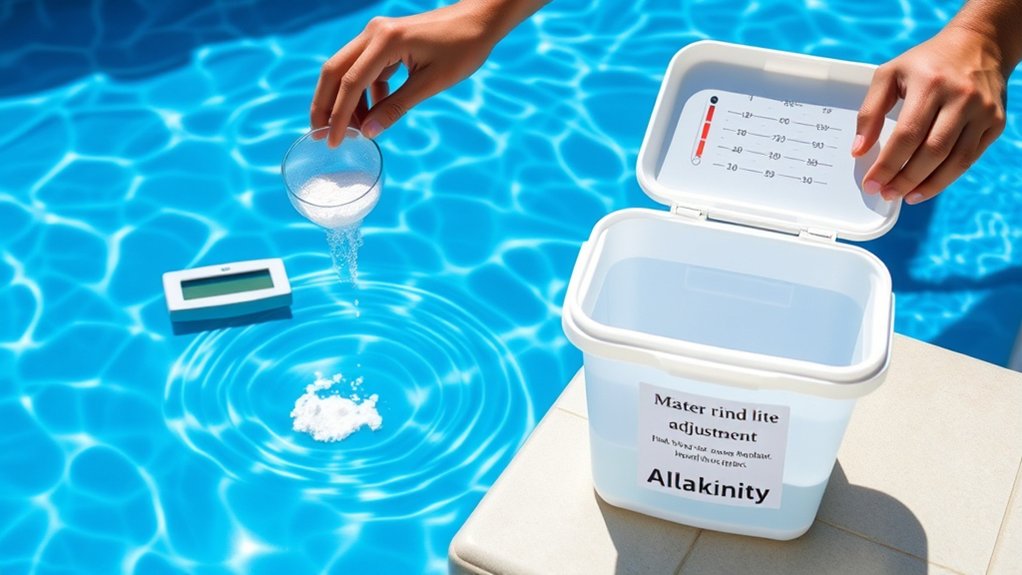
To increase alkalinity in your pool, first test total alkalinity using a liquid drop kit to identify current levels. If it’s below 80 ppm, add 1 to 1.5 pounds of sodium bicarbonate per 10,000 gallons to raise alkalinity by 10 ppm.
Make sure to distribute it evenly with your pump running. Avoid overdosing, and then wait 6 to 8 hours before retesting for accuracy.
It’s best to prioritize alkalinity adjustments before pH. Just follow these steps carefully to keep your water chemistry balanced as conditions change.
What Is Pool Alkalinity and Why It Matters
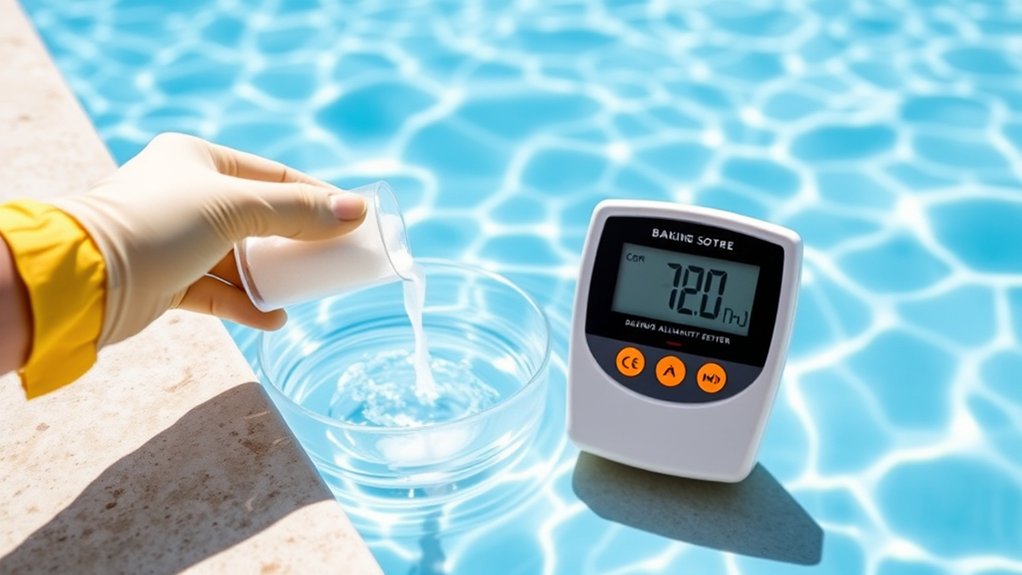
Pool alkalinity, also known as total alkalinity (TA), measures your pool water’s ability to neutralize acids, keeping the pH stable within the ideal range of 80 to 120 ppm.
Total alkalinity acts as a buffer for pH, preventing rapid fluctuations caused by environmental factors like rain or organic debris.
Maintaining balanced alkalinity is vital for stable pH levels, which guarantees chlorine remains effective and protects your pool surfaces and equipment from corrosive damage.
Low alkalinity leads to unstable pH and corrosive water, while high alkalinity can cause cloudy water and scaling.
Regular testing of pool alkalinity is essential for effective water chemistry management.
It helps you maintain a safe, clear, and comfortable swimming environment while avoiding costly repairs linked to chemical imbalances.
Taking care of your pool’s alkalinity really makes a difference!
Should You Adjust pH or Alkalinity First?
You should adjust alkalinity first because it creates a stable buffer that helps prevent your pH from bouncing all over the place.
Keep your total alkalinity between 80 and 120 ppm before you start tweaking the pH.
Once the alkalinity is steady, then you can fine-tune the pH to the ideal range of 7.4 to 7.8 without any surprises.
Prioritize Alkalinity Adjustment
Although pH levels are critical, always adjust alkalinity first to establish a stable chemical foundation. Low alkalinity causes pH swings, which reduce chlorine effectiveness and can even damage pool equipment.
Start by testing total alkalinity. If it’s below 80 ppm, raise it with sodium bicarbonate. For every 10,000 gallons of pool water, add 1 to 1.5 pounds to increase alkalinity by 10 ppm.
Distribute sodium bicarbonate evenly and let the water circulate before you retest. This adjustment helps stabilize pH, making any later pH adjustments more accurate and longer-lasting.
Be sure to test both alkalinity and pH regularly to keep your water balanced and clear while protecting your pool equipment.
Prioritizing alkalinity first ensures your pool chemistry stays stable, which optimizes sanitizer performance and extends equipment life.
Stabilize pH Afterwards
After stabilizing alkalinity, focus on adjusting the pH level to the ideal range of 7.4 to 7.6.
Since alkalinity acts as a buffer, raising alkalinity first with sodium bicarbonate guarantees your pH level remains stable and prevents fluctuations that reduce chlorine effectiveness.
Aim for total alkalinity between 80 and 120 ppm by adding about 1.4 pounds of sodium bicarbonate per 10,000 gallons to raise alkalinity 10 ppm.
After adding chemicals, wait at least six hours before chemical testing to get accurate pH readings.
Only then should you make precise pH adjustments if necessary.
This sequence is critical for effective pool maintenance, allowing you to stabilize pH efficiently and maintain balanced water chemistry for safe swimming conditions.
How to Test Your Pool’s Total Alkalinity
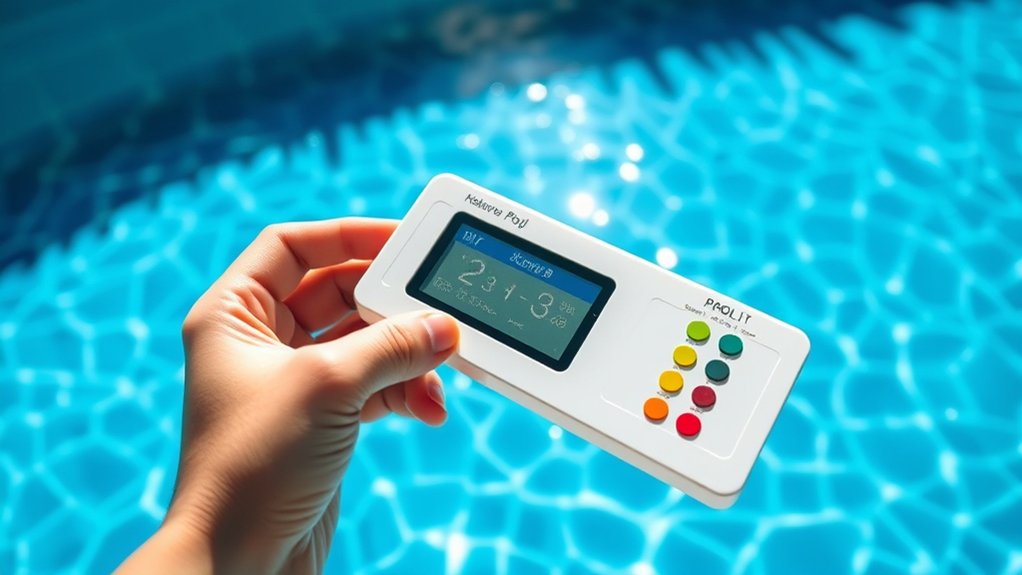
You’ll want a reliable way to measure your pool’s total alkalinity accurately. Liquid drop test kits, like the Taylor K-2005 or K-2006, work really well for this.
First, grab a clean water sample from your pool. Then, add drops from the kit following the instructions until the color changes.
After that, just compare the color to the chart provided to find out your alkalinity level in ppm. From there, you can decide if you need to make any adjustments.
Testing Methods Overview
How can you accurately measure your pool’s total alkalinity? Use reliable testing methods to track alkalinity levels and maintain balanced pH levels.
A liquid drop test kit offers precise total alkalinity readings by adding reagent drops to a water sample until a color change occurs. Smart pool monitors provide continuous pH and ORP data, helping identify alkalinity trends but don’t measure total alkalinity directly.
Regular testing, ideally weekly, guarantees early detection of imbalances caused by rainfall or chemicals.
| Testing Method | Measures | Notes |
|---|---|---|
| Liquid Drop Test Kit | Total alkalinity | Precise, requires manual sampling |
| Smart Pool Monitor | pH, ORP | Continuous data, no direct alkalinity |
| Test Frequency | Weekly | Maintains ideal alkalinity levels |
| Influencing Factors | Rain, chemicals | Can lower alkalinity, monitor closely |
| pH Comparison | pH levels | Critical for chlorine effectiveness |
Using Drop Test Kits
Accurately measuring your pool’s total alkalinity requires using a reliable drop test kit, such as the Taylor K-2005 or K-2006.
Start by filling the test vial with a water sample from your pool. Add the specified number of drops of the alkalinity reagent, watching for color changes carefully.
When the color shifts, compare the solution to the kit’s color chart to determine the total alkalinity in parts per million (ppm).
Regular testing at least once a week helps monitor your pool’s alkalinity, especially after heavy rain or high usage.
Make sure to record your test results consistently to track trends over time.
This practice guarantees you have accurate data to adjust alkalinity effectively. It helps maintain stable water chemistry and prevents potential pool issues.
Interpreting Test Results
When should you adjust your pool’s total alkalinity? Use your test kit to measure total alkalinity regularly, ideally weekly, to keep it within 80 to 120 parts per million (PPM).
Collect a water sample and add reagent drops until the color changes, indicating the TA level.
If the reading shows low alkalinity, below 80 PPM, you need to raise alkalinity to stabilize pH and protect pool surfaces. To do this, add sodium bicarbonate at a rate of approximately 1.4 lbs per 10,000 gallons to increase TA by 10 PPM.
Regular testing lets you catch imbalances early and maintain the best water quality.
Interpreting test results accurately ensures timely adjustments, preventing corrosion or scaling caused by improper alkalinity levels.
Calculating the Right Amount of Baking Soda for Your Pool
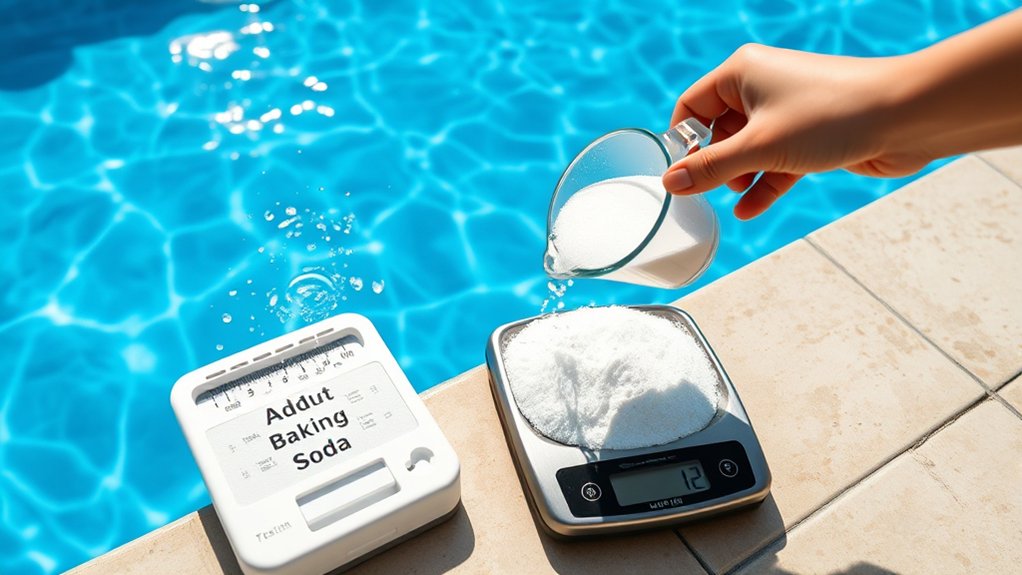
Determining the exact amount of baking soda to add depends on your pool’s volume and current alkalinity level. To increase your pool’s total alkalinity by 10 parts per million (PPM) in 10,000 gallons of water, you’ll need about 1.4 to 1.5 pounds of baking soda as an alkalinity increaser.
First, test your current alkalinity, then calculate the deficit against the desired level. Adjust the dosage proportionally based on your pool’s gallons of water. Avoid adding more than 50% of the required amount at once to prevent overshooting the target.
When adding baking soda, distribute it evenly around the pool with the pump running to guarantee proper dissolution and circulation. After that, retest the pool’s total alkalinity after 6 to 8 hours to see if you need to make any more adjustments.
This way, you keep everything balanced without any sudden changes. It’s all about taking it step by step for the best results.
Adding Sodium Bicarbonate to Your Pool Safely
After calculating how much baking soda your pool needs, you’ll want to add it safely to avoid sudden chemical imbalances.
Use sodium bicarbonate to raise alkalinity, as it increases total alkalinity without greatly affecting pH.
For every 10,000 gallons of pool water’s volume, add 1 to 1.5 pounds of baking soda to raise alkalinity by about 10 PPM.
Sprinkle the sodium bicarbonate evenly over the pool surface or pour it into the skimmer while the pump runs to guarantee proper distribution.
Allow the water to circulate for at least six hours before you retest alkalinity levels.
This careful method maintains balanced alkalinity and prevents overcorrection, keeping your pool water’s chemistry stable and within the ideal range.
When to Wait and Retest Alkalinity
Because sodium bicarbonate needs time to fully disperse, you should wait at least 6 to 8 hours before retesting your pool’s alkalinity.
During this period, keep the pool pump running to guarantee even chemical distribution and accurate readings.
Retesting too soon can cause misleading results, risking overcorrection and an unbalanced pool environment.
If alkalinity remains low after retesting, add sodium bicarbonate in smaller increments and repeat the wait before testing again.
Maintain a schedule of regular testing to monitor and stabilize alkalinity effectively.
- Wait 6 to 8 hours after adding sodium bicarbonate
- Keep the pool pump running continuously
- Avoid retesting prematurely to prevent inaccurate results
- Add chemicals incrementally if levels don’t normalize
- Conduct regular testing weekly for balanced alkalinity
Common Mistakes to Avoid When Raising Pool Alkalinity
When raising your pool’s alkalinity, you must avoid common mistakes that can destabilize water chemistry. First, don’t overload your pool with sodium bicarbonate (baking soda). Excess alkalinity spikes can really make it hard to stabilize your water.
Run the pool pump during application to get even distribution. Always retest alkalinity after 6 to 8 hours to prevent overcorrection. It’s important to focus on alkalinity first, not pH, to keep your pool’s chemistry balanced.
Avoid using soda ash because it raises pH but doesn’t increase alkalinity.
| Mistake | Cause | Impact |
|---|---|---|
| Overdosing baking soda | Excess sodium bicarbonate | Alkalinity spikes |
| Pump off during addition | Poor chemical circulation | Uneven alkalinity distribution |
| Skipping retest | Immediate measurement | Overcorrection risk |
| Confusing pH & alkalinity | Misunderstood chemistry | Improper adjustments |
| Using soda ash | Wrong chemical choice | pH rise without alkalinity increase |
Tips for Maintaining Stable Pool Alkalinity Year-Round
Although maintaining stable pool alkalinity requires ongoing attention, you can prevent common fluctuations by testing your water weekly and keeping alkalinity levels between 80 and 120 ppm.
To raise alkalinity effectively, use baking soda as recommended by your pool store, and always monitor both alkalinity and pH together for balanced water chemistry.
Follow these tips to keep your pool stable year-round:
- Test alkalinity and pH weekly to detect imbalances early
- Limit use of trichlor pucks, which lower alkalinity
- Use baking soda to raise alkalinity gradually and safely
- Cover your pool to reduce evaporation and debris impact
- Schedule professional maintenance for expert advice and adjustments
Consistently applying these steps helps you maintain a stable, healthy pool environment.
It’s really about staying on top of things so your pool stays inviting all year long.
Frequently Asked Questions
Can Raising Alkalinity Affect Chlorine Effectiveness?
Yes, raising alkalinity directly affects chlorine stability by helping maintain a proper pH balance.
When alkalinity is balanced, you stabilize water chemistry, which boosts sanitizer efficiency and supports the oxidation process. This prevents rapid pH swings that reduce chlorine’s ability to control algae growth.
Proper alkalinity also protects pool equipment and guarantees effective pool maintenance.
Is It Safe to Swim Immediately After Adding Baking Soda?
You don’t want to jump in immediately after adding baking soda. Think of it as a mini chemical cocktail that needs time to blend.
For the best swimming safety and swimmer comfort, let your pool pump run for at least 6 hours to evenly distribute the baking soda. This helps guarantee proper pool maintenance and keeps chemical balance in check.
It also maintains stable alkalinity levels.
Always perform water testing afterward to make sure conditions are perfect before diving back in.
How Does Alkalinity Interact With Calcium Hardness?
Alkalinity levels directly impact calcium balance by stabilizing pH, which is essential for maintaining proper water chemistry.
When alkalinity is too high, it raises pH, increasing scaling issues as calcium precipitates out. Low alkalinity causes corrosive water that leaches calcium, disrupting calcium hardness.
Use reliable testing methods to monitor both parameters regularly. You can adjust alkalinity by adding baking soda to raise it or muriatic acid to lower it. This helps keep calcium hardness balanced and pH stable.
Keeping an eye on these levels makes a big difference in water quality and prevents common problems like scaling or corrosion. It’s all about finding that sweet spot where everything works together smoothly.
Can High Alkalinity Cause Cloudy Pool Water?
Yes, high alkalinity can cause cloudy water in your pool. When alkalinity goes above the ideal range of 80-120 ppm, it messes with the pH balance. This reduces how well chlorine works and can encourage algae to grow.
It’s a good idea to check your alkalinity levels regularly using proper measurement methods. Rain can also raise alkalinity, which might surprise you.
Plus, if your filtration system isn’t doing its job well, it can make the cloudiness worse.
Keeping your alkalinity in the right range helps make sure your pool water stays clear and your sanitation stays effective. It’s really about finding that balance to enjoy a clean pool.
Are There Alternative Chemicals to Baking Soda for Alkalinity?
Think of soda alternatives as your toolkit’s secret weapons for balancing alkalinity.
Besides baking soda, you can use liquid alkalinity, commercial products designed as pH stabilizers, and mineral solutions that act as natural additives. Each has its pros and cons, so weigh cost comparisons carefully.
Liquid alkalinity offers quick adjustment, while mineral solutions provide steady buffering.
Choose based on your pool’s needs and how easy it’s to apply. This way, you can maintain ideal water chemistry effectively.
Conclusion
So, you want perfectly balanced pool alkalinity without the hassle. Easy, right? Just remember, it’s not about dumping baking soda like it’s salt at a diner.
Test first, add the right amount, and wait patiently. Skipping steps only turns your crystal-clear pool into a chemical soup.
Follow these precise steps, and you’ll keep your pool’s alkalinity steady. You’ll save yourself from unexpected headaches and costly fixes. Who knew chemistry could be this straightforward?