How Deep Is An Olympic Swimming Pool – Official Measurements
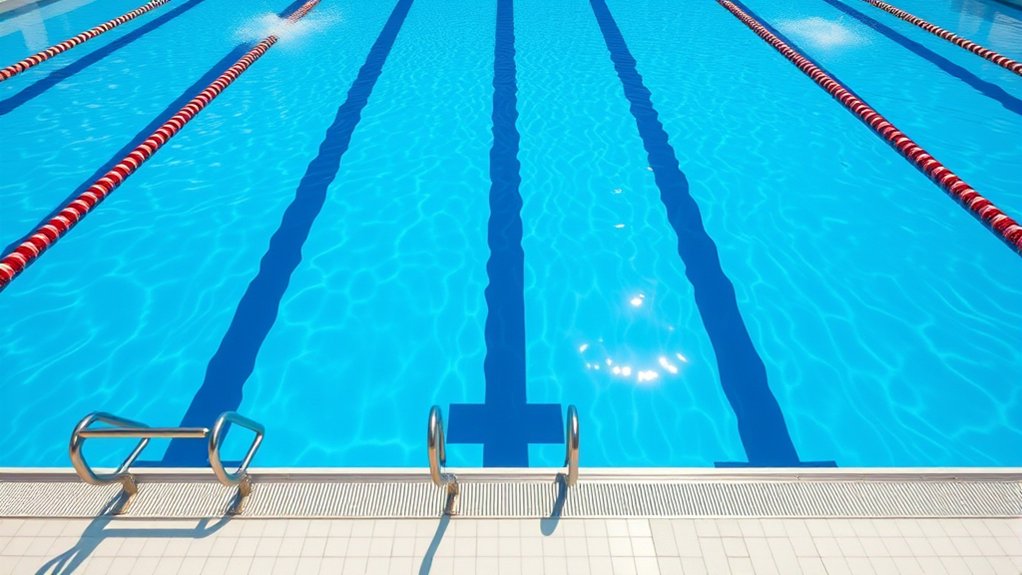
An Olympic swimming pool must be at least 2 meters deep to meet official World Aquatics standards. This depth ensures your safety and helps you perform at your best. Starting blocks require a minimum depth of 1.35 meters, while diving pools need to be at least 5 meters deep.
Pools around 3 meters deep create better hydrodynamics. This reduces waves and can improve race times. If you want to understand how these depth rules impact competition and pool design, keep exploring the details.
Official Olympic Pool Depth Requirements
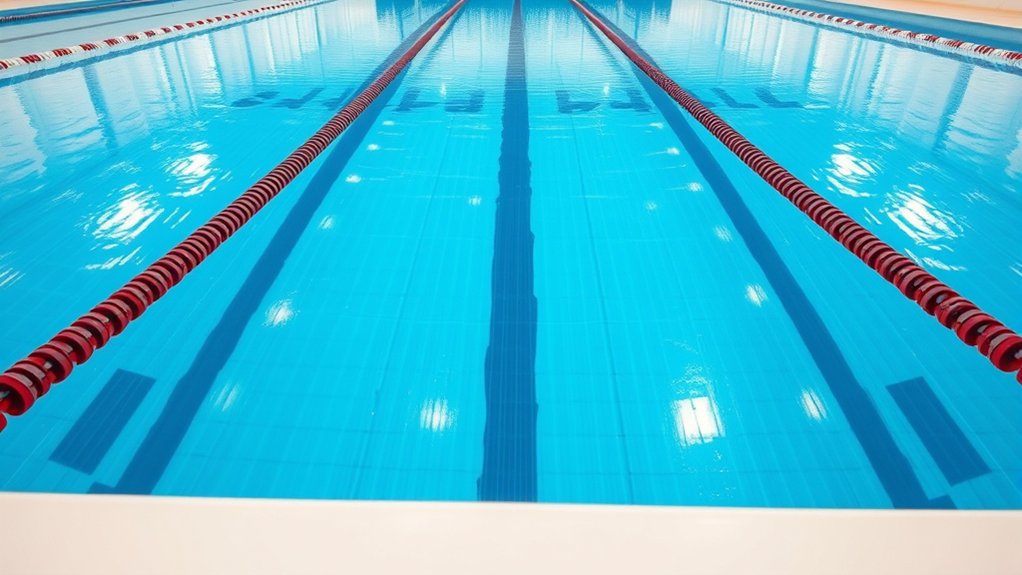
When you’re looking at an Olympic swimming pool, the minimum depth required by World Aquatics regulations is 2 meters (6.5 feet). This depth meets the standard for competitive swimming, ensuring consistent conditions across events.
Pools with starting blocks must have a minimum depth of 1.35 meters (4.43 feet) at the starting area to accommodate dive starts safely.
For multi-discipline use and ideal swimmer performance, a recommended depth of 3 meters (9.8 feet) is often applied, reducing hydrodynamic drag.
Diving pools, designed for higher platforms, require a deeper minimum of 5 meters (16 feet).
These depth requirements set by World Aquatics guarantee that Olympic swimming pools provide a standardized and safe environment for athletes competing at the highest level.
Importance of Minimum Depth for Swimmer Safety
Although you might focus on lane lines and timing systems, the pool’s minimum depth plays a vital role in swimmer safety. An Olympic swimming pool must have a minimum depth of 2 meters to provide adequate safety during competitions.
In areas with starting blocks, a depth of 1.35 meters is required to prevent injury when swimmers enter the water. These depth standards reduce risks associated with shallow water, such as hitting the pool bottom.
Besides safety, sufficient depth helps absorb waves generated by swimmers, maintaining a stable environment. While hydrodynamic drag relates to performance, here, the emphasis on minimum depth guarantees you can train and compete without unnecessary hazards.
Adhering to these depth guidelines is essential to protect you and all swimmers in the pool. It’s something that mightn’t always be top of mind, but it definitely should be.
Keeping the water deep enough means everyone stays safer and can focus on swimming their best.
How Pool Depth Affects Hydrodynamics and Race Times
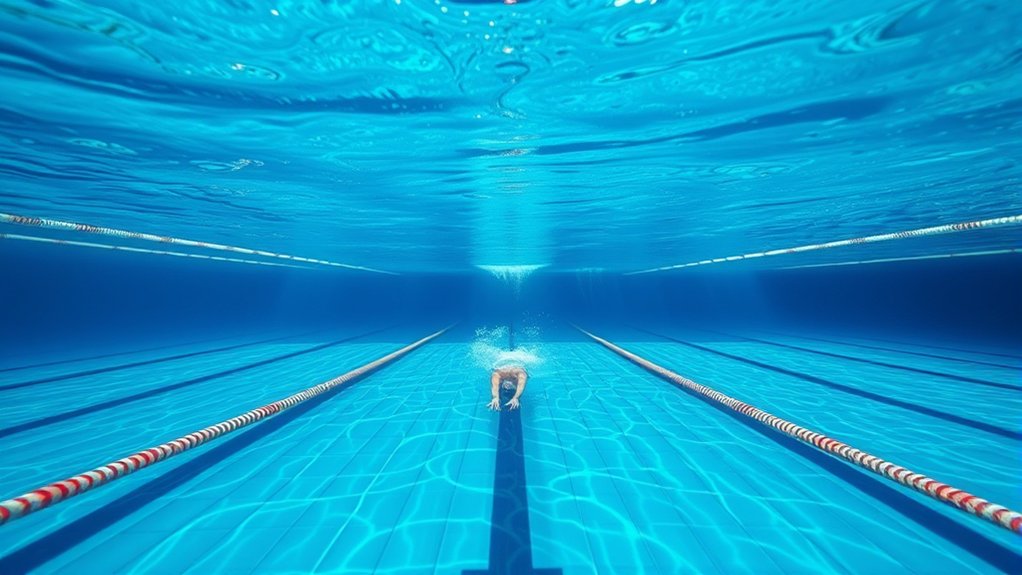
You’ll notice that pool depth plays a key role in reducing wave drag, which can really slow you down during a race.
Olympic pools, for example, are recommended to be at least 3 meters deep to optimize those hydrodynamic conditions. This extra depth helps create a smoother water environment, and that directly impacts your race times.
Depth Reduces Wave Drag
Because pool depth directly influences water dynamics, it plays an essential role in reducing wave drag during swimming competitions.
When you swim in an Olympic swimming pool with increased depth, typically around 3 meters, you experience improved hydrodynamic conditions. This depth lessens wave drag by minimizing surface turbulence created by swimmers.
That means you can move through the water more efficiently. Reduced turbulence means less resistance against your movements, which can boost your performance and help you swim faster.
The 2008 Olympic Water Cube, with a 3-meter depth, is a prime example. Depth there helped break twenty-five world records.
Optimal Depth Recommendations
Building on how depth reduces wave drag, knowing the ideal pool depth can help you understand why certain standards exist. Olympic pools have a minimum depth requirement of 2 meters, but a preferable depth of 3 meters is recommended to enhance swimmer performance. This depth minimizes turbulence and hydrodynamic drag, allowing you to maintain speed with less resistance.
Accurate measurements guarantee the pool meets these requirements, supporting various disciplines like diving and synchronized swimming safely. Insufficient depth increases wave formation, negatively impacting your swim by creating more turbulence.
Pools meeting the preferable depth standard provide consistent conditions that help improve overall performance. Understanding these depth recommendations clarifies why official pools prioritize certain dimensions to enhance competitive swimming environments.
It’s all about creating the best setting for athletes to perform at their peak.
Impact On Race Times
Although the minimum depth for Olympic pools is 2 meters, increasing it to the recommended 3 meters greatly improves race times by reducing hydrodynamic drag.
When you swim in a deeper Olympic swimming pool, the greater depth absorbs waves more effectively, creating stable water conditions. This stability minimizes turbulence, allowing you to maintain ideal speed and technique.
The reduced hydrodynamic drag means you face less resistance, directly enhancing your performance.
For example, the 3-meter depth of the Water Cube during the 2008 Beijing Olympics contributed to twenty-five world records, illustrating how depth influences fast race times.
To conclude, a deeper pool not only supports better wave absorption but also fosters an environment where you can achieve your best competitive results with less physical drag.
It really makes a difference when you want to swim your fastest.
Depth Rules for Starting Blocks and Diving Areas
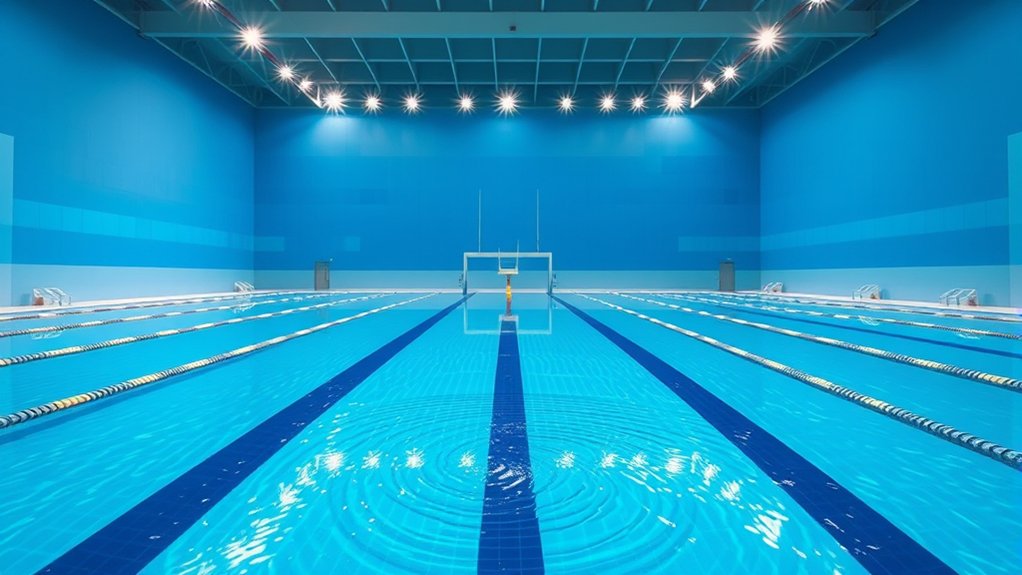
When you step onto the starting blocks, the pool beneath must be at least 1.35 meters (4.43 feet) deep to ensure your safety and maximum performance.
In Olympic swimming pools, this minimum depth guarantees that swimmers launching off starting blocks enter the water safely without risk of injury.
For general competitive swimming, the pool depth must be at least 2 meters (6.5 feet) to meet official standards.
Diving pools require even greater depth, at least 5 meters (16 feet), to accommodate high dives safely and prevent accidents.
These depth rules are essential to maintaining safety and compliance across different pool areas.
By adhering to these minimum depths, Olympic swimming pools provide the appropriate environment for both starting blocks and diving pools.
They prioritize athlete safety and competition integrity.
How Pool Depth Reduces Waves and Improves Lanes
Olympic pools are designed with a minimum depth of 2 meters, but many go deeper, up to 3 meters, to help reduce wave turbulence created by swimmers. This increased depth decreases hydrodynamic drag, allowing you to swim with less resistance and better speed.
By minimizing wave turbulence, the pool offers smoother swimming conditions, which is vital for competitive swimming where every millisecond counts.
Plus, the inclusion of a buffer lane in ten-lane pools absorbs excess waves, further stabilizing the water surface and improving lane quality. Together, these design elements guarantee fair and consistent swimming conditions.
This setup helps you perform at your best during races.
Maintaining these depth standards is fundamental to uphold the integrity of Olympic swimming competitions worldwide. It’s all about creating the best environment for athletes to shine.
Differences in Depth Standards for Multi-Sport Aquatic Venues
Since aquatic venues host various sports, they must meet different depth requirements to guarantee safety and performance. An Olympic-sized swimming pool has a minimum depth of 2 meters.
But for multi-discipline use, including swimming and synchronized swimming, a recommended depth of 3 meters secures ideal conditions.
Synchronized swimming competitions specifically require this minimum depth to allow safe and effective routines.
Diving pools demand a much greater minimum depth of 5 meters to safely accommodate high diving.
Pools with starting blocks must have a minimum depth of 1.35 meters to enable safe swimmer launches.
Temporary pools, such as those at the 2024 Olympics, may vary in depth. Some are set at 2.2 meters, which can affect competition dynamics.
These varying depth standards reflect the diverse needs of aquatic sports in multi-sport venues.
Examples of Olympic Pool Depths From Past Games
Understanding the specific depths of pools used in past international competitions helps you appreciate how design affects performance and safety.
For instance, the Water Cube, the Olympic-sized swimming pool at the 2008 Beijing Olympics, had a depth of 3 meters. This meets official requirements that enhance swimming competitions by reducing hydrodynamic drag.
In contrast, the temporary pool built for the Paris Olympics in 2024 features a shallower depth of 2.2 meters. This may influence race times compared to deeper venues.
Traditionally, Olympic pools maintain a depth around 2 meters, though 3 meters is preferred for multi-discipline events.
These examples highlight how depth varies across Games. It directly impacts competitive conditions while adhering to established official requirements for ideal athlete performance and safety.
How Temporary Pools Meet Official Depth Standards
When you check out temporary Olympic pools, you’ll notice they’ve to meet strict depth requirements. For example, they need to be at least 2 meters deep to comply with World Aquatics standards.
But these pools often go even deeper—sometimes as much as 5 meters. That extra depth helps make sure events like diving can happen safely.
Making sure these official standards are met is really important. It keeps athletes safe and ensures the competition is fair for everyone.
Temporary Pool Depth Requirements
Although temporary Olympic swimming pools are built for short-term use, they still have to meet strict depth requirements to keep athletes safe and ensure fair competition.
These pools follow World Aquatics regulations, which set minimum depth standards for different aquatic events.
Here’s the scoop on temporary pool depth requirements:
For competitive swimming, temporary pools have a minimum depth of 2 meters (6.5 feet). Sometimes, this goes up to 2.2 meters to boost safety and performance.
Diving events need deeper pools, usually at least 5 meters deep, to make sure entries into the water are safe.
Many temporary pools come with adjustable designs, so they can maintain the right depth throughout the event.
This helps keep things fair and compliant.
Meeting these depth requirements is really important to protect athletes and keep the competition honest when using temporary pools.
Compliance With Official Standards
Since temporary Olympic swimming pools must meet stringent depth requirements, their design carefully follows World Aquatics standards to guarantee safety and fairness.
You’ll find that these pools maintain a minimum depth of 2 meters to comply with official regulations for competitive swimming. When starting blocks are involved, the depth increases to at least 1.35 meters to secure athlete safety and proper compliance.
Temporary Olympic-sized swimming pools often exceed minimum depths, reaching around 2.2 meters to optimize performance conditions.
This strict adherence to depth standards guarantees consistency in race times and upholds safety during events. Whether permanent or temporary, the pools must meet the same World Aquatics depth regulations.
That way, they qualify for official competitive swimming competitions without compromise.
Frequently Asked Questions
What Are the Official Dimensions of an Olympic Swimming Pool Besides Depth?
You’ll find the official pool dimensions are 50 meters long and 25 meters wide, meeting strict competition standards.
The pool holds eight lanes, each with precise lane markings to minimize waves and improve performance. This guarantees ideal pool capacity and water volume for events.
Safety regulations require exact measurements, including lane width and pool length, to maintain fairness and swimmer safety during competitions.
How Is Water Temperature Regulated in Olympic Swimming Pools?
Like a maestro fine-tuning an orchestra, you rely on precise water heating and temperature control to keep the pool at the perfect tempo.
Advanced systems, combined with pool insulation, maintain consistent warmth between 25–28°C. This ensures athlete comfort and peak performance impact.
You also monitor chemical balance carefully, preventing fluctuations that could disrupt conditions.
This harmony guarantees swimmers face ideal environments. It lets their skills shine without temperature distractions.
What Materials Are Used to Construct Olympic Swimming Pools?
You’ll find that Olympic pool construction uses concrete, stainless steel, and tiles to guarantee material durability and meet strict design standards.
These materials balance environmental impact and cost analysis effectively, offering long-lasting performance. Maintenance requirements stay manageable thanks to their resistance to corrosion and wear.
Choosing these materials helps you comply with international regulations while optimizing pool longevity and swimmer safety during competitions.
It’s all about making sure the pool not only lasts but also provides a safe and top-notch experience for everyone.
How Often Are Olympic Pools Cleaned and Maintained?
You’d think pool cleaning happens every second in an Olympic pool, and you’re almost right. Maintenance schedules guarantee daily surface cleaning and constant monitoring of water quality and chemical balance.
Filtration systems work nonstop, cycling all 660,000 gallons in under five hours.
Every 2-4 weeks, a deep clean targets floors and walls.
Seasonal checks include draining for repairs. This rigorous routine keeps the pool competition-ready at all times.
Are There Specific Lighting Requirements for Olympic Swimming Pools?
Yes, Olympic swimming pools have specific lighting requirements to meet visibility requirements and safety standards.
You’ll find pool lighting uses energy-efficient LED fixtures strategically placed to reduce glare and shadows on the water.
This setup enhances visibility for athletes and officials while maintaining consistent illumination.
By following these guidelines, the lighting guarantees fair competition and spectator comfort.
All of this is done while complying with strict regulations designed to balance performance with energy savings.
Conclusion
You might think an Olympic pool’s depth is just a number, but it’s actually a carefully measured factor that keeps swimmers safe, fast, and fair. Ironically, the deeper the pool, the smoother the race, proving that a few extra feet of water can make all the difference in world records and athlete safety.
So next time you watch a swim meet, remember: it’s not just the swimmers making waves, but the pool itself.