How To Improve Swimming Technique – Expert Tips
To improve your swimming technique, focus on maintaining a streamlined body position with a neutral head and engaged core to reduce drag. Master breathing by rolling your head smoothly to the side and exhaling steadily underwater. Strengthen your arms using pull drills with pull buoys and paddles to boost propulsion.
Synchronize your kicking with arm strokes for better stability and rhythm. With expert coaching and personalized feedback, you’ll accelerate your progress and unveil greater efficiency. Keep exploring to discover strategies that maximize your potential.
Perfect Your Freestyle Body Position
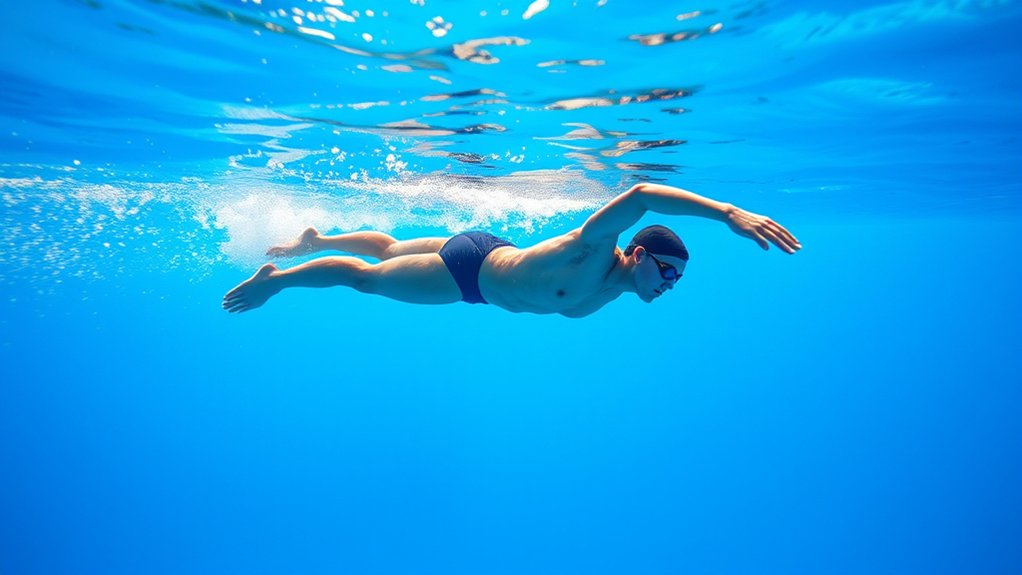
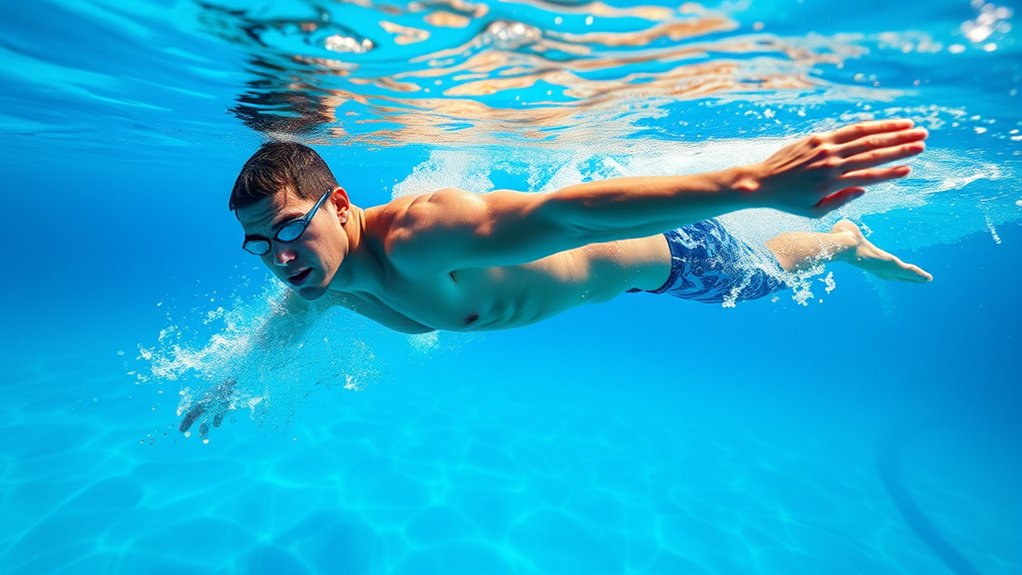
When you perfect your freestyle body position, you drastically reduce drag and increase your efficiency in the water. Maintaining a straight body line at the surface is essential. Align your head, hips, and feet to minimize resistance.
Keep your head neutral, looking straight down to avoid lifting. Lifting causes your hips and legs to drop and slows your freestyle stroke. Engage your core muscles to stabilize your body and further reduce drag.
Slightly rolling your body onto your side with each stroke activates larger back muscles. This boosts propulsion and refines your swimming technique.
Master Freestyle Breathing for Better Rhythm
Maintaining a streamlined freestyle body position sets the stage for mastering your breathing technique. This directly affects your rhythm and efficiency in the water.
To get the hang of freestyle breathing, focus on continuous, controlled exhalation underwater. This helps you stay relaxed and keeps your stroke flowing smoothly.
Roll your head smoothly to the side, clearing your mouth from the water without lifting your head. This way, you preserve proper body alignment. Quick, relaxed inhales are key because they optimize oxygen intake without messing up your rhythm. That’s essential for keeping up your speed over time.
Exhale continuously underwater to avoid holding your breath and to stay relaxed. Roll your head to the side while keeping your hips aligned and your head neutral.
Practice taking quick breaths to maintain oxygen levels and keep your stroke rhythm steady.
Refining your breathing technique will boost your freestyle rhythm and make you a more efficient swimmer overall. Keep practicing, and you’ll notice the difference in no time.
Build Arm Strength and Efficiency With Pull Drills
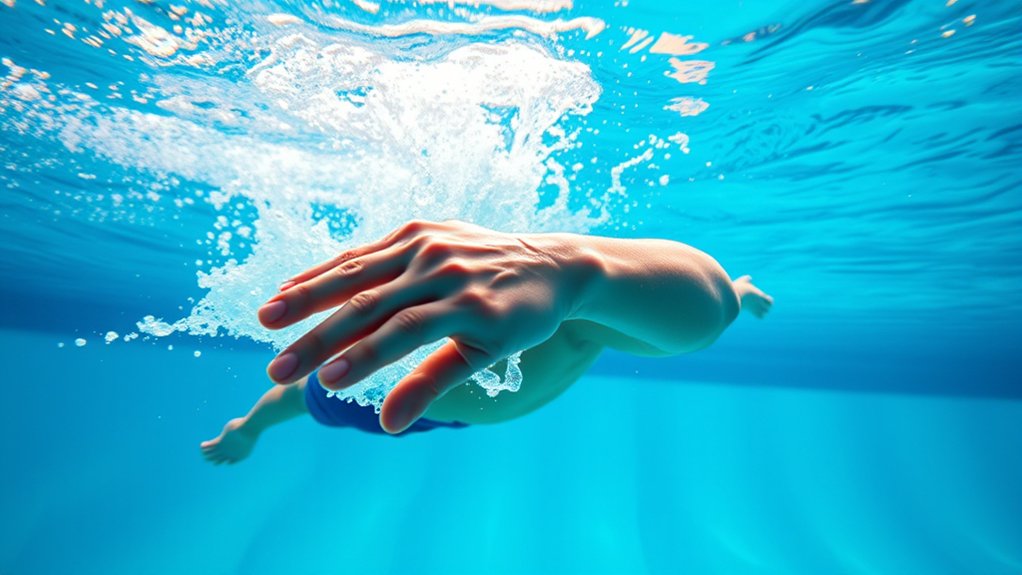
If you want to build arm strength and efficiency, the key is focusing on proper pull mechanics that help you get the most propulsion with every stroke.
One great way to do this is by adding targeted drills into your routine.
For example, using a pull buoy and paddles can really help challenge your muscles while also refining your technique.
The best part? When you practice these exercises consistently, you’ll notice your arm power and stroke precision improve.
Before you know it, your swimming will be on a whole new level.
Keep at it, and those stronger, more efficient pulls will become second nature!
Proper Pull Mechanics
Mastering proper pull mechanics is essential for building arm strength and boosting your swimming efficiency. Focus on maintaining a high elbow during the pull phase. This guarantees your forearm faces backward, maximizing propulsion and enhancing stroke efficiency.
Concentrate on refining your pull technique to reduce drag and improve power transfer. It really makes a difference when you pay attention to these details.
To sharpen your skills, incorporate these strategies:
- Use a pull buoy to isolate arm movement, eliminating kicking distractions.
- Practice the finger-drag drill to promote a high elbow during arm recovery.
- Utilize video feedback or a coach’s guidance to analyze and perfect your stroke mechanics.
These simple steps can help you swim stronger and more efficiently in no time.
Targeted Arm Strength
Boost your arm strength and swimming efficiency by incorporating targeted pull drills into your routine. Use a pull buoy to isolate your arm pull, focusing solely on upper body engagement without leg propulsion.
Adding paddles increases resistance, intensifying muscle activation and helping you improve your freestyle power.
Practice the finger-drag drill to maintain a high elbow position, which enhances the catch phase of your stroke technique for maximum propulsion.
The catch-up drill sharpens coordination between arm strokes, promoting smooth, efficient power transfer. Throughout each drill, monitor your stroke technique closely to guarantee proper alignment and reduce drag.
By consistently applying these focused pull drills, you’ll build stronger arms and refine your stroke. This will ultimately boost your overall freestyle performance with greater strength and efficiency.
Keep at it, and you’ll notice the difference in your swim!
Progressive Drill Techniques
Incorporate progressive drill techniques into your swim training to systematically build arm strength and enhance stroke efficiency. Pull drills are essential. They isolate your upper body using a pull buoy, allowing you to focus on power and technique without leg interference.
To further boost arm strength, use paddles during pull drills. They increase resistance and sharpen your pull phase. Integrate these drills to refine coordination and arm movement timing.
Here are some drills to try:
The catch-up drill has one arm stay extended as the other completes a stroke, which improves synchronization.
The finger-drag drill emphasizes a high elbow during recovery to maximize propulsion.
Make sure you consistently track your progress. That way, you’ll see steady improvements in stroke efficiency and arm strength.
Stay committed to these targeted techniques, and you’ll transform your swim performance effectively.
Improve Kicking for Stability and Propulsion
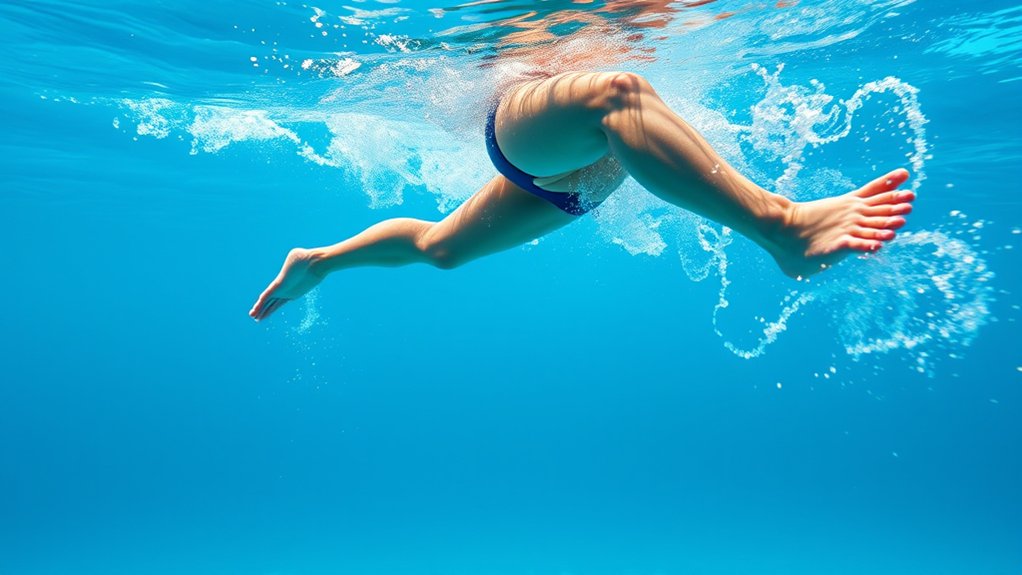
Although your arm strokes generate much of the propulsion, improving your kicking technique is essential for maintaining stability and enhancing forward momentum in the water. Focus on a relaxed two-beat kick that syncs with your arm strokes. This will boost your endurance and ensure consistent propulsion.
Short, quick kicks reduce drag, keep your body streamlined, and engage your core to stabilize and align your stroke.
| Technique | Benefit | Tip |
|---|---|---|
| Two-beat kick | Energy efficient | Maintain rhythm with arms |
| Short, quick kicks | Reduced drag | Avoid large sweeping motions |
| Core engagement | Stability | Tighten abs during kicks |
Master these to boost your kicking power, stability, and overall swimming efficiency. You’ll notice the difference in your stroke and how you move through the water!
Practice Drills to Correct Common Freestyle Technique Flaws
Mastering your freestyle technique requires targeted practice drills that address common flaws head-on. To improve your swimming fast, focus on drills that refine key parts of the stroke. This helps ensure efficiency and power in your movements.
Targeted drills sharpen your freestyle, boosting stroke efficiency and power for faster swimming.
Incorporate these effective Swimming Tips into your routine:
- Finger-drag drill: Enhances your high elbow recovery, reducing drag and promoting smoother arm movement.
- Catch-up drill: Builds stroke coordination by having one arm fully extend before the other pulls. This improves balance and timing.
- Fist drill: Strengthens forearm propulsion by forcing reliance on technique over hand catch. It boosts overall stroke power.
Coordinate Freestyle Stroke Timing for Maximum Efficiency
After honing your freestyle stroke through targeted drills, the next step is to synchronize your arm pulls and kicks for maximum propulsion and efficiency.
In freestyle swimming, precise stroke timing is key. You want to initiate a high elbow recovery, then immediately execute a powerful pull as your hand enters the water.
This sequence minimizes body disruption and helps reduce drag. Pair this with a steady two-beat kick that matches your arm rhythm. This ensures continuous propulsion without wasting energy.
Don’t forget to coordinate your breathing. Exhale underwater and inhale swiftly during arm recovery to maintain momentum.
Mastering this timing improves fluidity and speed, turning your freestyle stroke into a smooth, efficient powerhouse.
Focus on these elements, and you’ll see your swimming efficiency and endurance soar.
Use Pull Buoys and Paddles to Enhance Your Freestyle Technique
Incorporate pull buoys and paddles into your freestyle training to target specific aspects of your technique and build upper body strength effectively.
Pull buoys keep your legs buoyant, letting you isolate and refine your arm stroke without distraction.
Pull buoys lift your legs, allowing you to focus solely on perfecting your arm stroke technique.
Paddles increase water resistance, forcing your muscles to work harder, which helps improve your endurance and power.
To maximize benefits, try using a pull buoy during one-arm freestyle drills to sharpen stroke technique and water feel.
Make sure paddles fit snugly with a finger strap to maintain ideal grip and stroke efficiency.
Also, analyze your form regularly to develop a high elbow position during the pull phase.
These small tweaks can really make a difference!
Get Personalized Coaching Feedback to Speed Up Improvement
You’ll speed up your progress by getting expert coaching that shows you exactly where your technique needs improvement.
Personalized feedback helps you make precise tweaks to your stroke efficiency and body position, so every practice really counts.
Plus, with tailored guidance, you stay accountable and zero in on the skills that will boost your speed and endurance.
Benefits Of Expert Guidance
When you work with an expert coach, you gain personalized feedback that targets the exact aspects of your stroke needing improvement. This kind of guidance accelerates your progress beyond what solo practice can achieve.
Personalized coaching refines your stroke techniques by pinpointing inefficiencies quickly, saving you time and effort. Expert feedback, often supported by video analysis, helps you visualize and internalize correct form.
Plus, dedicated practice under professional supervision boosts your consistency and motivation.
Key benefits include:
- Tailored insights based on your unique body structure and swimming style.
- Enhanced accountability that keeps your training focused and purposeful.
- Performance gains up to 30% faster compared to training alone.
With expert guidance, you transform your swimming by sharpening skills efficiently and confidently. It really makes a difference!
Tailored Technique Adjustments
Release your full swimming potential by embracing tailored technique adjustments guided by expert coaching. With personalized coaching, you receive tailored feedback pinpointing specific areas in your stroke technique to enhance propulsion and reduce drag.
Coaches analyze your body position, arm recovery, and breathing rhythm, ensuring each element supports efficient, powerful swimming.
Using video analysis, you visually track your form, which lets you make precise, real-time corrections. This detailed insight helps you develop custom training plans that focus on your unique strengths and weaknesses, so you can accelerate your progress.
Regular check-ins keep you accountable and motivated, making it easier to continuously refine your technique.
Frequently Asked Questions
What Nutrition Supports Better Swimming Performance?
You should focus on hydration strategies to stay energized and prevent cramps during swims.
Eat energy-boosting foods like bananas and oats before workouts to fuel your muscles. For pre workout snacks, choose easily digestible carbs with a bit of protein, like yogurt with fruit.
After swimming, prioritize post swim recovery with protein-rich meals and electrolytes to rebuild muscles and replenish lost minerals.
Consistent nutrition will boost your performance and endurance in the pool.
How Often Should I Rest Between Swim Workouts?
You might think pushing through every swim workout builds strength, but smart rest intervals between sessions are essential. Aim for at least one full rest day per week, adjusting based on your training schedules and fatigue management needs.
Try to include active recovery techniques like light stretching or yoga to help boost muscle repair.
Prioritizing recovery guarantees you swim stronger and faster, and helps you avoid burnout. Mastering rest is just as important as mastering technique.
What Swimwear Is Best for Competitive Swimming?
For competitive swimming, you want swimwear made from high-performance materials like Lycra or polyester blends that offer durability and flexibility.
Racing suits should fit snugly to reduce drag but not restrict movement. So, focus on fit considerations carefully.
Look for suits with temperature regulation features if you swim in varied conditions.
Investing in the right swimwear boosts your confidence and performance. It helps you glide through water efficiently and race at your best.
How Do I Prevent Swimmer’s Ear Effectively?
To prevent swimmer’s ear effectively, you need to prioritize ear protection by wearing silicone earplugs or a swim cap that covers your ears.
Make sure to dry your ears thoroughly after swimming. Avoid sticking objects into your ear canal.
Also, try tilting your head to help water drain out quickly.
These simple steps are essential for preventing infections and keeping your ears healthy. When you do this, you can swim confidently without any discomfort.
Can Yoga Improve My Swimming Flexibility?
Yes, yoga can dramatically improve your swimming flexibility. Incorporating targeted yoga poses enhances your range of motion, letting you move more efficiently in the water.
Yoga also boosts core strength, which is essential for maintaining balance and stability during strokes.
Plus, its breathing techniques train you to control your breath, increasing endurance. Commit to regular practice, and you’ll notice smoother, more powerful swimming.
You’ll also reduce your risk of injury while elevating your overall performance.
Conclusion
Now, imagine slicing through the water with effortless grace, your freestyle stroke perfectly timed and powerful. You’re just one focused session away from revealing that level of mastery.
By honing your body position, breathing, and strength with targeted drills, you’ll transform your technique and speed. Don’t settle for average. Push yourself, seek feedback, and watch your swimming evolve beyond what you thought possible.
The breakthrough you crave is closer than you think.