How Fast A Dolphin Can Swim – Speed Facts
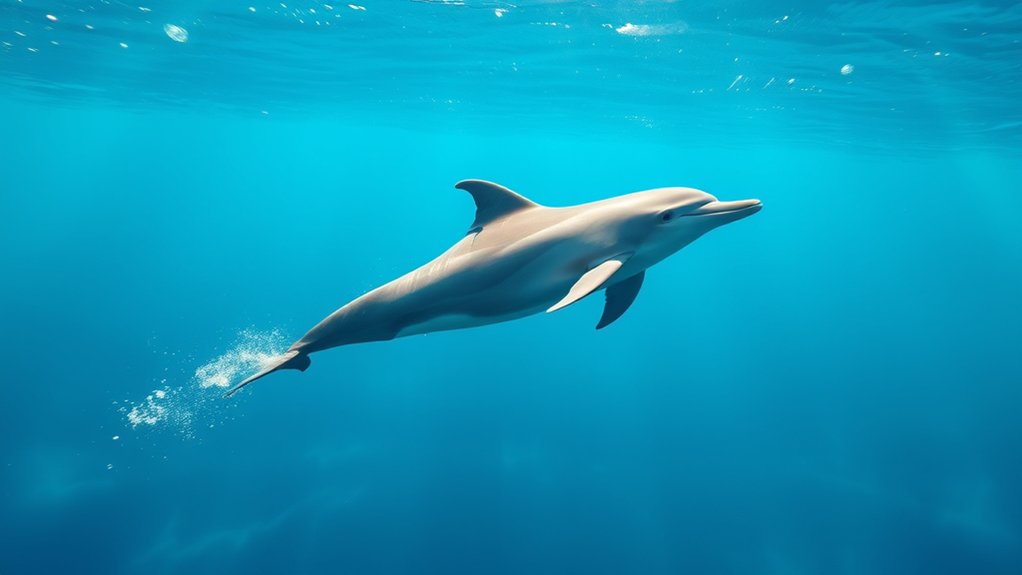
Dolphins swim at impressive speeds, with the common dolphin reaching up to 60 km/h (37 mph). This makes it the fastest species among dolphins. Their streamlined, torpedo-shaped bodies, powerful tail flukes, and smooth skin reduce water resistance and boost propulsion.
They also save energy by porpoising and riding bow waves, which helps them maintain efficiency over long distances. Scientists use GPS and high-speed cameras to measure their speeds accurately.
Understanding these factors shows how important speed is for dolphin survival. It also highlights the challenges dolphins face from human impact.
How Fast Can Different Dolphin Species Swim?
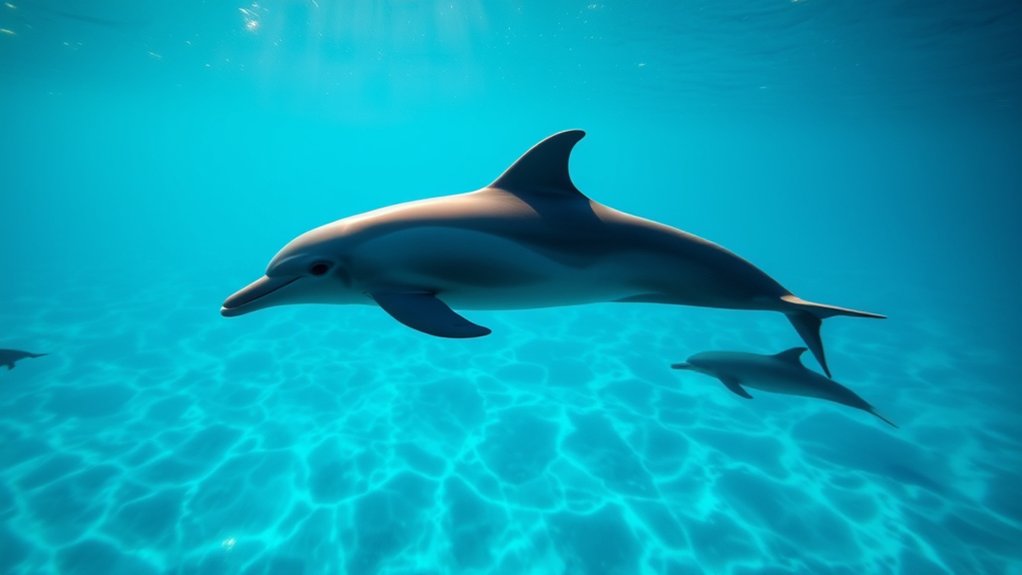
How fast can dolphins really swim? When looking at dolphin speeds, the Common Dolphin stands out as the fastest species, reaching up to 60 kilometers per hour (37 miles per hour).
Orcas, or killer whales, come close behind at nearly 56 kilometers per hour (35 miles per hour). This makes them the swiftest marine mammals within the dolphin family.
The Dall’s Porpoise, known for being quick among small cetaceans, can hit speeds of 55 kilometers per hour (34 miles per hour).
Bottlenose dolphins are a bit slower but still show impressive agility, swimming up to 35 kilometers per hour (22 miles per hour).
Understanding these speed differences helps us appreciate the variety of movement abilities among marine mammals. It also highlights why the Common Dolphin holds the title as the fastest dolphin species known.
What Physical Traits Affect Dolphin Speed
Although many factors influence dolphin speed, their physical traits play an essential role in determining how fast they can swim.
Dolphins have streamlined bodies that greatly reduce water resistance, enabling efficient movement. Their powerful tails, or flukes, generate strong propulsion, allowing rapid acceleration and impressive speeds.
You’ll notice their dorsal fins provide stability at high velocity, helping maintain balance. Moreover, dolphins use their flippers for precise steering, enhancing agility when traversing complex environments.
Their muscle structure supports quick, forceful movements, contributing to bursts of speed like the common dolphin’s 60 km/h (37 mph).
Understanding these physical characteristics clarifies why dolphins excel as swift swimmers, blending power and maneuverability to thrive in aquatic settings.
It’s pretty amazing how their bodies are built for speed and control all at once!
How Dolphins’ Bodies Help Them Swim Fast
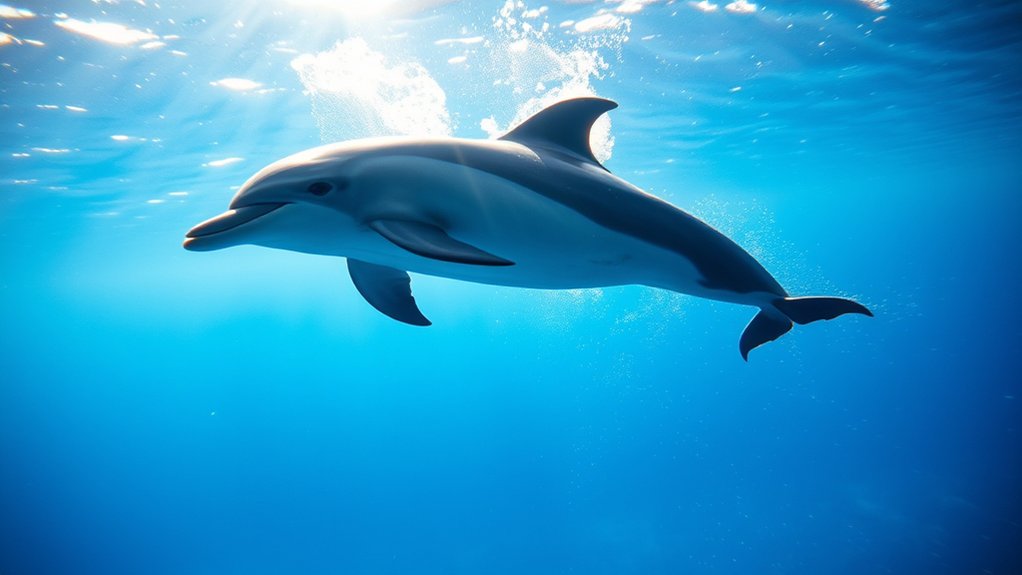
You’ll notice dolphins have streamlined, torpedo-shaped bodies that help reduce water resistance. This shape lets them glide through the water more easily.
Plus, their powerful tail flukes push them forward with strong bursts of energy. This means they can speed up quickly and keep moving fast for a long time.
All these features work together to make dolphins excellent swimmers in their underwater world.
Streamlined Body Shape
A dolphin’s streamlined, torpedo-shaped body minimizes water resistance, enabling it to move swiftly through its aquatic environment. This streamlined form reduces drag, allowing the dolphin to conserve energy while maintaining high speeds.
You’ll notice their smooth skin further decreases friction with water, making their movement more efficient.
By minimizing turbulence, dolphins optimize the flow of water around their bodies, enhancing their ability to accelerate and sustain velocity. This efficient interaction with water is essential for speed, as it allows dolphins to cut through the ocean with minimal effort.
While propulsion is primarily generated by their tails, the streamlined body shape plays a significant role in supporting rapid, energy-efficient movement.
This design helps dolphins achieve remarkable swimming speeds in their marine habitats.
Tail Propulsion Power
Dolphins rely on their powerful tails, known as flukes, to generate the primary propulsion that drives their swift swimming speeds, reaching up to 60 kilometers per hour (37 miles per hour).
This tail propulsion power enables efficient travelling speed by overcoming water resistance with precision.
Key features include:
- Specialized muscle structure in the flukes allows rapid bursts of speed.
- Flexible tail angles enhance thrust for both speed and acrobatic maneuvers.
- Streamlined body shapes complement tail power by minimizing drag.
- Strong dorsal fins provide stability and maneuverability during fast swimming.
Pretty amazing how all these features work together, right?
The combination of tail strength, flexibility, and body design really makes dolphins some of the fastest swimmers in the ocean.
How Dolphins Save Energy While Maintaining Speed
You’ll notice that dolphins often use a technique called porpoising, where they leap out of the water. This helps them reduce drag and save energy when they’re swimming fast.
It’s pretty clever!
They also make the most of the bow waves their bodies create. By riding these waves, they cut down on resistance and keep their momentum going strong.
All these tricks combined let dolphins save energy while still zooming along at impressive speeds over long distances.
Pretty amazing, right?
Porpoising For Efficiency
Mastering porpoising allows dolphins to leap out of the water, markedly reducing drag and conserving energy while maintaining impressive speeds.
This marine adaptation lets you see how dolphins achieve some of the fastest speeds with less effort.
Porpoising saves energy by minimizing resistance encountered underwater, which helps them maintain speed over long distances. It’s pretty clever when you think about it!
Key aspects include reducing drag by alternating between swimming and leaping.
Dolphins can save up to 30% energy compared to continuous submerged swimming.
They can reach speeds up to 17 mph (27 kph) efficiently.
Plus, their streamlined bodies and powerful tails make swift shifts between swimming and leaping possible.
Leveraging Bow Waves
Beyond porpoising, dolphins exploit environmental forces like bow waves generated by moving vessels to conserve energy while maintaining high speeds.
You’ll often see dolphins swimming alongside ship bows, effectively hitching a ride on the bow waves. This behavior reduces drag, allowing dolphins to maintain or even increase speed with less energy expenditure.
Research shows dolphins can reach speeds up to 7.3 m/s (14.6 knots) when following speedboats, demonstrating their ability to leverage these waves.
By capitalizing on bow waves, dolphins optimize energy use, enabling longer travel distances without excessive fatigue. It’s pretty fascinating how they do this, combining efficiency with a bit of cleverness.
This strategy highlights their adaptability within marine life, mixing survival skills and a playful nature as they interact dynamically with their environment.
You can almost see them enjoying the ride while working smart underwater.
Minimizing Water Drag
Although dolphins rely on powerful muscles for speed, their streamlined, torpedo-shaped bodies play an essential role in minimizing water drag. This design allows dolphins to conserve energy while maintaining high speeds.
You can see their efficiency in these key adaptations: Their fins and flukes function as precise propellers and steering tools, reducing resistance.
Dolphins use porpoising, leaping out of water to cut drag and travel faster with less energy. They alternate between bursts of speed and energy-efficient cruising, optimizing muscle use.
By carefully positioning their bodies, dolphins minimize drag and glide through water with minimal effort.
These strategies combined enable dolphins to swim swiftly while conserving energy, illustrating how evolution fine-tuned their form and behavior to thrive at high speeds.
How Scientists Measure Dolphin Speed Accurately
Scientists use a combination of high-speed cameras, GPS, and sonar technology to measure dolphin speed with precision. These measurements happen in both natural habitats and controlled settings. This way, they can capture swimming dynamics under different conditions.
Technology tracks dolphins during bursts of speed, like jumps or swimming near boats. This provides accurate data on their maximum velocity. It’s pretty cool how these tools can keep up with such fast swimmers.
Researchers also consider environmental factors like water temperature, salinity, and currents. These things influence how dolphins swim and can affect speed measurements. So, they make sure to account for these variables.
Plus, individual differences like age, health, and physical condition change how fast dolphins can go. Scientists take this variability into account too.
By combining advanced tracking tools with environmental data, they get reliable and objective assessments of dolphin speed. This helps improve our understanding of how dolphins move and behave in different aquatic environments.
It’s fascinating how much we can learn just by watching and measuring them carefully.
Why Dolphin Speed Matters for Their Survival
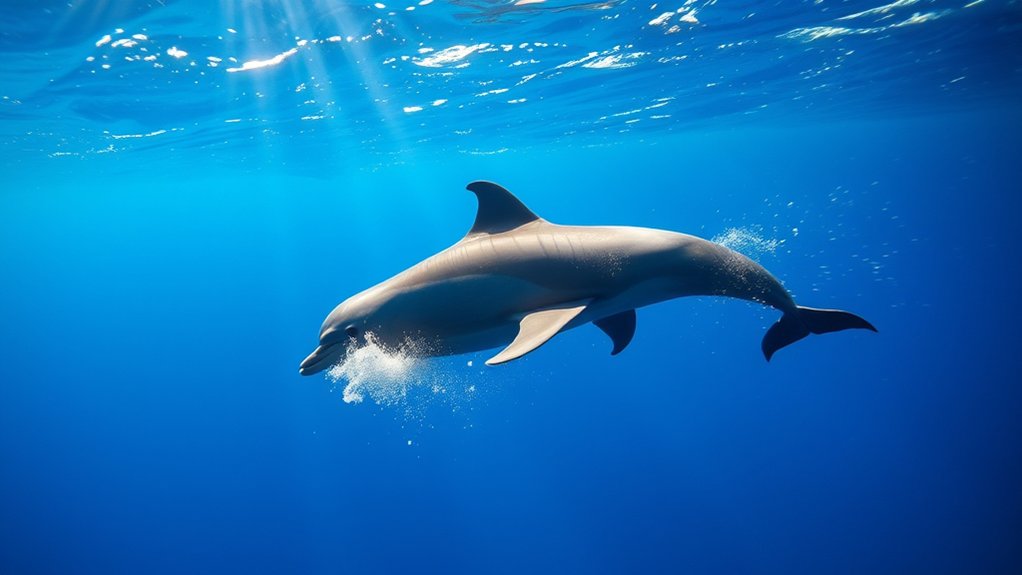
Understanding how dolphin speed is measured helps reveal why it matters so much for their survival. You’ll see that speed impacts several critical aspects of their life.
Escaping predators is a big one. Common dolphins can reach speeds up to 60 km/h, which is essential for evading threats quickly.
Hunting efficiency also depends on speed. High speed allows dolphins to catch agile prey like fish and squid effectively.
When it comes to migration, maintaining efficient speeds helps conserve energy during long journeys that can span hundreds of kilometers.
Speed also plays a role in steering through environmental challenges. It helps dolphins adapt to shifting ocean currents and diverse habitats.
How Human Activity Affects Dolphin Speed
When human activities increase noise pollution in the oceans, dolphins’ echolocation becomes disrupted. This makes it harder for them to navigate and swim efficiently. Noise pollution from ships masks the acoustic signals dolphins rely on, reducing their ability to detect obstacles and prey. As a result, their swimming speeds can decrease.
Vessel strikes pose serious risks too. They often cause injuries that impair dolphins’ mobility.
Marine debris, like fishing nets, can entangle dolphins, restricting their movement and further limiting their speed.
Human activities also change water quality and currents. This impacts dolphins’ health and natural swimming patterns.
All these factors combine to degrade the environment dolphins depend on. So, their swimming speeds and overall survival capabilities in the wild are directly affected.
Conservation Efforts That Protect Fast Dolphins
Although dolphins face numerous threats that can reduce their swimming speed, conservation efforts have made significant progress in protecting these agile marine mammals. By supporting Marine Conservation initiatives, you help protect their habitat and guarantee dolphins maintain the energy necessary for fast swimming.
Key efforts include reducing ocean noise pollution to preserve echolocation and communication, which are critical for speed and navigation. Preventing entanglement and bycatch through regulations and rescue programs also helps protect dolphin populations.
Reducing noise pollution and preventing entanglement are vital to protecting dolphins’ speed and survival.
Safeguarding habitats enables dolphins to migrate quickly and evade predators effectively. Enforcing restrictions on commercial whaling helps maintain ecosystem balance, which indirectly benefits dolphin health and speed.
These targeted actions allow dolphins to preserve their natural fast swimming abilities, enhancing survival and ecological function in marine environments. It’s really about giving them the best chance to thrive.
Frequently Asked Questions
How Do Dolphins Communicate While Swimming at High Speeds?
You rely on dolphins’ echolocation techniques to communicate effectively while swimming fast. They emit clicks and adjust communication signals, overcoming noise and maintaining social interaction within pods.
Their speed adaptations include streamlined bodies that minimize drag, allowing continuous vocal exchanges.
These communication signals coordinate hunting strategies and group cohesion. This ensures dolphins stay connected and coordinated even during rapid movement through their aquatic environment.
It’s pretty amazing how they manage to keep in touch while zipping through the water!
Can Dolphins Swim Faster Than Sharks?
You might be surprised, but dolphins often swim faster than sharks, especially in short bursts. This coincidence highlights dolphin agility, allowing them to outpace many shark species despite sharks’ endurance-focused behavior.
When you examine speed comparisons, dolphins reach up to 60 km/h, outmatching the great white shark’s 56 km/h.
These differences influence hunting techniques and ocean dynamics, where dolphins rely on quick maneuvers, while sharks maintain steady pursuit.
It’s pretty interesting how their speed plays a big role in how they survive and thrive in the ocean. So, next time you think about who’s faster, remember it’s not always the shark!
Do Dolphins Sleep While Swimming Fast?
No, dolphins don’t sleep while swimming fast. Their sleep patterns involve unihemispheric slow-wave sleep, which means one side of their brain rests while the other stays alert. This way, they can still be aware of their surroundings even while catching some rest.
During this time, their swimming slows down to conserve energy, usually around 2-4 mph. Moving slower also helps them stay hydrated and avoid predators since they need to surface often for air.
Fast swimming needs full alertness. So, to save energy and breathe safely, dolphins keep their speed down when they’re resting.
How Long Can Dolphins Maintain Their Top Speed?
You’d think dolphins could sprint like underwater rockets, but their dolphin speed limits mean they can only maintain top speed bursts for under a minute.
Top speed duration depends heavily on energy expenditure analysis, as pushing too long drains them quickly.
Environmental factors like water temperature and currents, plus the impact of age, also influence stamina.
Typically, they sustain max bursts around 1500 meters before needing to slow down and conserve energy.
Are Baby Dolphins as Fast as Adults?
No, baby dolphin speed is generally slower than adults due to growth factors like muscle development and size.
You’ll notice calves swim at reduced speeds as they develop swimming techniques by observing adults. Environmental influences, such as water conditions and pod dynamics, also affect their progress.
When you compare ages, young dolphins gradually improve, reaching near adult speeds only around 5 to 10 years old.
This highlights significant differences in swimming capabilities. So, they take some time to catch up!
Conclusion
Now that you understand how dolphin speed varies across species and is influenced by their physical traits and energy-saving adaptations, you see why accurate measurement is essential. Human activity can throw a wrench in their natural pace, affecting survival.
By supporting conservation efforts, you help guarantee these incredible swimmers keep their edge in the wild. Remember, every little bit counts when it comes to protecting these fast, graceful creatures of the sea.