Can Ants Swim – Surprising Facts
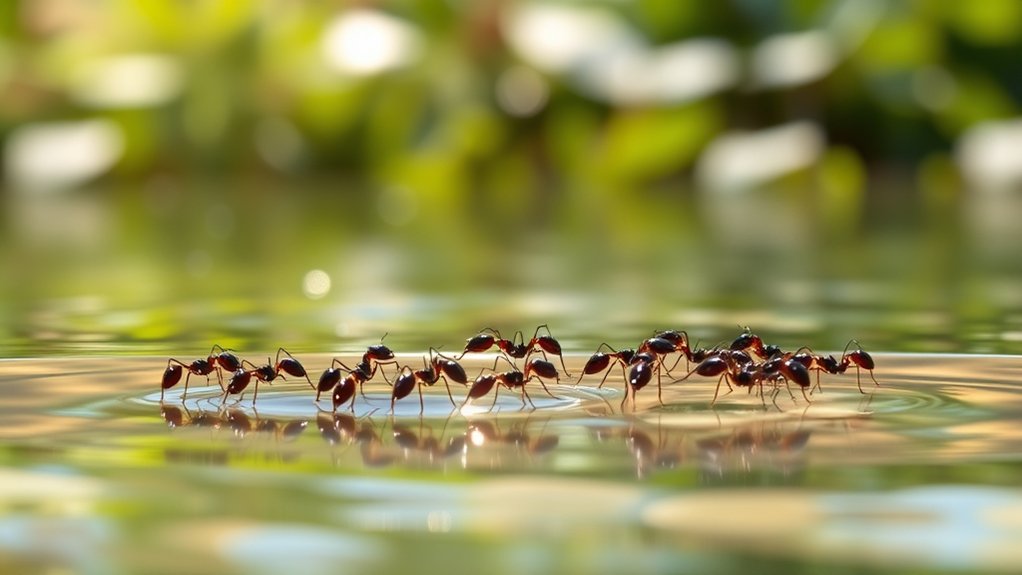
Yes, many ants can swim using specialized techniques tailored to their species. For example, black carpenter ants paddle with their forelegs and steer using their hind legs. This allows them to navigate efficiently in water.
Some ants, like fire ants, don’t truly swim but instead form rafts to float and survive floods. Ants also hold their breath underwater for extended periods. Their hydrophobic exoskeletons help trap air, which aids in this process.
Varied water conditions influence their swimming efficiency and survival. If you explore further, you’ll find some really intriguing behaviors and adaptations. Ants are more amazing swimmers than you might think!
How Ants Swim: Techniques Explained
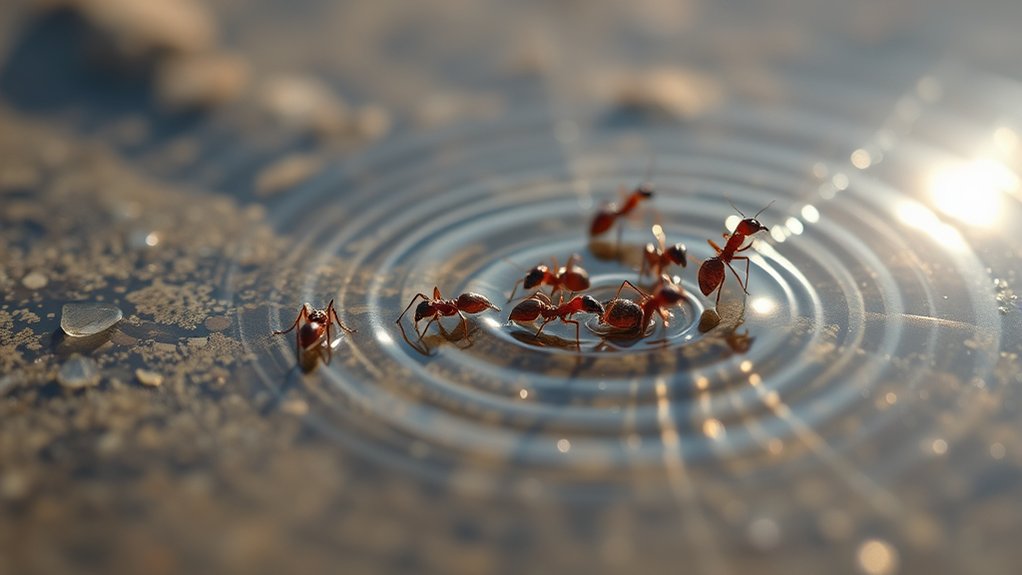
Although ants are primarily terrestrial, some species have developed specialized swimming techniques to navigate aquatic environments efficiently.
When you study how ants swim, you’ll notice black carpenter ants use their forelegs for paddling while their mid legs row. Their hind legs act as rudders to steer.
This leg morphology directly influences their aquatic performance, with longer forelegs correlating to faster swimming speeds.
In contrast, silky field ants adjust their leg movements similarly to walking, resulting in slower swimming.
These swimming techniques reflect distinct adaptations for aquatic environments, enabling each species to maneuver effectively despite varying velocity and acceleration.
Understanding these differences helps clarify how ants optimize their anatomy and behavior to survive and function in water.
It really highlights the diversity of their ecological adaptations.
Top Ant Species Known for Swimming Ability
When exploring ant species known for their swimming ability, you’ll find several with distinct adaptations that enhance their performance in aquatic environments.
The black carpenter ant (Camponotus pennsylvanicus) uses its long forelegs as an effective method to paddle efficiently through water.
The diving ant (Colobopsis schmitizi) regularly swims to hunt prey, demonstrating exceptional aquatic proficiency.
Trap-jaw ants (Odontomachus bauri) showcase a unique swimming style, employing hind legs for buoyancy while using middle and forelegs for propulsion. This allows them to have endurance over larger water bodies.
Similarly, Gigantiops destructor relies on hind legs for stability and other legs to control speed and direction.
Silky field ants (Formica subsericea) also swim but with less skill compared to black carpenter ants.
These ant species illustrate diverse and specialized swimming adaptations across the Formicidae family. It’s fascinating how different ants have evolved unique ways to navigate water.
Why Some Ants Float Instead of Swim
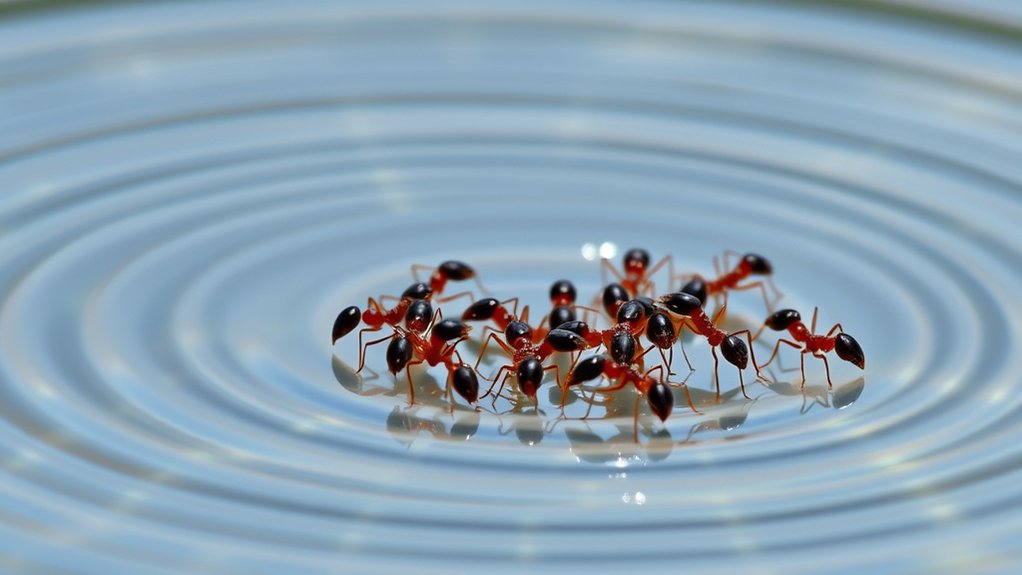
While some ants have developed specialized swimming techniques to navigate aquatic environments, others have adopted a different strategy that relies on buoyancy rather than active movement through water. Fire ants, for example, cannot swim but float by creating rafts through interconnected legs and mandibles. This floating method allows them to survive flooding by utilizing surface tension to stay above water without expending energy.
| Feature | Swimming Ants | Floating Fire Ants |
|---|---|---|
| Movement | Active swimming | Passive floating via rafts |
| Energy Use | High during swimming | Low, conserving energy |
| Flood Survival | Limited | High, due to raft formation |
This adaptation really boosts fire ants’ chances of survival and helps them relocate during floods. It’s pretty clever how they use teamwork to stay afloat without working too hard.
How Fire Ants Use Rafts to Stay Afloat
Because fire ants can’t swim, they rely on forming living rafts by interlocking their legs and mandibles to float on water. This behavior allows them to survive in flood-prone environments by creating buoyant structures composed of hundreds to thousands of ants.
The ants work collectively, demonstrating exceptional teamwork to maintain raft integrity and navigate toward dry land. This coordinated movement reduces individual risk and maximizes survival chances during floods.
Key points about fire ant rafts include:
- Rafts consist of tightly linked ants forming a waterproof, buoyant mass.
- Teamwork guarantees stability and directional control while afloat.
- This strategy allows fire ants to survive submersion longer than if isolated.
- Rafting behavior reflects evolutionary adaptation to frequent flooding, compensating for their inability to swim.
Can Ants Survive and Hold Their Breath Underwater?
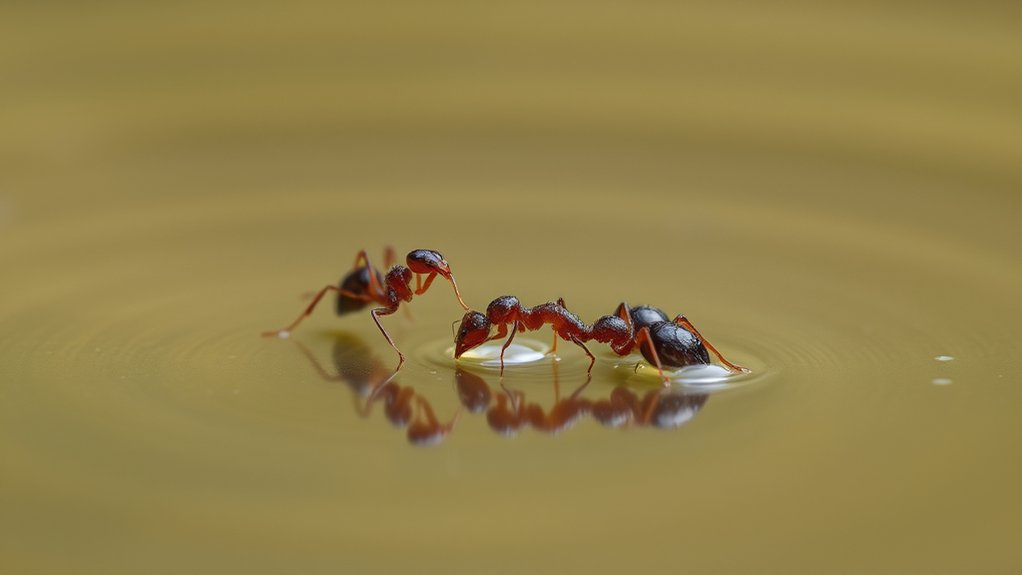
How long can ants actually survive underwater by holding their breath? Ants can survive submerged for varied durations depending on the species. Some can hold their breath underwater for extended periods, up to 14 days, by closing their spiracles and entering suspended animation, which drastically slows their metabolism.
Most ants survive in water from 15 minutes to several hours. Their hydrophobic exoskeletons repel water, allowing them to trap air bubbles that help with buoyancy and oxygen supply.
These adaptations let ants not only float but also manage respiration underwater quite effectively. While these features help ants survive underwater, the exact duration depends on the species and environmental factors.
It’s pretty fascinating how these tiny creatures exploit aquatic habitats even though they’re mainly terrestrial. Understanding these mechanisms shows just how adaptable ants really are.
How Water Conditions Impact Ant Swimming and Survival
Ants’ ability to survive underwater relies heavily on the conditions of the water they encounter. While ants can swim using a dog paddle-like motion, they swim well mostly in calm water conditions that allow effective navigation.
Turbulent water exhausts them rapidly, reducing their survival time. Their hydrophobic exoskeletons help ants stay afloat by trapping air bubbles, conserving energy during immersion.
Some species, like fire ants, can’t swim but survive floods by forming rafts.
Consider these water condition impacts on ants’ swimming and survival:
- Calm water promotes efficient swimming and longer survival time.
- Turbulent water increases energy expenditure, limiting swim ability.
- Hydrophobic exoskeletons enable buoyancy and air retention.
- Species-specific adaptations influence how ants stay afloat and survive underwater.
How to Prevent Ant Infestations at Home
To effectively prevent ant infestations at home, you need to eliminate their access to food, water, and shelter. Store food in airtight containers to remove accessible food sources that attract ants.
Address moisture issues by fixing leaks promptly, as ants require water to survive. Seal entry points such as cracks and gaps around windows and foundations with caulk to block ant entry.
Maintain cleanliness by regularly wiping surfaces and vacuuming to remove crumbs and residues. Moreover, trim vegetation and clear debris near your home to reduce potential nesting sites and ant pathways.
Implementing these extensive solutions reduces the likelihood of ant infestations markedly. If you’re dealing with persistent problems, it’s a good idea to consult professional pest control services.
They can guarantee targeted and effective elimination strategies that prevent ants from reestablishing colonies indoors.
What to Do About an Ant Infestation
When you notice an ant infestation, the first step is to accurately identify ant trails. This helps you pinpoint entry points and food sources.
Targeting these trails is key, especially with species like Black Ants, which can build large colonies.
Use ant baits along the trails you find. These baits attract ants and help eliminate infestations because the ants carry poison back to their nest.
Also, seal entry points with caulk to keep ants from coming back inside.
Keeping things clean is important too. Wipe down surfaces to minimize food residues that attract ants. This supports long-term control of the problem.
If the infestation doesn’t improve, it’s a good idea to call pest control experts. They can offer a thorough approach to get rid of the ants for good.
- Identify ant trails to locate nests and food.
- Apply ant baits strategically along trails.
- Seal entry points around foundations and windows.
- Keep surfaces clean to reduce attractants.
Frequently Asked Questions
Do Ants Swim Faster Than Other Insects?
You’ll find that ant swimming speed varies widely among species, often influenced by their aquatic adaptations and evolutionary traits.
Compared to many insects, some ants, like black carpenter ants, swim faster due to their robust forelegs and muscle mass.
However, other insects with specialized bodies or appendages may outperform ants.
Environmental factors and survival strategies shape these differences, making ants proficient swimmers but not necessarily the fastest among all insects.
Can Ants Swim in Saltwater?
Yes, some ant species can swim in saltwater, but how well they do depends on their specific adaptations to saltwater. Ant behavior in marine ecosystems actually varies quite a bit.
You’ll notice their buoyancy comes from hydrophobic exoskeletons, but saltwater can affect that. Some ants, like fire ants, have survival strategies such as forming rafts to stay afloat despite the challenges of saltwater.
However, many ants find it hard to keep their water balance in salty environments. This makes swimming and surviving in saltwater habitats pretty tough for most of them.
How Do Ants Avoid Drowning in Heavy Rain?
When it rains cats and dogs, ants rely on incredible colony strategies to avoid drowning. Their ant behavior includes forming living rafts, linking bodies to float and survive floods.
Their water adaptation features hydrophobic exoskeletons that trap air bubbles, enhancing rain survival.
Plus, their survival instincts help them hold their breath underwater and walk on surface tension.
These flood response mechanisms guarantee the entire colony withstands heavy rains effectively.
It’s pretty amazing how they work together to stay safe during storms.
Are Ant Larvae Able to Swim?
Ant larvae aren’t able to swim because their development isn’t complete yet and they lack the motor skills needed to move through water. Instead of swimming, they rely on adult ants to carry them when there’s flooding.
Their sensory abilities are pretty basic, so they don’t interact much with aquatic environments. Different species and environmental factors can affect how well they tolerate being in water, but mostly, they just endure being submerged without much movement.
Basically, larvae depend on the adults to get through watery challenges, rather than swimming on their own. It’s all about teamwork between the larvae and the adult ants.
Do Ants Teach Their Young to Swim?
You won’t find ants holding swimming lessons like a Victorian etiquette class. Ant behavior shows they don’t teach their young to swim. Instead, aquatic adaptation emerges through natural learning processes and survival strategies.
Parental care doesn’t include direct instruction. But species differences mean some young ants develop swimming skills by observation and experience. It’s pretty much an instinctive approach.
This way, they navigate water hazards effectively, relying on innate behaviors rather than formal teaching. Makes sense, right? They just figure it out as they go along.
Conclusion
Now that you know ants can swim, float, and even form rafts, you see how adaptable these tiny engineers truly are. Their survival tactics in water are nothing short of remarkable. They’re like nature’s little swimmers, mastering the art of buoyancy and breath-holding.
So, next time you spot ants near water, remember they’re not just wandering. They’re actually traversing a complex aquatic challenge. Understanding this can help you better manage and prevent infestations effectively.