What Muscles Does Swimming Work – Full Body Guide
Swimming works nearly every major muscle group, giving you a full-body workout that builds strength, endurance, and coordination. Your shoulders, chest, and arms power your strokes, while your core stabilizes your body for balance and efficiency.
Legs and glutes propel you forward through kicks. Different strokes emphasize various muscles, from the powerful butterfly to the rhythmic breaststroke. Combining swimming with strength training can boost results even more.
Keep exploring to discover how each stroke targets key muscles and improves your performance. It’s a great way to stay motivated and see the progress in your swimming skills.
How Swimming Engages Your Whole-Body Muscles
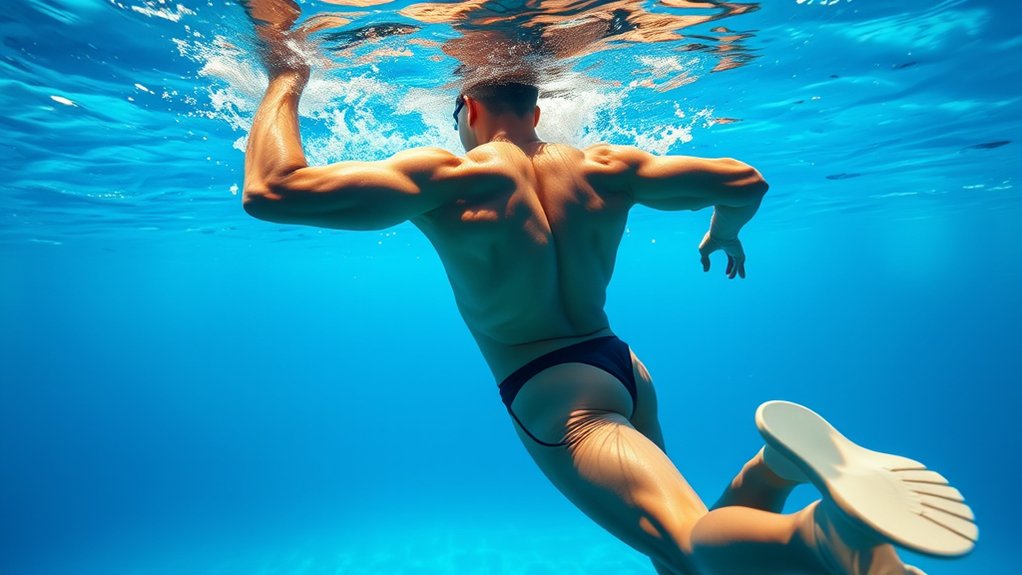
Although many exercises target specific muscle groups, swimming engages nearly every major muscle in your body, offering a powerful full-body workout.
When you swim, your upper body muscles, including your shoulders, chest, and arms, work hard to propel you through the water.
At the same time, your core muscles stabilize your body, enhancing balance and efficiency.
Your lower body isn’t left behind either; your legs and glutes push against the water, providing strength and coordination.
This thorough engagement of muscles makes swimming an exceptional full-body workout that builds strength and endurance.
Plus, the water’s natural resistance challenges your muscles without putting stress on your joints.
Muscles Worked Most By Butterfly Stroke
When you swim butterfly, your upper body power really comes from strong triceps, shoulders, and chest muscles that drive each stroke.
Plus, your core and hips are working hard to keep the rhythm steady and stable as you power through the dolphin kick.
This intense effort doesn’t just build muscle tone—it also helps boost your endurance and shoulder flexibility.
Upper Body Muscle Activation
Mastering the butterfly stroke demands powerful activation of your upper body muscles, especially the pectorals, deltoids, and triceps. These muscles drive the forceful arm movements needed to propel you through the water.
This upper body muscle activation heavily involves the pectoralis major and minor, providing strength for the wide, sweeping arm motions. Your deltoids and rotator cuff muscles work tirelessly to stabilize your shoulders, ensuring smooth, injury-free strokes.
The latissimus dorsi muscles contribute by pulling your arms down and back, generating propulsion and maintaining stroke efficiency.
While the butterfly also engages your core muscles for balance, here, the focus remains on your upper body. That’s where strength and coordination combine to create the powerful, rhythmic movements characteristic of an effective butterfly stroke.
Core And Hip Engagement
Because the butterfly stroke demands seamless coordination between your upper and lower body, your core and hip muscles play a pivotal role in maintaining stability and generating power. Your abdominal muscles, including the obliques, engage intensely to keep your body streamlined and aligned, reducing drag.
Meanwhile, the dolphin kick activates your hip flexors, glutes, and quadriceps, driving propulsion and rhythm through the water. This dynamic movement challenges your hip mobility and strength, ensuring your hips work in perfect harmony with your core.
As you master this stroke, you’ll build impressive muscle tone, enhance spinal flexibility, and boost endurance.
Focusing on core and hip engagement not only improves your butterfly efficiency but also fortifies your overall swimming performance and body control.
Intensity And Muscle Tone
Although the butterfly stroke challenges you with its demanding arm movements and powerful dolphin kicks, it delivers unparalleled benefits for muscle tone and intensity. This stroke intensely engages your upper body and core strength while boosting cardiovascular fitness through explosive, rhythmic motions.
By mastering full-body coordination, you sculpt a lean, athletic physique.
Here’s how the butterfly stroke enhances your muscle tone and intensity:
- Targets upper body muscles like triceps, biceps, shoulders, and chest through powerful arm pulls.
- Builds core strength and hip mobility using dynamic dolphin kicks that activate glutes and legs.
- Elevates cardiovascular fitness with high-intensity bursts, promoting endurance and muscle definition.
Incorporate butterfly stroke sessions regularly to maximize these benefits and push your physical limits.
Give it a try and feel the difference!
Key Muscle Groups Targeted By Backstroke
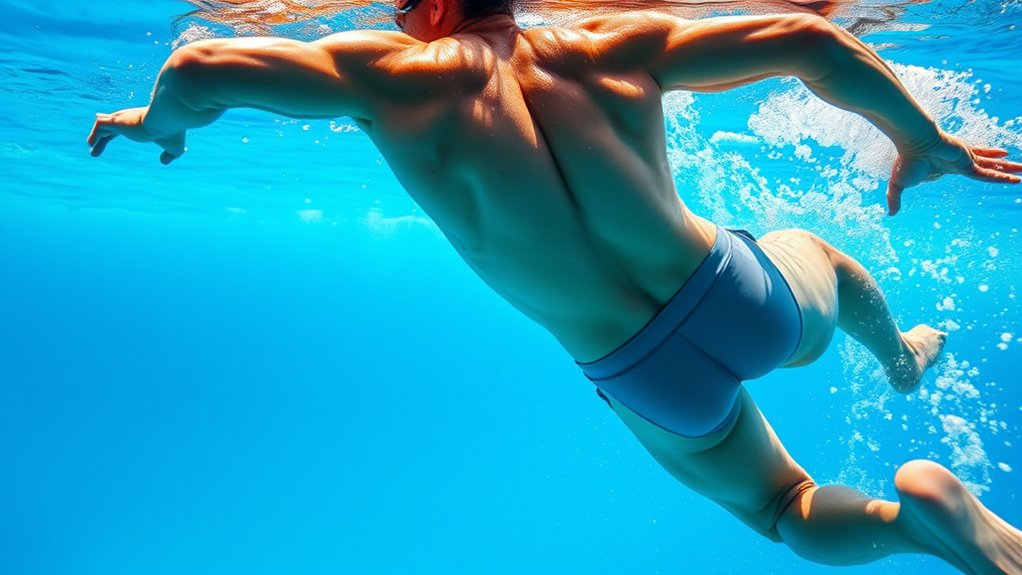
When you swim backstroke, your upper body really gets to work, especially your lats and shoulder stabilizers. These muscles help drive your arms smoothly through the water.
At the same time, your core is busy keeping your body streamlined and balanced, so you don’t lose speed or form.
Down below, your lower body powers the flutter kick, thanks to strong glutes and leg muscles.
When you master these key muscle groups, you’ll notice your efficiency and speed in the water improve a lot. It’s all about working together to move you forward effortlessly.
Upper Body Activation
Five key muscle groups power your upper body during the backstroke, driving efficient propulsion and stability in the water. Your upper body activation centers on these muscles working in harmony to maximize your stroke’s effectiveness.
The latissimus dorsi takes the lead, enabling the full overhead arm motion critical for propulsion.
Meanwhile, your shoulder muscles, including the deltoids, maintain strength and endurance through continuous rotation. The pectorals contribute powerfully during the pull phase, boosting speed and control.
Visualize these muscle groups in action:
- Latissimus dorsi pulling your arms through the water.
- Deltoids stabilizing your shoulder rotation.
- Pectorals driving the force behind each stroke.
Engaging these muscles consistently will enhance your backstroke performance and upper body strength. Keep focusing on them, and you’ll see the difference in your swim!
Core And Lower Body
Building on the strength and coordination of your upper body, your core and lower body play an essential role in powering the backstroke. Your core, including the abdominal and lower back muscles, stabilizes your body, helping you maintain a streamlined position that reduces drag.
Strong hip flexors activate during the flutter kick, generating propulsion and supporting smooth body rotation. The glutes contribute notably by enhancing kicking power and balance throughout each stroke cycle.
This rhythmic movement between your upper and lower body promotes seamless coordination, improving overall efficiency in the water. Engaging these key muscle groups consistently will boost your backstroke performance, making every stroke more powerful and controlled.
How Breaststroke Builds Strength In Legs And Chest
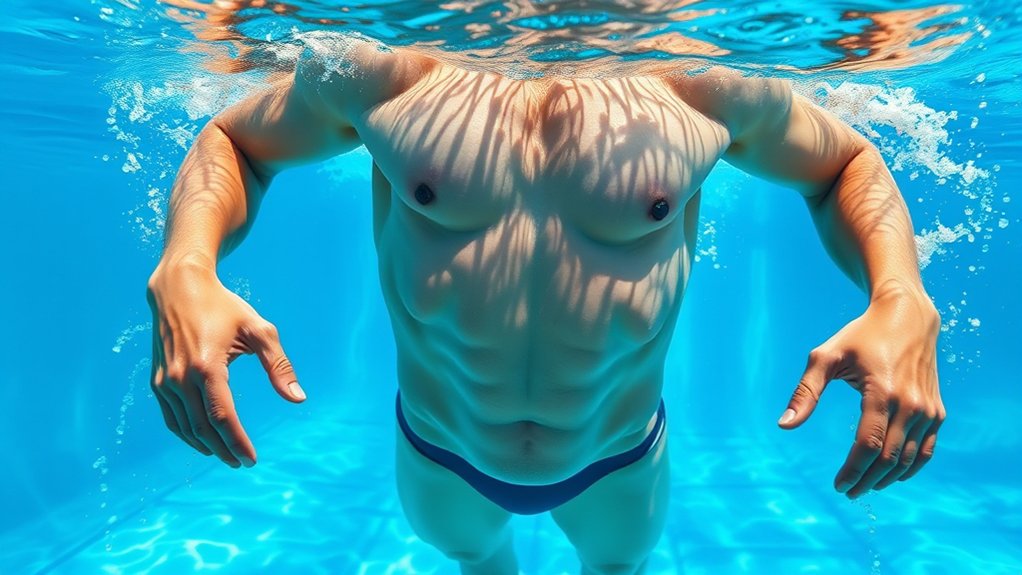
Although breaststroke may appear gentle compared to other swimming styles, it powerfully strengthens your legs and chest by engaging key muscle groups through its distinctive movements.
The breaststroke’s frog kick targets your quadriceps, hamstrings, glutes, and hip adductors, building leg strength essential for propulsion.
At the same time, the sweeping arm pulls activate your chest muscles, specifically the pectoralis major and minor. This enhances upper body power and stability.
This coordinated effort improves your overall performance and promotes balanced muscle development.
- Powerful frog kick engages major leg muscles for propulsion
- Sweeping arm pulls activate and strengthen chest muscles
- Stroke rhythm allows muscle relaxation, reducing fatigue while maintaining strength
Incorporating breaststroke into your routine will develop well-defined legs and chest.
It also boosts athletic ability and posture.
Key Muscles Used In Freestyle For Speed And Endurance
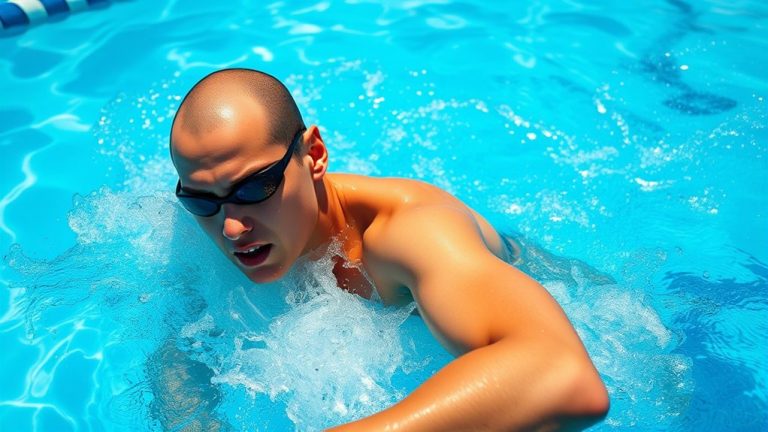
Speed and endurance in freestyle swimming depend on the powerful coordination of several key muscle groups. When you swim freestyle, your major muscle groups, including the deltoids, pectorals, latissimus dorsi, biceps, and triceps, drive propulsion and speed.
Your core muscles work tirelessly to maintain a streamlined body position, minimizing drag and maximizing efficiency.
Meanwhile, your leg muscles, especially the quadriceps, hamstrings, and calves, engage continuously through kicking, boosting both speed and endurance.
Effective freestyle swimming hinges on synchronizing these muscles with controlled breathing and precise arm-leg coordination.
By strengthening these areas, you’ll enhance your stroke rate and sustain performance over longer distances.
Focus on training these muscle groups to release your full potential in freestyle swimming for speed and endurance.
Why Core Muscle Strength Matters In Swimming
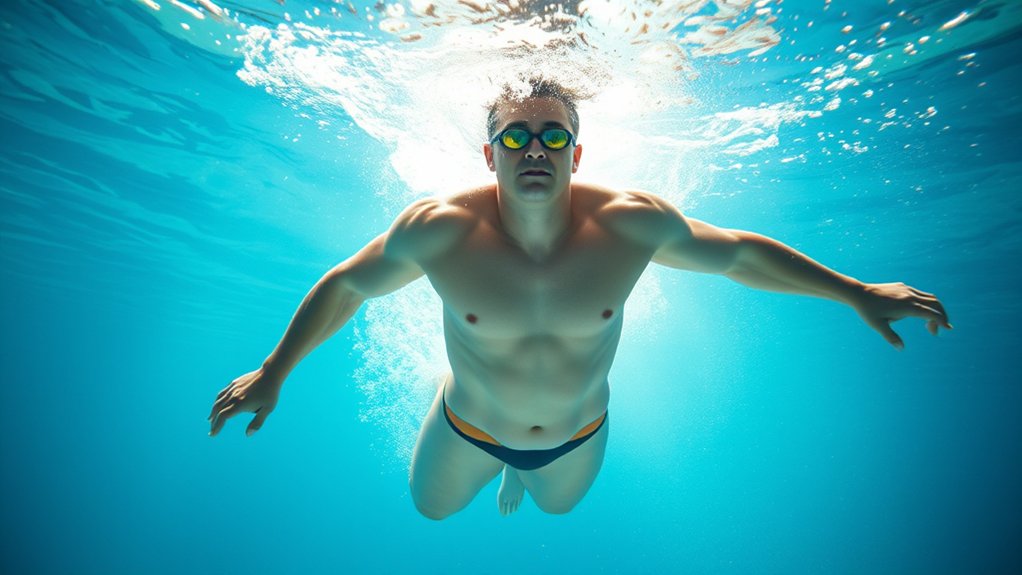
When you strengthen your core muscles, you create a solid foundation that stabilizes your entire body in the water. This allows for more efficient and powerful movements.
Core muscle strength guarantees proper body alignment, which minimizes drag and optimizes your stroke mechanics. It connects your upper and lower body, enabling synchronized, efficient movement that’s crucial for speed and endurance.
Core strength ensures body alignment, reduces drag, and synchronizes movement for faster, more efficient swimming.
Building core strength also boosts your overall performance by enhancing balance and posture.
Here’s how core strength impacts your swimming:
- Maintains a streamlined position, reducing resistance and increasing propulsion.
- Supports rotational movements essential for strokes like freestyle and butterfly.
- Conserves energy by stabilizing your body, allowing longer, more effective swims.
Focusing on your core will definitely elevate your swimming technique and results.
How Individual Medley Builds Balanced Muscle Strength
Building a strong core lays the groundwork for effective swimming, but incorporating the Individual Medley (IM) into your training takes muscle development even further.
The IM combines butterfly stroke, backstroke, breaststroke, and freestyle, offering a full body workout that targets diverse muscle groups.
The butterfly stroke particularly enhances your upper back muscles and core, while other strokes engage legs, chest, and arms. This variety promotes balanced muscle development, preventing imbalances and improving overall muscle strength.
By regularly practicing the IM, you not only build endurance but also improve coordination and muscle adaptability.
Embracing the IM in your routine guarantees a well-rounded physique, empowering you with functional strength that supports all aspects of swimming performance.
Combining Swimming With Strength Training For Better Results
Although swimming alone develops excellent cardiovascular fitness and muscle endurance, combining it with strength training can take your performance to the next level.
Swimming builds endurance, but adding strength training elevates your performance to new heights.
Strength training targets key muscle groups like the core and upper body, which are essential for efficient strokes and injury prevention.
Incorporating resistance exercises 2-3 times weekly enhances muscle tone and power, giving you stronger propulsion in the water.
To maximize results, focus on:
- Core exercises that stabilize your body during strokes.
- Upper body workouts to improve pull strength and stroke efficiency.
- Leg and glute movements like squats to boost your kicking power.
Frequently Asked Questions
How Does Swimming Improve Joint Mobility and Reduce Injury Risk?
Swimming improves your joint flexibility by encouraging a full range of motion through smooth, low-impact movements.
This aquatic therapy promotes muscle balance around your joints, enhancing stability and reducing injury risk.
By regularly engaging in swimming, you benefit from rehabilitation benefits that strengthen muscles without strain.
It’s ideal for injury prevention.
You’ll enjoy improved joint mobility and long-term musculoskeletal health, keeping you active and resilient in your daily life.
What Role Does Breathing Technique Play in Muscle Endurance?
Breathing technique plays a vital role in muscle endurance by optimizing your breathing patterns for oxygen efficiency. When you coordinate your breaths with your stroke, you maintain smooth stroke coordination, which reduces energy waste.
This controlled breathing improves your lung capacity, allowing you to take in more oxygen during endurance training. Because of that, your muscles stay fueled longer, delay fatigue, and perform better throughout your swim sessions.
It’s all about keeping your body working efficiently so you can swim stronger for longer.
How Often Should Beginners Swim to See Muscle Development?
You should swim at least 2-3 times per week to promote ideal muscle adaptation. This swimming frequency helps you build strength steadily while benefiting from proper recovery.
For beginners, training consistency is key. Stick to your schedule and mix strokes to target different muscles.
Remember, recovery benefits prevent burnout and enhance progress.
With these beginner tips, you’ll see noticeable improvements in muscle tone and endurance in just a few weeks. Keep pushing!
Can Swimming Help With Muscle Recovery After Other Workouts?
Yes, swimming can definitely help with muscle recovery after other workouts. It serves as an excellent form of active recovery, combining low-impact exercise with cardiovascular benefits.
The buoyancy of water promotes muscle relaxation and reduces joint stress. At the same time, the gentle resistance helps improve flexibility.
What Dietary Tips Support Muscle Growth for Swimmers?
Oh sure, just eat junk and expect muscles like a pro swimmer!
In reality, you need lean protein sources like chicken and fish for growth, balanced with complex carbohydrate intake for energy.
Don’t skip meal timing. Consume protein and carbs within 30 minutes post-swim to maximize recovery.
Keep hydration importance front and center. Water fuels your performance.
Healthy snacks like nuts and avocados keep energy steady and support muscle repair.
Stay consistent, and watch gains happen!
Conclusion
By now, you know swimming activates every major muscle group, from the powerful butterfly stroke to the steady freestyle. Think of your body as a finely tuned Renaissance machine, where every movement builds strength and endurance.
Keep swimming and combining it with strength training to access your full potential. With consistent effort, you’ll develop a balanced, resilient physique that supports not just your performance in the pool but your overall health and vigor.
Immerse yourself and power up!