How Many Laps Is A Mile In Swimming – Distance Guide
In swimming, one lap means swimming from one end of the pool to the other. To swim a mile, you’ll need about 66 laps in a 25-yard pool, roughly 64 laps in a 25-meter pool, or 32 laps in a 50-meter Olympic pool.
Knowing this helps you track progress and build stamina effectively. As you train, focus on consistency and technique to improve endurance. Keep going, and you’ll discover how to tailor your workouts and lap counting to your goals.
What Counts As One Lap In Swimming?
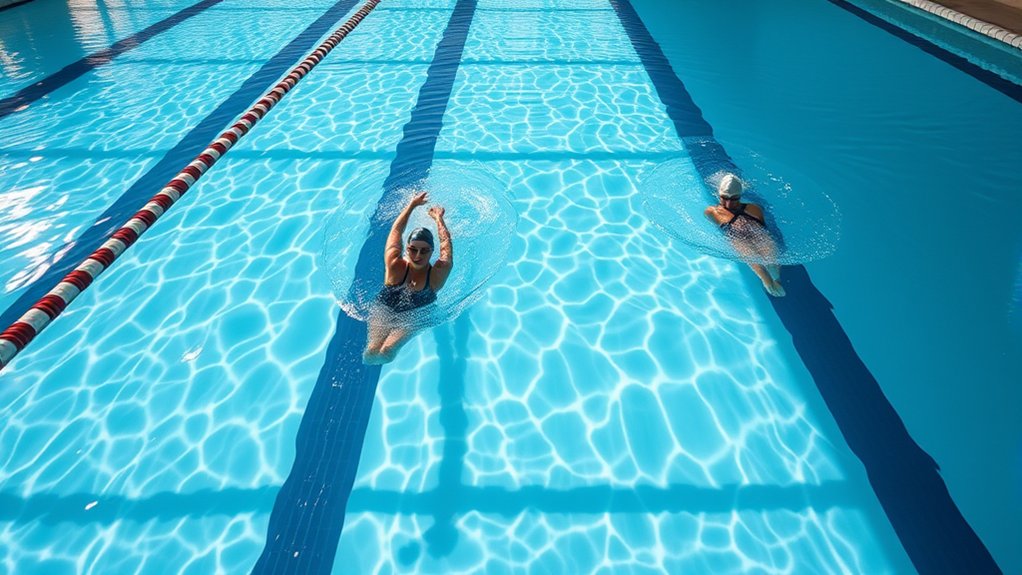
When you swim, one lap counts as a single length of the pool, from one end straight to the other. In competitive swimming, this clear definition helps you track your distance accurately. It avoids confusion with the casual idea of a lap being a round trip.
Understanding that a lap equals one length is essential for measuring your progress, especially when aiming to cover a specific distance like a mile. Pools vary in size; some are measured in yards, others in meters. So, knowing the exact length you’re swimming guarantees your training is precise.
By consistently using the correct terminology, you can set realistic goals and monitor improvements effectively.
How Pool Lengths Affect Laps In A Mile
Pool length directly impacts how many laps you need to swim to cover a mile, so knowing your pool’s exact measurement is crucial. Different pool lengths, whether measured in meters or yards, change the number of laps required to reach your distance goals.
In competitive swimming, a mile typically means 1,650 yards, which translates to about 66 laps in a 25-yard pool. If you’re swimming in a 25-meter pool, expect roughly 64.4 laps for a true mile or 60 laps for the competitive 1,500-meter mile.
Olympic-sized 50-meter pools require around 32 laps to cover a mile.
Even non-standard pools, like a 20-yard pool, demand more laps, 88 to be exact. Understanding these differences guarantees your training stays on track and your goals stay achievable.
How Many Laps Make A Mile In A 25-Yard Pool
Exactly how many laps do you need to swim to complete a mile in a 25-yard pool? To swim a true mile, which is 1,760 yards, you’ll need approximately 70.4 laps.
However, competitive swimmers often focus on the 1650-yard freestyle event, which is 66 laps in a 25-yard pool. This distance is just shy of a true mile by 110 yards.
Understanding the pool dimensions is essential because even slight variations affect your lap count. Using a reliable lap counter helps you track the exact number of laps needed for swimming a mile accurately.
Whether you aim for the true mile or the 1650-yard event, knowing these details keeps you motivated and precise.
Calculating Mile Laps In 25- And 50-Meter Pools
Swimming a mile in a 25- or 50-meter pool means knowing the exact lap count to stay on track and hit your distance goals. In a 25-meter pool, you’ll swim about 64.4 laps for a true mile. But many swimmers just round it to 64 or 66 laps to keep things simple during training.
In a 50-meter pool, you’ll swim roughly 32.2 laps, which makes covering distance a bit more efficient. Before you start, make sure to check your pool length so you can calculate laps accurately.
Getting a handle on these lap counts helps you plan your swim workouts better and track your progress.
Understanding lap counts improves your swim training and lets you monitor your progress effectively.
Whether you’re training for endurance or speed, knowing how many laps equal a mile in your pool keeps you motivated and makes sure your distance goals are clear and doable.
Adjusting Lap Counts For Unusual Pool Sizes
When you train in pools that don’t match the standard 25- or 50-meter lengths, you’ll need to adjust your lap counts to keep your mile distance accurate. Non-standard pool sizes like hotel pools often measure around 20 or 30 yards. This means swimmers find they must swim more or fewer laps to equal a mile than usual.
Accurate measurement is key. It’s a good idea to consult with pool operators to clarify exact lengths. For example, in a 20-yard hotel pool, you’d swim about 88 lengths to reach a mile. Meanwhile, a 30-yard pool requires roughly 59.
Using swim apps or watches during training can track distance precisely and make adjustments easier. By managing your lap counts carefully, you guarantee every swim meets your mileage goal.
This way, you keep your workouts effective and consistent.
Why Competitive Mile Distances Are Shorter Than A True Mile
You might’ve noticed that competitive swimming miles are actually shorter than a true mile. In the U.S., for example, races are often set at 1,650 yards, while international competitions usually go for 1,500 meters.
So, why the difference? Well, it all comes down to fitting the race neatly into standard pool lengths. This way, swimmers and officials can easily keep track of laps without the hassle of awkward distances.
It’s a smart way to keep things both practical and efficient. Once you understand these measurement quirks, you’ll see how swim meets strike a balance between accuracy and simplicity.
Competitive Mile Standards
Although a true mile measures 1,760 yards or about 1,609 meters, competitive swimming events use shorter distances like 1,650 yards or 1,500 meters to fit the pool lengths and keep race formats consistent and manageable.
You’ll find these standards designed to optimize competition and training for swimmers.
Here’s why competitive mile distances differ from the true mile:
Pool lengths dictate the race distance. For example, 1,650 yards equals 66 lengths in a 25-yard pool, which fits neatly into standard pools.
Metric distances, like the Olympic 1,500-meter event, align with international measurement standards, making global competition simpler.
Shorter distances keep events intense yet manageable. This helps swimmers maintain peak performance throughout the race.
Understanding these standards helps you appreciate how distance, pool size, and event format shape competitive swimming.
Distance Measurement Differences
Understanding why competitive swimming distances fall short of a true mile starts with recognizing the practical limits set by pool sizes and racing formats. A true mile equals 5,280 feet, but competitive swimming uses a 1,650-yard freestyle, which is about 110 yards shorter, and a 1,500-meter metric mile, nearly 109 meters less.
These lengths fit better within standard swimming pools, like the Olympic pool, where laps and turns shape race design. For swimmers training, knowing these differences helps tailor your efforts to event-specific distances rather than a traditional mile.
Competitive swimming evolved to adopt these benchmarks for efficiency and fairness, aligning laps with pool dimensions.
How To Track Your Laps During A Mile Swim
Tracking your laps during a mile swim becomes much easier when you use the right tools and strategies. Before you start, always check the pool length to accurately calculate your laps and total distance.
To track your swimming efficiently, try these tips: Use a waterproof fitness tracker or smartwatch designed for swimmers to automatically count laps and distance.
Break the mile into smaller sets, like 400-yard or 500-meter segments, helping you manage laps without losing focus.
You can also utilize lap counters or mobile apps tailored for swimming that provide real-time updates on your progress. These tools make it easier to stay on track without constantly counting in your head.
Give them a try and see what works best for you!
How To Build Endurance For Swimming A Mile
Start by gradually increasing your swim distances so you can build stamina without overdoing it.
It’s important to take it easy at first and listen to your body. Also, focus on practicing your technique consistently.
When your strokes become more efficient, you’ll save energy and swim smoother.
With steady progress and better form, you’ll find your endurance improving, and before you know it, you’ll be swimming a full mile with confidence.
Gradual Distance Increase
When you want to build endurance for swimming a mile, gradually increasing your distance each week is key. Start by swimming shorter distances in your common pool, then gradually increase your swimming distance by 10% to 20% weekly. This steady progress helps your body adapt without overtraining.
Remember, a true mile requires completing the right number of laps. Track your progress carefully to know when you hit that mark.
Enhance your routine by adding interval sets with rest to boost stamina. Technique drills improve efficiency and reduce drag.
Try to swim laps consistently, ideally 3-4 times a week.
Consistent Technique Practice
Mastering your swimming technique consistently is essential to building the endurance needed to swim a mile efficiently. Focus on refining your stroke to reduce drag and maintain energy throughout your swim.
Understand the standard lap count: depending on the pool used, a mile equals about 70.4 laps in a 25-yard pool.
Practice swimming from one end to the other with true technique, ensuring each lap is efficient. Incorporate interval training to boost stamina and speed, breaking your swim into manageable sets.
Use a swim watch to track progress and set clear goals, reinforcing your endurance gains.
Consistent technique practice not only improves efficiency but also builds confidence, making the challenge of swimming a mile less intimidating and more achievable.
Keep at it, and you’ll notice the improvement soon enough!
Frequently Asked Questions
What Swimming Strokes Burn the Most Calories per Lap?
Butterfly stroke burns the most calories per lap because it really works your whole body and has a demanding stroke technique.
Freestyle is also great for burning calories, especially when you nail proper body positioning and breathing.
If you’re curious about calorie burn, butterfly beats freestyle, breaststroke, and backstroke.
To up your game, try adding interval training and endurance work to your swim sessions.
Focusing on your stroke technique not only improves how you swim but also helps you burn more calories.
Keep practicing, and you’ll see both your performance and calorie burn go up!
How Does Water Temperature Affect Swimming Performance?
Water temperature directly impacts your swimming performance. Staying within the ideal range (77°F to 82°F) helps maintain muscle function, mental focus, and breathing technique.
Cold water can boost your speed, but it may also risk fatigue and reduce muscle efficiency. On the other hand, warm water often leads to overheating and decreased endurance.
To get the most out of your swims, try adapting your training to different temperatures. This way, you stay comfortable and keep your stamina up no matter the conditions.
What Gear Helps Improve Lap Counting Accuracy?
To improve lap counting accuracy, you should use swim watches and interval timers that automatically track your laps. Incorporate swim apps to log your progress and analyze your performance.
Employ counting strategies combined with mental techniques, like breaking sets into smaller segments. Rely on pool markers and pace clocks to stay on track.
Jot down notes in waterproof journals to review later. Using these tools keeps you focused and motivated during training. It really helps make counting laps less stressful and more precise.
Can Swimming Laps Improve Cardiovascular Health?
Think of your heart as a tireless engine, fueled and strengthened each time you swim laps. Yes, lap swimming offers powerful cardiovascular benefits, boosting heart health through consistent aerobic exercise.
By increasing your swimming frequency, you enhance endurance training and overall fitness, while reducing stress.
Health statistics confirm that regular swimming improves circulation and lowers blood pressure.
Immerse yourself, and let the water sculpt a stronger, healthier you.
How Often Should I Rest During a Mile Swim?
You should set rest intervals based on your swim pacing and fatigue management, typically every 250 to 400 yards. Use breathing techniques to control exertion, integrating rest to boost endurance building.
Tailor rest based on your training strategies and workout frequency, ensuring mental focus remains sharp.
Prioritize recovery methods during breaks to maintain performance. Listen to your body, adjust rest to avoid burnout, and stay motivated to reach your swimming goals efficiently.
It’s all about finding what works best for you and keeping your swim sessions effective and enjoyable.
Conclusion
Now that you know how many laps make a mile in different pools, you’re ready to plunge in with confidence. Remember, every stroke brings you closer to your goal, like climbing a ladder one rung at a time. Keep track of your laps, adjust for pool size, and build your endurance steadily.
Stay focused, push your limits, and soon swimming a mile will feel like second nature. You’ve got this!