Can Bees Swim or Float? Know More Details About It
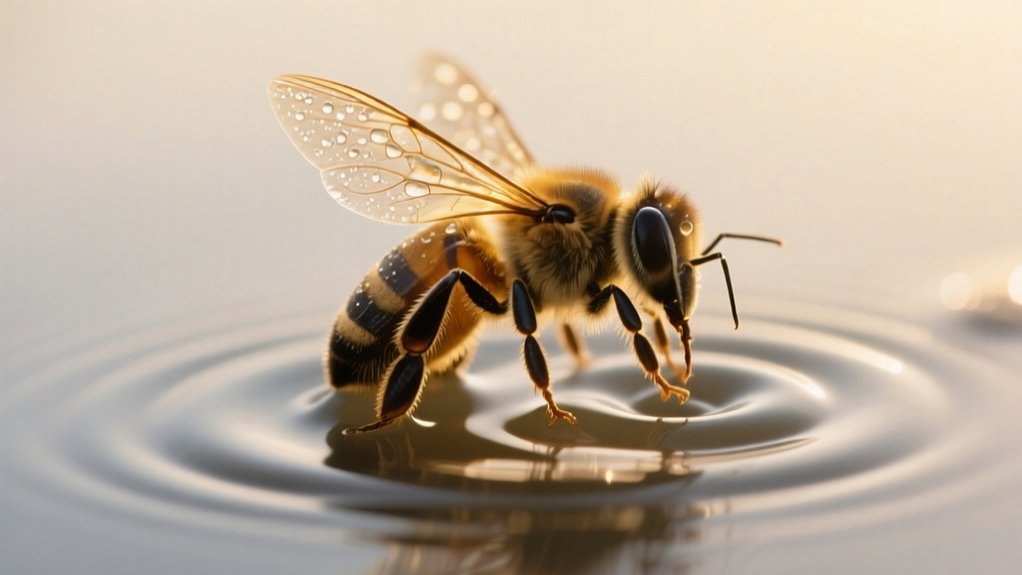
You might think bees can swim, but they actually float and move on water by rapidly flapping their wings to create ripples through hydrofoiling, a unique propulsion method. They don’t have swimming limbs and can only sustain this movement for about ten minutes before tiring.
Water clinging to their wings hinders flight, increasing drowning risk. While bees rely on water for survival, they face challenges on its surface. There’s more to learn about their interaction with water and its impact.
Can Bees Swim?
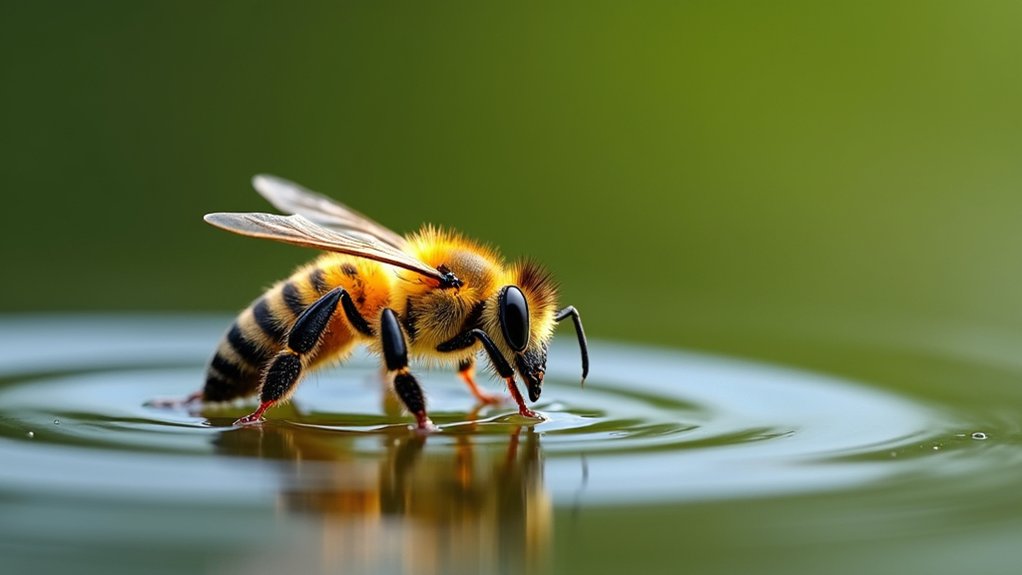
Although bees aren’t built to swim, they can use their wings to generate ripples on the water’s surface, a process called hydrofoiling, which helps them move toward safety when stranded.
When you observe bees swim, you’ll notice they lack specialized swimming limbs, relying entirely on wing movements to create propulsion. Their wings produce small waves that push against water, enabling limited movement across water sources.
However, their wing structure collects water, increasing drag and making flight escape difficult after landing in water. Bees can hold their breath underwater for about five minutes, but they risk drowning if they can’t reach safety quickly.
Hydrofoiling demands substantial energy, restricting bees to roughly ten minutes of this activity before exhaustion prevents further movement.
Consequently, while bees swim using hydrofoiling, it’s an emergency, energy-intensive maneuver rather than a sustainable swimming method.
How Do Bees Move on Water?
Bees move on water by rapidly flapping their wings to create ripples, a process called hydrofoiling that propels them forward.
When bees use their wings in this way, they generate small waves that produce asymmetrical patterns, allowing efficient forward movement with minimal energy.
This technique enables them to glide across the water surface, but they can only maintain it for about ten minutes before fatigue sets in.
The small waves created reduce the force needed for propulsion, making hydrofoiling an effective strategy for short-distance travel on water.
However, water sticks to their wings, increasing weight and making it harder for them to escape by flight.
Still, by continuously beating their wings and producing these small waves, bees can maneuver to the edge of a water body, boosting their chances of survival.
Why Can’t Bees Fly Away When They Land on Water?
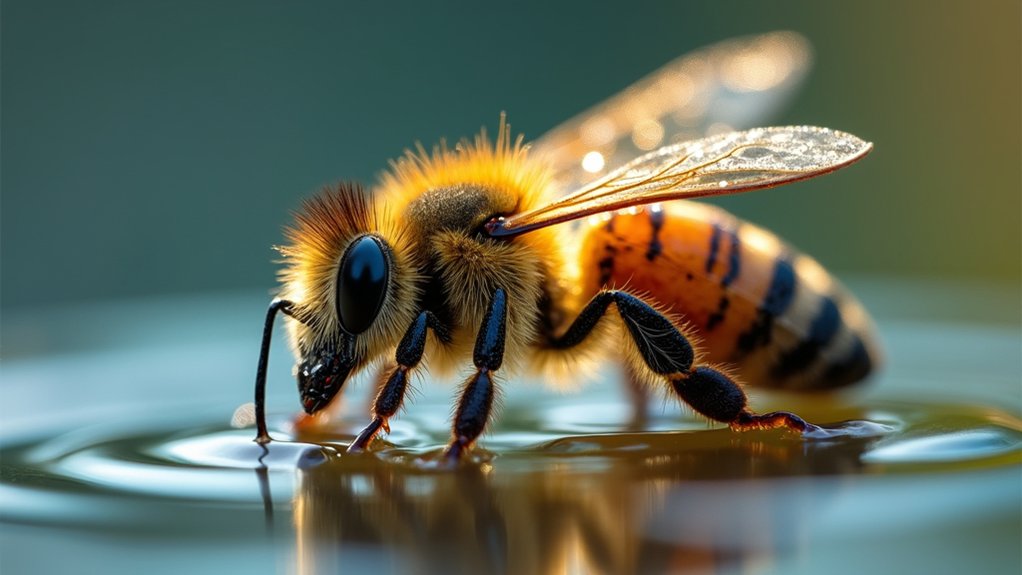
When a bee lands on water, water droplets stick to the tiny hairs on its wings. This makes the wings heavier than usual, which makes it really hard for the bee to lift off.
Plus, the water creates extra drag, kind of like resistance, so the bee’s flight muscles have to work way harder to get it flying again.
Because of this added weight and drag, the bee just can’t generate enough force to escape.
Wing Water Adhesion
Since water clings tightly to the tiny hair follicles covering bee wings, you’ll notice that their lightweight wings quickly become weighed down upon contact with a water surface.
This water adhesion increases wing drag considerably, reducing the bee’s ability to generate lift.
The microscopic hairs, which normally aid flight by stabilizing airflow, instead trap water droplets, adding weight and disrupting wing movement.
As a result, the bee’s wings lose aerodynamic efficiency, making it difficult to take off.
Although bees can attempt hydrofoiling by rapidly moving their wings to create ripples, this energy-intensive method only works briefly.
Consequently, wing water adhesion critically impairs flight by increasing drag and weight, often leaving bees stranded on water surfaces and vulnerable to drowning without swift recovery.
Flight Hindrance Factors
Water clinging to the fine hairs on bee wings creates significant flight hindrance, making it difficult for them to lift off from water surfaces. Several flight hindrance factors emerge when a bee lands on water:
- The lightweight, hairy structure of the bee’s wings increases water adhesion, reducing aerodynamic efficiency.
- Water adds weight and drag, overwhelming the wings’ ability to generate lift necessary for flight.
- Prolonged contact with water exhausts the bee, limiting its capacity to beat its wings effectively.
Because bee wings aren’t adapted for aquatic environments, these factors combine to prevent flight, risking drowning within minutes.
Understanding these flight hindrance factors explains why bees struggle to escape water and underscores the critical need for rapid movement to dry land for survival.
Weight Impact on Wings
Although bees possess remarkable flight capabilities, the added weight of water clinging to their wings drastically impairs their ability to take off after landing on a water surface.
The weight impact on wings arises because bee wings are lightweight and covered in tiny hair follicles, increasing their stickiness to water. This causes water to accumulate, considerably increasing drag and preventing the bee from generating the lift necessary for flight.
When you observe a bee struggling, you’re witnessing its inability to shed water quickly, which traps it in a vulnerable state. This combination of water weight and wing structure limits the bee’s escape options, often leading to drowning within minutes.
Understanding this weight impact on wings explains why bees can’t fly away easily once they’ve landed on water.
How Long Can Bees Survive in Water?
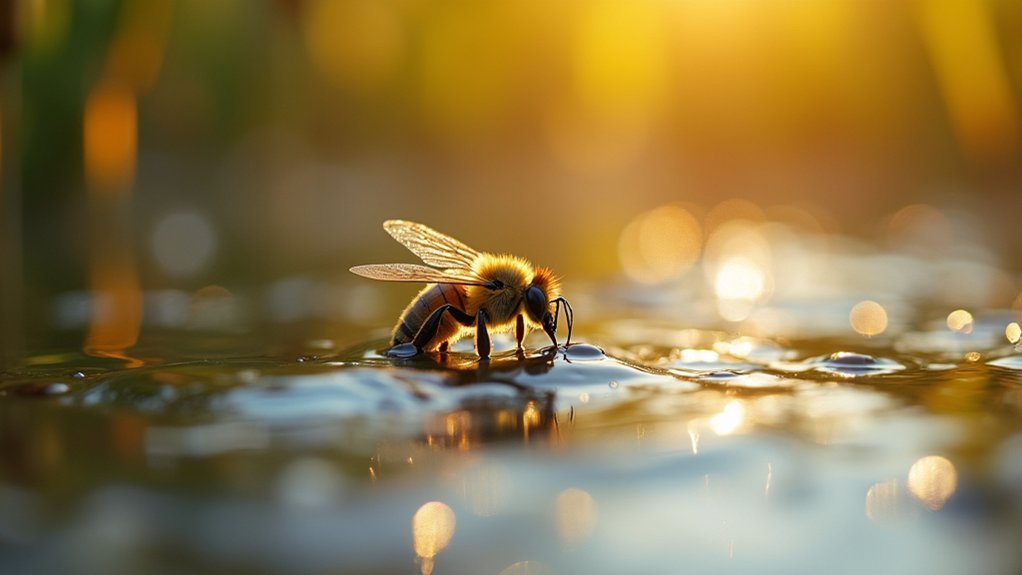
How long can a bee survive once it finds itself submerged? Bees can hold their breath for about five minutes due to spiracles that close to conserve oxygen.
However, survival depends on several factors:
- Oxygen Conservation: Bees hold their breath underwater, but if submerged beyond five minutes, oxygen depletion becomes critical.
- Physical Constraints: Waterlogged wings hinder flight, increasing drowning risk and limiting escape options.
- Energy Expenditure: Bees can hydrofoil and swim briefly, but fatigue sets in around ten minutes, reducing survival chances.
You’ll see that quick access to dry land is essential for a bee to survive in water.
Without it, exhaustion and oxygen loss will lead to drowning, highlighting the limited window bees have once submerged.
The Role of Water in Bee Survival
You rely on water not just to keep bees hydrated but also to help regulate the hive’s temperature when it gets hot.
Worker bees go out and collect water from all sorts of places. This way, the whole colony stays cool and hydrated.
When you think about it, it really shows how important water is for keeping bees healthy and the hive running smoothly.
Water’s Vital Functions
Since bees rely on water for hydration, you’ll find it plays a critical role in their survival and hive health. Water supports essential metabolic functions in bees and maintains overall hive stability.
Here are three crucial functions water serves for bees:
- Hydration: Bees require water to stay hydrated, which directly impacts their physiological processes and health.
- Hive Regulation: Worker bees distribute water within the hive to help regulate temperature, especially during hot weather.
- Attraction to Sources: Bees seek water sources, including chlorinated pools, because chlorine mimics minerals found in natural water, aiding their foraging behavior.
Providing safe, shallow water with landing spots prevents bee drowning, ensuring they can collect water efficiently.
Understanding these functions highlights water’s indispensable role for bees’ survival and hive functionality.
Hydration and Hive Cooling
Although bees collect nectar and pollen for nutrition, they also depend heavily on water to stay hydrated and regulate hive temperature. Hydration is essential for individual bee survival and overall colony health.
Worker bees actively distribute water within the hive, facilitating hive cooling by fanning their wings to evaporate water. This process lowers internal temperatures during hot conditions and keeps the hive’s ideal environment. It prevents heat stress that could compromise brood development.
You’ll find bees drawn to various water sources because they require consistent access to support these critical functions.
Understanding the dual role of hydration and hive cooling highlights why water availability directly influences a colony’s resilience and productivity. It really emphasizes the importance of safe, accessible water for bee survival.
Bee Water Collection Methods
When bees gather water, they target sources that provide essential minerals and guarantee safe collection to avoid drowning.
You’ll find bees often collecting water from pools, where chlorine mimics natural minerals vital for their survival.
To facilitate safe water collection, you can provide shallow dishes with pebbles or corks. These allow bees to land securely.
Here are three key bee water collection methods:
- Seeking mineral-rich water sources like pools or natural ponds.
- Utilizing shallow containers with landing aids to prevent drowning.
- Worker bees distributing collected water within the hive for hydration and temperature regulation.
Why Are Bees Attracted to Swimming Pools?
Why do bees frequently visit swimming pools despite the risks involved? Bees are drawn to pools primarily because chlorine mimics essential minerals found in their natural water sources.
During hot weather, you’ll notice bees actively seeking water to hydrate and cool their hives. The pool’s reflective water surface often catches their attention as a promising spot.
Bees seek water to hydrate and cool their hives, often attracted by the pool’s reflective surface.
However, when bees land on the water surface, their wings can become wet and heavy, impairing flight and increasing drowning risk. This attraction is a survival response, not a preference for pools.
You can help by providing shallow water dishes with pebbles or floating corks. This allows bees to access water safely without struggling to keep their wings dry and functional.
What Happens When a Bee Lands on Water?
Bees attracted to swimming pools often face immediate challenges upon landing on the water’s surface. Their wings become weighed down by water, which hinders immediate takeoff. To cope, bees use a movement called hydrofoiling, where they rapidly flap their wings to create ripples and help them navigate.
Here’s what happens when a bee lands on water:
- Bees navigate the surface by hydrofoiling, generating lift and propulsion despite their wings not being adapted for swimming.
- This hydrofoiling can continue for about ten minutes but requires significant energy, causing fatigue.
- The water’s drag on their wings limits flight capability, increasing drowning risk if they can’t escape quickly.
Understanding these dynamics highlights their vulnerability when encountering water surfaces.
How Do Bees Escape From Water?
When you watch a bee trying to get out of water, you’ll see it flapping its wings really fast to create tiny ripples. This action is called hydrofoiling, and it helps push the bee forward.
Basically, the bee uses precise wing strokes to lift itself against the water’s resistance.
But keep in mind, this takes a lot of energy. Bees can only keep up this escape effort for about ten minutes before they start getting tired.
Wing Movement Techniques
Although escaping water poses a significant challenge, insects employ specialized wing movement techniques to improve their chances of survival.
Bees use a method called hydrofoiling, which involves precise wing movements to generate water ripples that aid propulsion.
You’ll notice these key aspects of their wing movement techniques:
- Bees perform a backward wing beat creating upward water displacement, producing waves that push them forward.
- Hydrofoiling generates a force of roughly 20 millionths of a Newton, enough to move them slowly but not escape water directly.
- This technique is energy-intensive and sustainable for only about ten minutes before exhaustion sets in.
These specialized wing movements optimize your bee’s ability to reach the pool’s edge, which is essential for survival.
Hydrofoiling Mechanics Explained
A critical process known as hydrofoiling enables these insects to escape from water by generating ripples through specialized wing movements.
When you observe a bee trapped on water, it uses hydrofoiling by rapidly pronating and supinating its wings to create small waves. These waves produce thrust, propelling the bee forward toward safety.
However, water adhesion makes the wings heavy, preventing immediate flight. Hydrofoiling allows bees to maintain momentum on the water surface, but this technique demands substantial energy.
You should note that hydrofoiling is effective only for about ten minutes; after this period, fatigue sets in, increasing the risk of drowning.
Understanding these wave-generating mechanics clarifies how bees exploit hydrofoiling to navigate water despite their natural limitations.
Energy Limits in Escape
Hydrofoiling enables bees to generate propulsion on the water surface, but it comes with significant energy costs that limit their escape options.
When you observe a bee trying to escape water, you’ll notice these constraints:
- Bees expend a high amount of energy hydrofoiling, allowing about ten minutes before exhaustion impairs their movement.
- Water adhering to their wings increases their weight, making immediate flight impossible and delaying escape.
- By closing spiracles, bees can hold their breath for around five minutes, conserving oxygen during submersion but only briefly.
Because of these energy limits, a bee’s successful escape from water depends on rapid movement toward dry land before fatigue or drowning risk rises substantially.
Understanding these factors highlights how essential timing and energy management are in a bee’s aquatic survival.
The Mechanism Behind Bee Wing Movement on Water
When bees move on water, they generate symmetrical wave patterns with their wings that create ripples essential for propulsion despite their inability to swim.
As a bee lands on water, it uses wings to generate precise pronation and supination motions, producing both thrust and recovery strokes. These movements exert approximately 20 millionths of a Newton of force, sufficient to hydrofoil across the surface.
This wing action creates ripples that push against the water, enabling the bee to navigate toward the edge of the pool.
However, this method demands significant energy, limiting movement duration to about ten minutes before fatigue.
The wing dynamics are specialized not for sustained flight but for short, energy-intensive bursts that help the bee escape water hazards efficiently.
Risks Bees Face While in Water
Although bees use specialized wing movements to propel themselves on water, the physical challenges they face in this environment pose serious threats to their survival.
Worker bees, in particular, encounter significant risks due to their inability to swim and the rapid onset of fatigue.
The primary risks bees face while in water include:
- Drowning risk: Water weight on their wings causes them to become heavy and ineffective. This can lead to drowning within five minutes if they can’t escape.
- Wing drag and fatigue: Continuous hydrofoiling generates ripples but exhausts the bees in about ten minutes. This severely limits their survival time.
- Increased water adhesion: Tiny hairs on worker bees increase stickiness, making it difficult to shed water and regain flight quickly.
These risks highlight the critical need for a swift escape from aquatic environments to avoid fatal outcomes.
How to Help Bees Stuck in Water
If you come across a bee struggling in water, you can take specific steps to increase its chances of survival. To help bees stuck in water, gently scoop the bee out using a flat object, minimizing harm.
Place it on a dry surface away from puddles, allowing it to recover.
Since bees need water but can become trapped, offering a small amount of pure or sugar water (made from granulated cane or refined white sugar) can help revive the bee’s energy.
Handle the bee calmly. Trapped bees aren’t aggressive but seeking escape.
These precise actions support the bee’s natural recovery processes and improve its likelihood of survival after water immersion, reflecting a responsible approach to assisting these essential pollinators.
Creating Safe Water Sources for Bees
Because bees rely on consistent access to safe water for hydration and hive temperature regulation, you can greatly aid their survival by creating shallow water stations equipped with landing materials like pebbles or corks.
These setups reduce drowning risks and provide reliable hydration.
To establish effective alternative water sources, consider the following:
- Use a shallow dish filled with clean water and add pebbles or corks to create safe landing spots for bees.
- Position water stations in accessible, shaded areas to prevent rapid evaporation and overheating.
- Regularly clean and refill the shallow dish to maintain water quality and prevent contamination.
Applications of Bee Water Locomotion Research
Understanding how bees interact with water not only helps in creating safer hydration sources but also opens avenues for innovative technological applications.
Research on bee water locomotion reveals that bees generate symmetrical wave patterns to propel themselves efficiently, exerting forces as small as 20 millionths of a Newton.
Bees create symmetrical water waves, propelling themselves with forces as tiny as 20 millionths of a Newton.
This unique hydrofoiling technique, absent in most insects, inspires engineering advancements. By mimicking bees’ wing movements, engineers develop small robots capable of traversing both air and water, enhancing multifunctional drone capabilities.
These bioinspired designs optimize energy use and maneuverability in complex environments.
If you’re involved in robotics or drone technology, integrating principles from bee water locomotion can lead to innovative solutions that combine aquatic and aerial navigation, pushing the boundaries of current engineering applications.
Frequently Asked Question
Do All Bee Species Exhibit Water Locomotion Behavior?
Not all bee species exhibit water locomotion behavior. You’ll find that honey bees are the most studied and display unique swimming techniques like hydrofoiling.
However, other bees differ in wing structure and size, which affects their ability to navigate water. Some may float or struggle, while others avoid water altogether.
Since research mainly focuses on honey bees, you can expect variations.
But extensive knowledge about all species’ water behaviors remains limited.
Can Bees Carry Water While Moving on Its Surface?
You might think bees can carry water while moving on its surface, but they actually can’t.
The weight of water disrupts their wing motion, which generates only about 20 millionths of a Newton of force.
This force is just enough for hydrofoiling and gliding, not for transporting water.
Their wings pull water along during movement, but that’s insufficient for carrying water effectively across the surface.
How Does Water Temperature Affect Bee Movement on Water?
Water temperature greatly impacts how you observe bee movement on water. Warmer water lowers viscosity, letting bees move more easily and maintain surface tension.
Conversely, cold water slows their metabolism, reducing their ability to generate propulsion and increasing fatigue. This means in colder conditions, bees struggle to stay afloat or escape quickly.
Are There Predators That Target Bees on Water Surfaces?
Yes, predators like dragonflies, certain fish species, water striders, and birds target bees on water surfaces.
When you observe bees struggling to escape water, these predators exploit their vulnerability.
Dragonflies and fish seize bees during this moment, while water striders use their legs to capture them.
Birds hunting near water also snatch bees attempting to flee.
These threats considerably affect bee survival near water sources, increasing predation risk during their escape attempts.
Do Bees Communicate About Water Sources Using Wing Movement?
Think of bee wing movements as Morse code in the air. They do communicate about water sources using precise wing vibrations.
These subtle wing beats generate specific signals, complementing their waggle dance, to alert hive members about nearby hydration spots.
This dual communication method improves foraging efficiency, especially in dry conditions.
Conclusion
You can picture a lone bee, like a tiny vessel maneuvering ripples, its delicate wings struggling against water’s hold. Though it can’t truly swim, it floats and paddles, symbolizing resilience amid adversity.
Understanding this delicate dance not only reveals nature’s intricate balance but also highlights how we must protect these essential pollinators. By creating safe water sources and aiding stranded bees, you help sustain their survival, ensuring their crucial role in ecosystems continues unbroken.