Can Giraffes Swim – Truth Revealed
You might not know it, but giraffes can swim, although it’s not easy for them. Their long legs and heavy bodies make balance tricky, and they need about 2.8 meters of water depth to float.
Their awkward neck position and 13.5% higher water drag complicate movement, so they mostly avoid deep water. In the wild, they prefer shallow wading and land routes around rivers.
Understanding how habitat changes affect their water crossings offers deeper insight into their survival challenges. It’s pretty fascinating when you think about how these gentle giants manage in their environment.
Can Giraffes Swim?
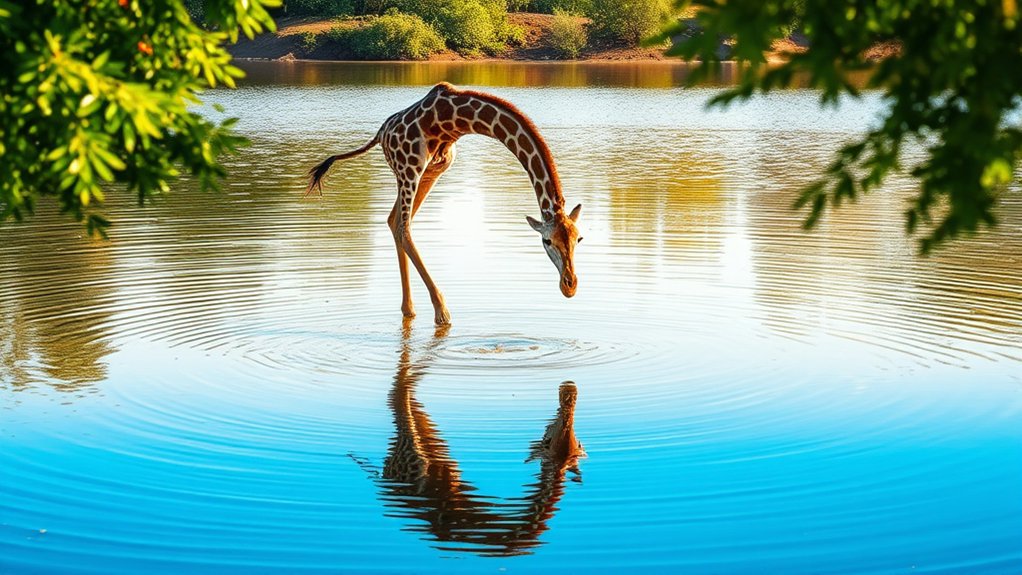
How well can giraffes swim? Though giraffes can’t swim with ease like many animals, they’re technically capable of swimming. According to a study published in the Journal of Theoretical Biology, swimming giraffes require approximately 2.8 meters of water depth to achieve buoyancy.
However, their long legs and heavy bodies create significant balance challenges, making controlled and sustained swimming difficult. Their anatomy, characterized by long necks and uneven leg lengths, complicates swimming mechanics. This results in awkward, exhausting movements in water.
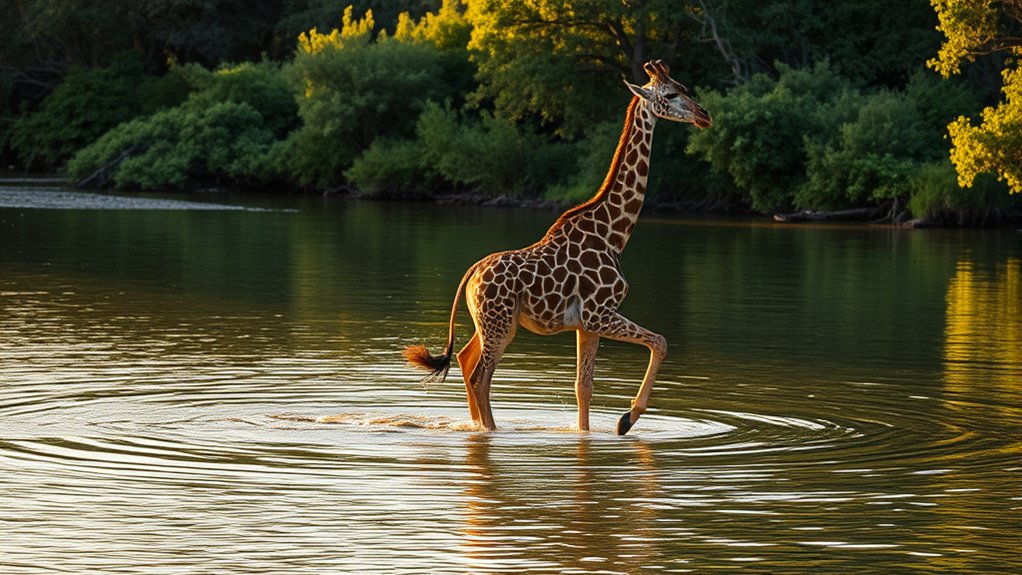
Typically, giraffes avoid deep water, preferring to wade in shallow areas no deeper than their knees. While they can float and swim, their abilities are far inferior to those of horses.
How Giraffes Float and What It Looks Like
When you watch a giraffe floating, you’ll see its buoyancy makes the hips rise above the shoulders, which gives it a bit of an unbalanced look.
Their long necks have to stay horizontal or partly underwater so their eyes can stay above the waterline, and honestly, that can look kind of awkward.
Plus, with their high center of gravity, it’s no surprise they’ve a tough time staying stable in the water.
Buoyancy and Body Position
Although giraffes aren’t natural swimmers, they begin to float once the water reaches about 2.8 meters deep. Their hind limbs lift off the ground before their forelimbs do. This change in buoyancy causes the hips to elevate relative to the shoulders, forcing a distinct body position.
Because of their long necks, which average around six feet, their floating posture becomes pretty complex. They’ve to hold their necks horizontally or even submerged to keep their balance. The long front legs pull the body downward, making the head position awkward as giraffes try to keep their eyes above water.
Their high center of gravity makes things even trickier and less stable.
All in all, buoyancy and body position work together in a unique way for giraffes. This makes their floating look pretty unusual compared to other four-legged animals.
Floating Posture Challenges
The unique buoyancy giraffes experience in deep water directly influences their floating posture, presenting several challenges.
You’ll notice giraffes begin to float in about 2.8 meters of water, with their hind limbs lifting off the bottom before their forelimbs. This causes their hips to rise higher than their shoulders, forcing their necks into a horizontal or even submerged position.
To keep their eyes above water, giraffes must maintain uncomfortable head postures. Their long front limbs and high center of gravity complicate buoyancy and balance, resulting in an awkward floating posture. It’s not easy for them to stay balanced.
Furthermore, giraffes face 13.5% more frictional drag compared to horses, making it harder for them to swim efficiently.
This combination of anatomical and physical factors defines the distinctive floating posture giraffes adopt in water. So, their unique body shape really changes how they manage being in deep water.
What We Know About Giraffes Swimming in the Wild
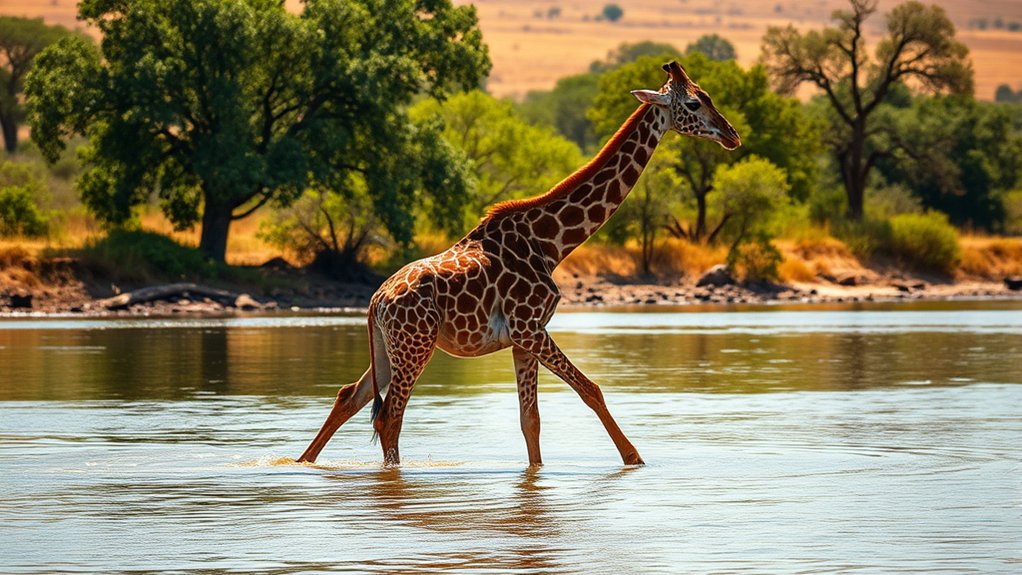
Because of their unique anatomy, giraffes exhibit limited swimming capabilities in the wild. Studies, including research from the University of Portsmouth, confirm that giraffes move cautiously around rivers and lakes, primarily wading in shallow water rather than swimming. You’ll find very few documented cases of giraffes swimming.
In fact, they practically can’t swim efficiently due to their long legs and necks. When faced with water barriers, giraffes tend to avoid deep or fast-moving water, preferring narrow or shallow crossings. Their heavy bodies make swimming uncomfortable and inefficient.
So, they rely on land routes whenever possible. Environmental pressures like drought or habitat loss further influence their behavior, encouraging giraffes to navigate around rather than through aquatic obstacles.
This evidence highlights that giraffes’ natural movement is mainly terrestrial, with swimming being a rare exception.
How Giraffes’ Long Legs and Neck Make Swimming Hard
When you consider a giraffe’s long legs and neck, you quickly realize how these features hinder its swimming ability.
Giraffes’ long legs hang downward when floating, disrupting balance and stability in water. Their front legs, longer than the back legs, create uneven limb length, complicating coordination during swimming attempts.
The neck, averaging six feet, requires an awkward position to keep the head above water, which further impairs efficient movement.
Plus, giraffes have a high center of gravity, making them less stable in deep water. Their muscles are built for walking on land, not for swimming, so swimming is tough and not very efficient for them.
All these features combined mean giraffes can’t swim well. It really limits how they can move through water or aquatic environments.
Why Do Giraffes Avoid Deep Water and Strong Currents?
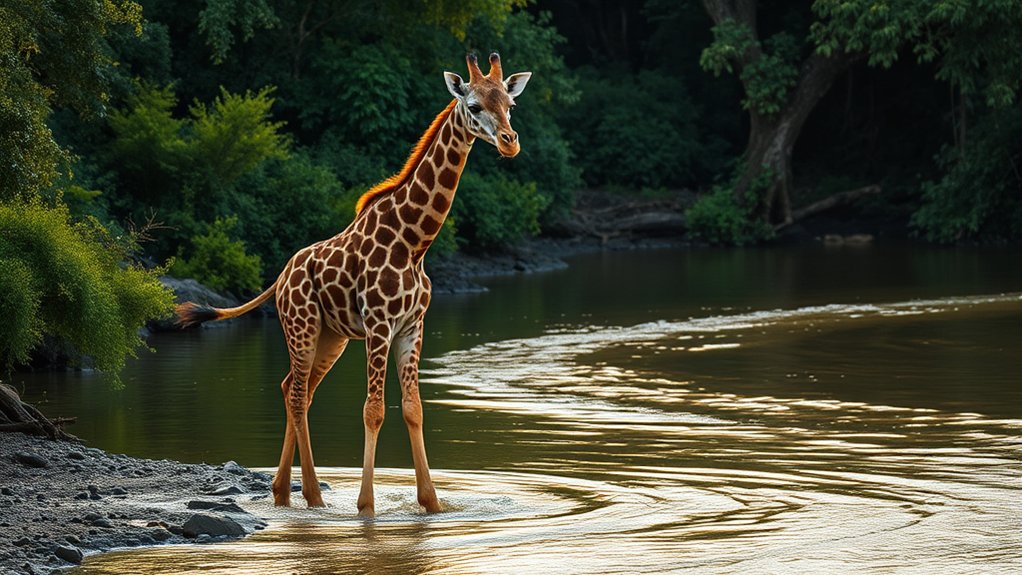
Giraffes’ unique body structure, which makes swimming challenging, also influences their behavior around water. Their long legs and heavy bodies create instability in deep water, making it difficult for giraffes to maintain balance near the water surface.
Strong currents increase this risk because giraffes’ high center of gravity makes them prone to being swept away or drowning. Their awkward floating posture, with submerged necks and downward-hanging legs, hinders effective movement in fast-moving water.
You’ll also find that giraffes instinctively avoid deep water due to predator presence near lakes and rivers, which further discourages risky crossings.
As a result, giraffes prefer to stay away from both deep water and strong currents to minimize dangers associated with instability and predation. It’s all about keeping safe and avoiding unnecessary risks.
How Giraffes Safely Cross Rivers and Shallow Water
Although giraffes generally avoid deep or fast-moving water, they’ll cross rivers and shallow water when necessary by carefully selecting stable, shallow areas. You’ll notice that giraffes prefer narrow river sections where the water depth enables them to wade safely without risking footing on uneven riverbeds.
Their long legs require precise movements to navigate such terrain, minimizing the risk of injury or exhaustion.
In water depths up to approximately 2.8 meters, giraffes can float to some extent, which helps them cross. However, they rarely rely on swimming and instead use buoyancy to assist wading.
Typically, giraffes cross rivers only when food is scarce or their habitat isn’t safe.
How Habitat Changes Affect Giraffes’ Swimming and Crossings
You’ll notice that when habitats get fragmented, giraffes end up in new areas they’re not used to. This means they run into water barriers more often, which can be tough for them to cross.
Plus, when their natural routes are blocked or limited, giraffes have fewer safe paths to get across rivers.
Habitat Fragmentation Impact
When habitat fragmentation intensifies, it forces giraffes into unfamiliar territories where water barriers become more frequent and challenging to cross. You’ll find that giraffes often avoid water when possible, as habitat fragmentation limits their access to traditional, safe crossing points.
This fragmentation, driven by human activities and environmental changes, disrupts giraffes’ natural movement patterns.
You must understand that drought and heavy rains further complicate these movements, increasing encounters with rivers and lakes. As landscapes become more fragmented, giraffes’ ability to navigate across water safely diminishes, impacting their survival.
Consequently, habitat fragmentation plays an essential role in shaping giraffes’ behavior. It often compels them to bypass water bodies that once posed minimal risk, ultimately restricting their range and access to essential resources.
Water Barrier Challenges
As habitat changes shrink and fragment giraffes’ ranges, you’ll find water barriers like rivers and lakes increasingly complicate their movements. Giraffes usually avoid deep or fast-flowing water because their long legs and heavy bodies make crossing difficult and risky.
When drought forces them to travel farther for food, the likelihood of encountering such barriers rises. Similarly, heavy rains can create new water obstacles that disrupt their routes.
These water barriers hinder giraffes’ ability to move freely within their habitat, limiting access to essential resources. Maintaining open, connected landscapes is vital to allow giraffes to navigate around these water barriers safely.
Without this, their movement becomes restricted, increasing stress and the potential for injury during risky crossings. It’s clear that keeping these pathways open helps giraffes stay safe and healthy as they move through their environment.
How Conservation Helps Protect Giraffes’ Water Crossing Habitats
Although giraffes are great at moving across large areas, water barriers can really slow them down. Conservation is super important for protecting their habitats, especially by keeping landscapes open and connected. This helps giraffes cross rivers and streams safely.
By preserving shallow river crossings, conservation work ensures giraffes can reach the food they need and find safer spots without facing deep water dangers. When drought hits and giraffes have to travel farther for resources, protecting these water sources and crossing points becomes even more vital.
Preserving shallow crossings helps giraffes safely access food and water, crucial during droughts and long travels.
Human activities that break up natural pathways make things riskier for giraffes. That’s why focused conservation efforts are so important.
Groups like Save Giraffes Now are working hard to protect these habitats, reducing the challenges water barriers create and helping giraffes keep up their natural migration and survival habits.
Frequently Asked Questions
Do Baby Giraffes Learn to Swim From Their Mothers?
You won’t find baby giraffes learning to swim from their mothers because their instincts don’t include aquatic adaptations.
Maternal guidance is all about helping them survive on land, not teaching them swimming skills.
Early on, you might see calves wading in shallow water, but they don’t actually develop swimming abilities.
Giraffes’ physical build and natural behavior just aren’t suited for swimming.
So, instead of learning to swim from their moms, calves rely on their instincts and maternal cues to stay away from deep water.
It’s more about avoiding danger than picking up swimming skills through teaching.
Can Giraffes Drown if Trapped in Water Too Deep?
If you think giraffes are unstoppable swimmers, think again. They can drown if trapped in water too deep.
Despite their giraffe buoyancy letting them float, their long legs and heavy bodies make managing water depth tricky.
In trapping scenarios, their awkward necks and high center of gravity increase drowning risks.
You’ll find they avoid deep water because they simply aren’t designed to swim well or handle strong currents safely.
How Do Giraffes’ Swimming Abilities Compare to Other Tall Animals?
You’ll find giraffes lag behind other tall animals in swimming abilities due to unique tall animal adaptations.
Their swimming mechanics struggle with inefficient animal buoyancy caused by high center of gravity and awkward posture.
Evolutionary traits favor land browsing over aquatic movement, unlike moose or elephants, which have adapted streamlined bodies and trunks to enhance swimming.
Has Any Giraffe Ever Been Observed Swimming in Captivity?
Yes, you’ll find very few captivity observations of giraffes swimming. Giraffe behavior typically shows avoidance of deep water, and their swimming mechanics aren’t well-developed compared to other animals.
While some captive giraffes have been seen wading or floating briefly, true swimming remains rare.
Animal adaptations like long legs and necks make swimming awkward. Most data suggest giraffes prefer shallow water to maintain stability and comfort.
Do Giraffes Use Water Sources Primarily for Drinking or Cooling Off?
Do you think giraffes use water mainly to cool off? Actually, their drinking habits reveal they rely on water sources primarily for hydration, not cooling.
Their cooling mechanisms depend on habitat preferences like shade and airflow, rather than water immersion.
Giraffes’ hydration strategies involve obtaining moisture from leaves, minimizing water intake.
When they do drink, they carefully lower their necks, emphasizing water’s critical role in survival, not temperature regulation.
Conclusion
You’ve discovered that giraffes grapple with great challenges when it comes to swimming, given their long legs and lofty necks. They cautiously circumvent deep currents, choosing safer shallow crossings instead. Shifting habitats and changing climates complicate their crossing capabilities, calling for careful conservation.
By comprehending these creatures’ cautious crossing choices, you can better appreciate the balance between biology and environment that safeguards giraffe survival in swiftly shifting settings.