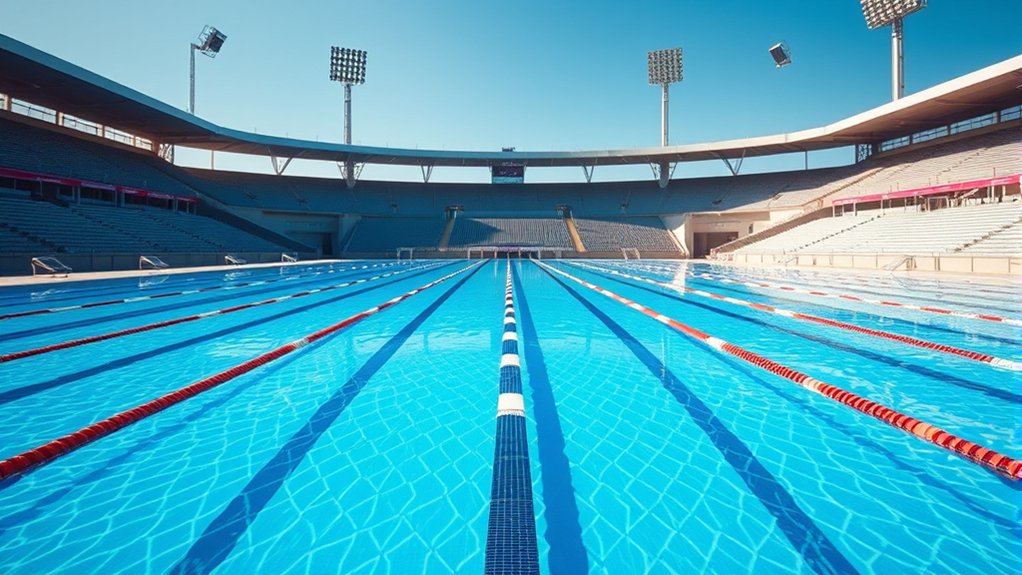
How Many Gallons Are In An Olympic Size Swimming Pool – Full Breakdown
An Olympic size swimming pool holds about 660,000 gallons of water, based on standard dimensions of 50 meters by 25 meters, with a minimum depth of 2 meters. This volume equates to roughly 2.5 million liters and weighs around 5.5 million pounds.
It’s nearly 15 times larger than a typical residential pool. Because of its size, it requires extensive maintenance, precise temperature control, and advanced filtration systems.
Understanding how these factors impact operational logistics and swimmer performance offers deeper insights into Olympic pool management. It’s pretty fascinating how much goes into keeping these pools in top shape!
How Many Gallons Does an Olympic Size Swimming Pool Hold?
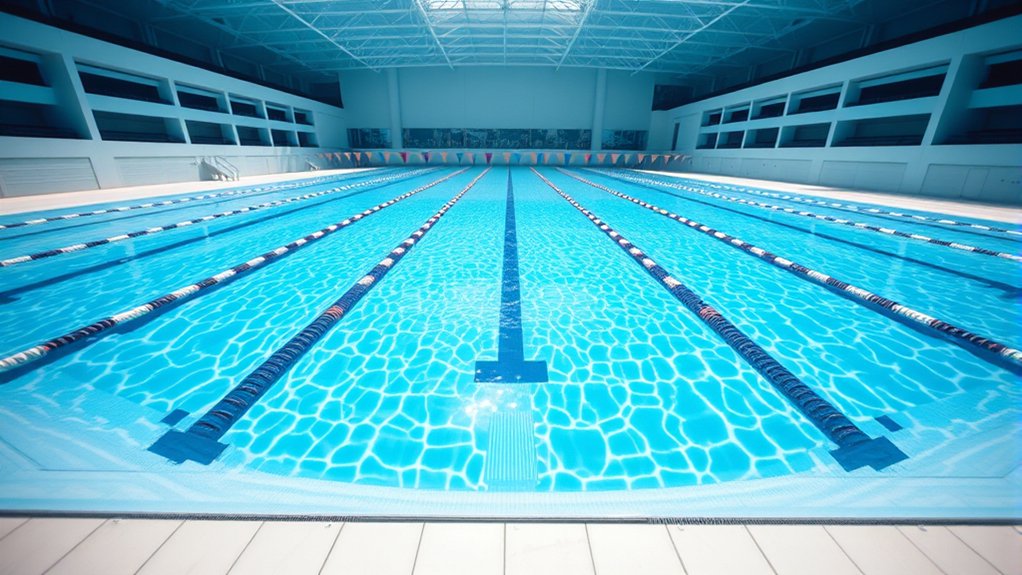
Exactly how many gallons does an Olympic-sized swimming pool hold? An Olympic-sized swimming pool contains approximately 660,000 gallons of water. This volume supports international swimming competitions by providing consistent conditions across venues.
The gallons of water equate to about 2.5 million liters, which really shows how much capacity is needed for official events. Such a volume guarantees the pool maintains adequate depth and water displacement for swimmers’ performance and safety.
It’s pretty important to understand this capacity when managing water treatment, filtration, and heating systems in competitive environments. The sheer gallons of water also put significant structural demands on the pool’s construction.
How Pool Dimensions Determine Water Volume
Three key dimensions, length, width, and depth, directly determine the water volume of an Olympic-sized swimming pool. Specifically, the pool measures 50 meters long, 25 meters wide, and has a minimum depth of 2 meters. This establishes its overall capacity.
You calculate the volume by multiplying these pool dimensions: length × width × depth. That gives you approximately 2,500 cubic meters or about 660,000 gallons. This volume reflects the minimum depth required to meet international standards.
Deeper designs, like 3 meters, increase water volume to accommodate varied competitive events.
Understanding these precise pool dimensions is vital since they define the total gallons of water held. This ensures the pool’s suitability for official competitions and helps maintain consistent athletic performance conditions.
How Do Olympic Pools Compare to Residential and Other Pools?
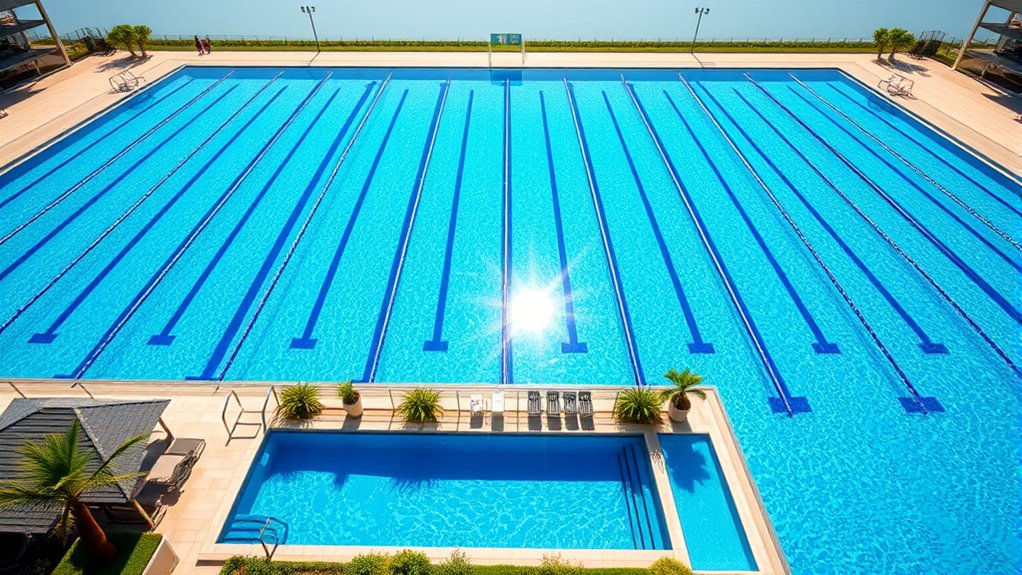
You’ll find that Olympic pools hold about 660,000 gallons, which is huge compared to residential pools. Most home pools usually range between 15,000 and 48,000 gallons, so there’s quite a difference.
Olympic pools have standardized dimensions of 50 by 25 meters, while home pools come in all sorts of shapes and sizes, generally much smaller.
This big difference in size and volume means Olympic pools need way more water and have much higher usage requirements.
Olympic Vs Residential Volume
Understanding the volume differences between Olympic-sized and residential swimming pools highlights the scale of these aquatic structures. An Olympic-sized pool holds approximately 660,000 gallons, dwarfing residential pools that typically range between 15,000 and 48,000 gallons.
The standard dimensions of 50 meters by 25 meters give Olympic pools an immense capacity, designed to meet competitive swimming demands.
In contrast, residential pools vary widely in size and shape, reflecting their primary use for leisure rather than competition. This disparity in gallons also influences engineering requirements.
Olympic pools must support roughly 5.5 million pounds of water, demanding rigorous structural standards, whereas residential pools face less stringent constraints.
You can grasp the magnitude by noting that filling one Olympic-sized pool equals nearly 39,000 average household showers. It’s pretty wild when you think about it!
Pool Size Differences
Although residential and school pools serve different purposes, comparing their sizes to Olympic pools reveals striking contrasts in scale and design.
An Olympic-sized swimming pool measures 50 meters by 25 meters, holding approximately 660,000 gallons of water. That’s far more than the typical 15,000 to 48,000 gallons found in residential pools.
You’ll notice pool size differences also extend to depth. Olympic pools maintain a minimum depth of 2 meters, while residential pools average 4 to 5 feet.
School pools, often 25 yards long, offer shorter racing distances compared to the Olympic pool’s 50 meters.
Furthermore, Olympic pools accommodate 8 to 10 lanes, each 2.5 meters wide, designed specifically for competition.
These precise dimensions and volumes highlight the technical scale that distinguishes Olympic pools from residential and school pools.
Everyday Comparisons to Visualize Olympic Pool Gallons
One Olympic-sized swimming pool contains about 660,000 gallons of water. That’s enough to power over 39,000 average showers in a single day. Pretty impressive, right?
To help you get a better idea, this pool holds enough water to fill roughly 1,500 standard hot tubs. Those hot tubs usually range from 300 to 450 gallons.
If you compare it to a typical residential pool, which holds between 15,000 to 48,000 gallons, an Olympic pool’s volume is about 15 times greater.
In terms of weight, the water totals approximately 5.5 million pounds, which is about the same as a small airplane’s maximum takeoff weight.
And get this—it could fill nearly 9,428 standard bathtubs, each holding 70 gallons.
These everyday comparisons really show just how huge the gallons in an Olympic-size swimming pool are.
What’s Involved in Filling an Olympic-Sized Swimming Pool?
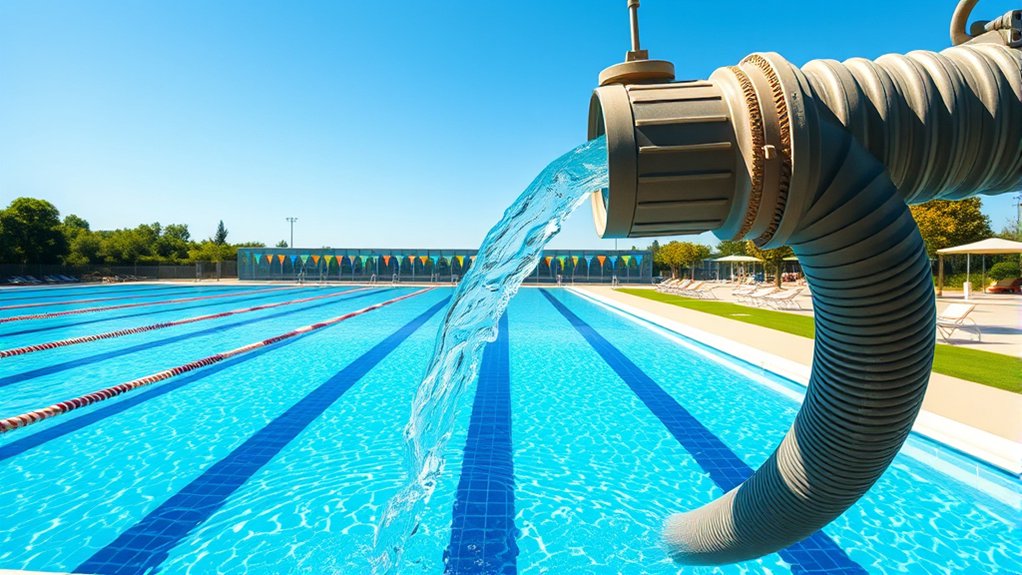
Filling an Olympic-sized swimming pool requires delivering approximately 660,000 gallons of water. This process can take up to 19 days if you’re using a standard garden hose flowing at 9 gallons per minute.
Before you start filling, it’s important to thoroughly clean and inspect the pool. This step ensures ideal health and safety conditions are met. The water usually comes from municipal supplies and often needs treatment to meet strict health standards.
During the filling process, maintaining the water temperature between 77°F and 82°F is essential. However, this can be energy-intensive and demands precise thermal management.
Because of the huge volume, Olympic pools need strong structural engineering to support the water’s weight safely.
Every step in filling the pool is designed to uphold health and safety protocols. At the same time, it manages the logistical and technical challenges unique to Olympic pools. It’s quite a complex but fascinating process!
How Much Does an Olympic Pool’s Water Weigh?
The 660,000 gallons of water held in an Olympic-sized swimming pool weigh approximately 5.5 million pounds, a mass comparable to the maximum takeoff weight of a typical commercial airplane.
When you consider the weight of water in such a pool, you realize the immense structural demands it places on the facility.
This weight results directly from the pool’s dimensions: 50 meters long, 25 meters wide, and at least 2 meters deep.
Understanding the weight of water is vital for engineers and architects designing Olympic swimming pools. It influences material selection and construction methods.
Accurately calculating the gallons and corresponding weight guarantees safety, stability, and longevity in these aquatic venues.
It’s pretty amazing to think about how much goes into just holding all that water safely!
How Olympic Pool Size Affects Maintenance
Managing the 660,000 gallons of water in an Olympic-size pool comes with some real challenges. You’ll need to be spot-on with chemical balancing and filtration to keep the water quality just right.
Then there’s the temperature to think about. Keeping the water between 77°F and 82°F isn’t easy—it uses a lot of energy and means you’ll need advanced heating and cooling systems.
All of this adds up, making the maintenance of an Olympic-size pool both complex and costly.
Water Volume Challenges
Because an Olympic-sized swimming pool holds roughly 660,000 gallons of water weighing about 5.5 million pounds, maintaining it demands rigorous water management and structural considerations. The sheer water volume challenges filtration, chemical balancing, and structural integrity. You have to implement advanced systems to manage water turnover and minimize chemical use while ensuring safety and clarity.
Managing that much water isn’t simple. It requires careful planning and constant monitoring to keep everything running smoothly. Without the right approach, the pool’s quality and safety can quickly decline.
| Aspect | Challenge | Impact on Maintenance |
|---|---|---|
| Water Volume | Large quantity to treat | Extended filtration cycles |
| Structural Load | Heavy weight on infrastructure | Requires reinforced materials |
| Water Refill Time | ~19 days via standard hose | Demands efficient water sourcing |
| Chemical Treatment | Minimize chemical use | Advanced treatment systems |
These factors make water volume management absolutely essential when maintaining Olympic swimming pools. It’s a big job, but with the right systems in place, it’s definitely manageable.
Temperature Regulation Impact
Maintaining water volume is only part of the challenge when managing an Olympic-sized swimming pool. Controlling its temperature adds another layer of complexity. Because the pool holds about 660,000 gallons, temperature regulation demands precision and energy.
You need to keep the water between 77 to 82°F for peak performance. This requires installing energy-efficient heating systems to offset heat loss from the large surface area. It also means continuously monitoring water temperature so you can adjust heating and circulation promptly.
On top of that, you’ll want mechanical systems designed to manage heating, evaporation, and circulation effectively. These factors make temperature regulation in Olympic swimming pools a technically demanding task. It greatly impacts operational costs and maintenance strategies.
Why Depth and Lanes Matter in Olympic Pool Volume
Although the standard Olympic pool measures 50 meters in length and 25 meters in width, its depth and lane configuration critically influence the total water volume and competitive conditions.
The minimum depth is set at 2 meters to meet safety and competition standards, but increasing it to 3 meters improves wave dissipation, reducing turbulence that can affect swimmer performance.
Lane width, typically 2.5 meters, allows for 8 to 10 lanes, accommodating multiple swimmers while minimizing interference.
These factors directly impact the pool’s volume, which approximates 660,000 gallons under standard dimensions but varies with depth adjustments.
Proper lane and depth specifications guarantee fairness and ideal swimmer conditions.
Understanding these parameters helps you appreciate how volume and design intricacies preserve competitive integrity in Olympic swimming events.
Frequently Asked Questions
How Often Is the Water in an Olympic Pool Replaced?
You’ll find the water replacement frequency in an Olympic pool varies between every 3 to 6 months, depending on maintenance schedules and usage intensity.
Proper scheduling balances hygiene and environmental impact, minimizing unnecessary water waste.
Advanced filtration often extends intervals, but factors like swimmer load, temperature, and chemical balance dictate exact timing.
What Chemicals Are Used to Keep Olympic Pool Water Clean?
You might think Olympic pools run on magic, but no, they rely on chlorine and some clever chemistry. To keep the water pristine, you have to monitor the pH balance meticulously. This ensures chlorine works effectively.
Sometimes, chlorine alternatives like bromine come into play, especially for sensitive swimmers. Algaecides prevent unwanted green guests, while cyanuric acid stabilizes chlorine under intense sunlight.
Pool maintenance demands precise chemical control, or you risk turning a world-class pool into a murky mess.
How Long Does It Take to Heat an Olympic-Sized Pool?
Heating an Olympic-sized pool typically takes several days to over a week, depending on your heating methods and desired temperature.
Using standard heaters, you can expect about a 1°F increase per hour. Solar heating, on the other hand, can take weeks and is influenced heavily by the weather.
Effective temperature regulation and energy efficiency really come down to proper insulation and maintenance.
When you optimize these factors, you reduce energy consumption and shorten heating time. This also helps you keep precise control over the pool temperature while using fewer resources.
Are There Eco-Friendly Alternatives for Maintaining Olympic Pools?
Imagine crystal-clear water shimmering under the sun. Eco-friendly alternatives like solar heating systems harness this energy to warm Olympic pools efficiently.
You can combine natural filtration methods with energy-efficient pumps to maintain water quality while cutting chemical use. These technologies reduce environmental impact and operational costs. They promote sustainable pool management.
How Is Water Quality Monitored During Olympic Events?
You monitor water quality during Olympic events through rigorous water testing, measuring pH, chlorine, alkalinity, and turbidity levels to meet strict safety standards.
You rely on continuous filtration systems to remove contaminants and maintain clarity. These systems work alongside advanced treatment technologies to guarantee chemical balance and swimmer safety.
Regular inspections confirm compliance with international regulations. This helps you maintain ideal water conditions for peak athlete performance and health throughout the competition.
It’s all about keeping the water safe and clear so athletes can perform their best.
Conclusion
Understanding that an Olympic pool holds about 660,000 gallons helps you grasp the scale. Imagine filling it with over 8,000 standard 55-gallon drums.
For example, a university upgrading its aquatic center found precise volume calculations critical for budgeting water treatment chemicals and energy costs. Knowing exact dimensions and volume guarantees efficient maintenance and resource management. This makes your planning both cost-effective and technically sound.