Can Deer Swim – Natural Ability Explained
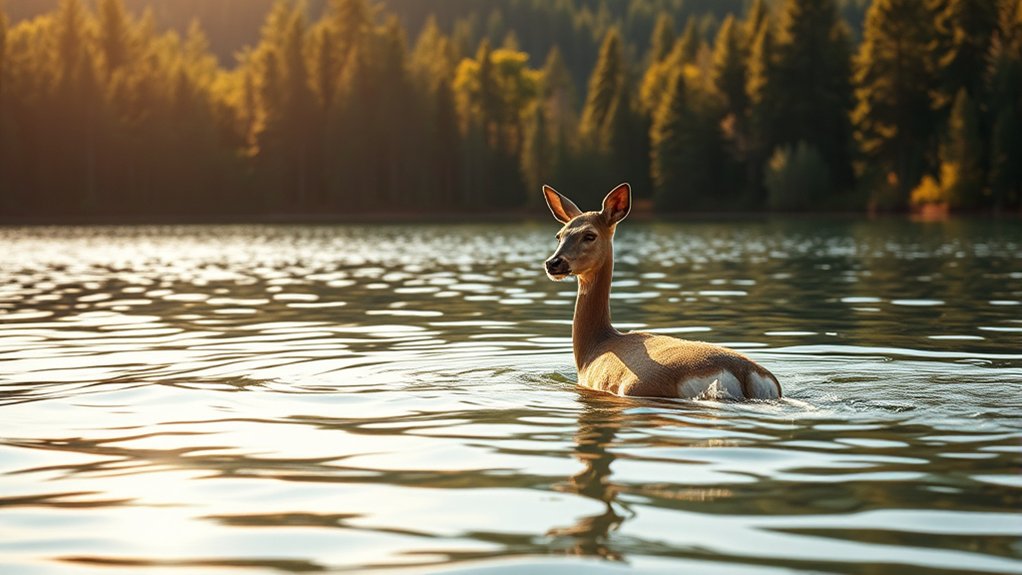
Yes, deer can swim naturally using strong hind legs that propel them efficiently at speeds up to 15 mph. Their two-layered coat insulates and supports buoyancy, while streamlined bodies reduce drag. They typically swim distances under three miles, though some have covered up to ten miles across rivers and lakes.
Fawns swim less effectively and rely on their mothers for guidance. These adaptations are essential for escaping predators and accessing resources. A range of environmental factors influence their swimming behavior and endurance.
Overview of Deer Swimming Ability
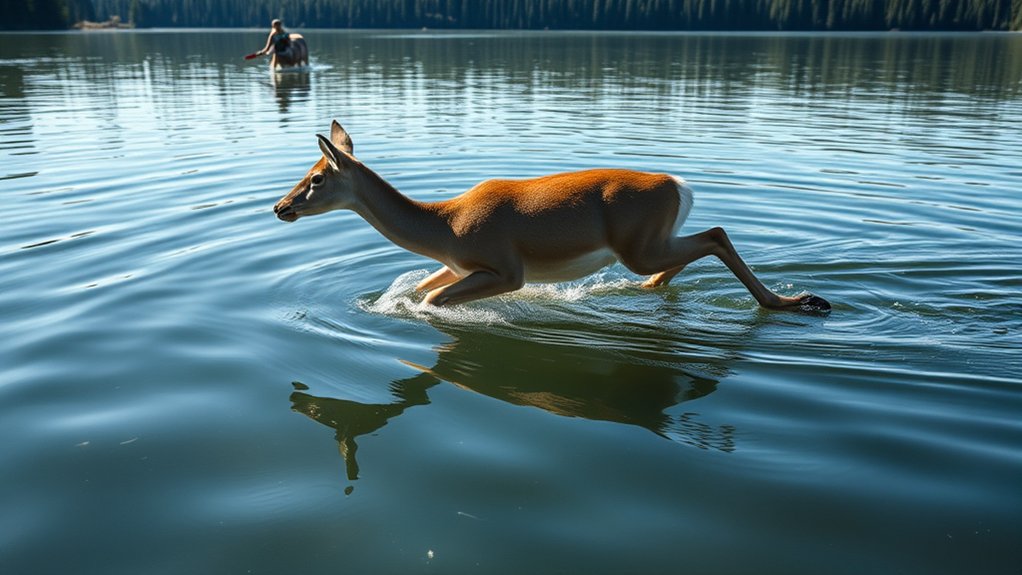
Although you mightn’t immediately associate deer with strong swimming skills, whitetail deer can reach speeds up to 15 mph in water and cross rivers more than half a mile wide. This shows just how good they’re at swimming.
They are capable swimmers, largely because of their strong hind legs, which give them powerful propulsion. Their streamlined bodies help reduce water resistance, making swimming easier.
Plus, whitetail deer have a unique two-layered coat that provides insulation and buoyancy. This helps them save energy while swimming.
Whitetail deer’s two-layered coat offers insulation and buoyancy, conserving energy during swims.
These adaptations allow deer to cross rivers as part of their natural behavior, whether they’re trying to avoid predators or access new resources.
How Far Can Deer Swim in Natural Settings?
You might be surprised to learn that whitetail deer can swim quite far—sometimes up to 2.4 miles.
In rare cases, they’ve even been known to cover distances between 8 to 10 miles, depending on the conditions they face.
There are studies and eyewitness reports that show deer crossing large rivers and handling strong currents, like those in the Mississippi and St. Clair rivers.
Of course, how far a deer can swim really depends on things like its stamina and the challenges posed by the environment.
Documented Swimming Distances
Deer can swim impressive distances in natural settings, with documented cases showing they cover up to 2.4 miles across rivers. Whitetail deer are capable swimmers, with reliable reports of crossing major waterways like the Mississippi River. For example, a buck swam 1.25 miles during peak flood.
Studies confirm deer swim distances ranging from 400 yards in the Wisconsin River to 500 to 1,100 yards across lakes, according to Minnesota DNR data. Furthermore, deer have been observed swimming about 1,000 yards between Shelter Island and Long Island. This really shows their endurance in open water.
While anecdotal evidence suggests deer might swim up to 10 miles under ideal conditions, verified instances consistently highlight their ability to negotiate significant water barriers.
Factors Affecting Swim Range
When evaluating how far whitetail deer can swim in natural settings, several factors come into play that directly influence their swim range. You need to take into account individual stamina, which varies among deer and affects their capacity to swim long distances.
Water currents also play a critical role; stronger currents can reduce the effective swim range by increasing energy expenditure.
Environmental conditions, such as water temperature and weather, impact endurance and safety during swimming. Deer are capable of swimming across large bodies of water, sometimes covering up to 2.4 miles.
Anecdotal evidence suggests they may match the energy of their parents, enabling extended swims.
Understanding these factors helps you appreciate how deer adapt their swimming behavior to natural challenges. This way, they can successfully navigate aquatic obstacles when necessary.
Notable Swimming Case Studies
Although swimming may not be the first skill you associate with whitetail deer, documented cases reveal their impressive aquatic capabilities. Whitetail deer have demonstrated remarkable swimming abilities, covering long distances in natural settings.
For example, several bucks swam between 0.9 to 2.4 miles across the Mississippi River, highlighting their endurance and impressive capability during flood stages. One buck particularly swam 1.25 miles across the Mississippi River, showcasing stamina in challenging conditions.
In New York, deer traversed approximately 1,000 yards between Shelter Island and Long Island, further illustrating their adaptability. GPS tracking off Maine’s coast recorded deer swimming up to 5 miles, emphasizing their capacity for long-distance travel in diverse aquatic environments.
These case studies collectively confirm deer’s strong swimming skills and endurance. So, next time you think about whitetail deer, remember—they’re way better swimmers than you might expect!
Physical Traits That Help Deer Swim
A combination of specialized physical traits equips whitetail deer for efficient swimming. Their unique coat consists of a dense undercoat that traps warmth and a topcoat with hollow, air-filled hairs, enhancing buoyancy as they move through water. This natural buoyancy reduces the energy and propulsion needed to stay afloat, allowing deer to swim efficiently.
Their slim, torpedo-shaped bodies minimize drag, enabling smooth movement across various water bodies. Powerful hind legs provide strong propulsion, propelling them at speeds up to 15 mph.
Plus, their large lung capacity supports extended stamina, allowing them to swim long distances, sometimes reaching five miles.
Their impressive lung capacity fuels endurance, enabling whitetail deer to swim miles without tiring.
These physical traits collectively optimize deer for aquatic environments. So, they can navigate effectively and conserve energy while swimming. It’s pretty cool how nature equips them for life in the water!
How Fawns Swim Differently From Adult Deer
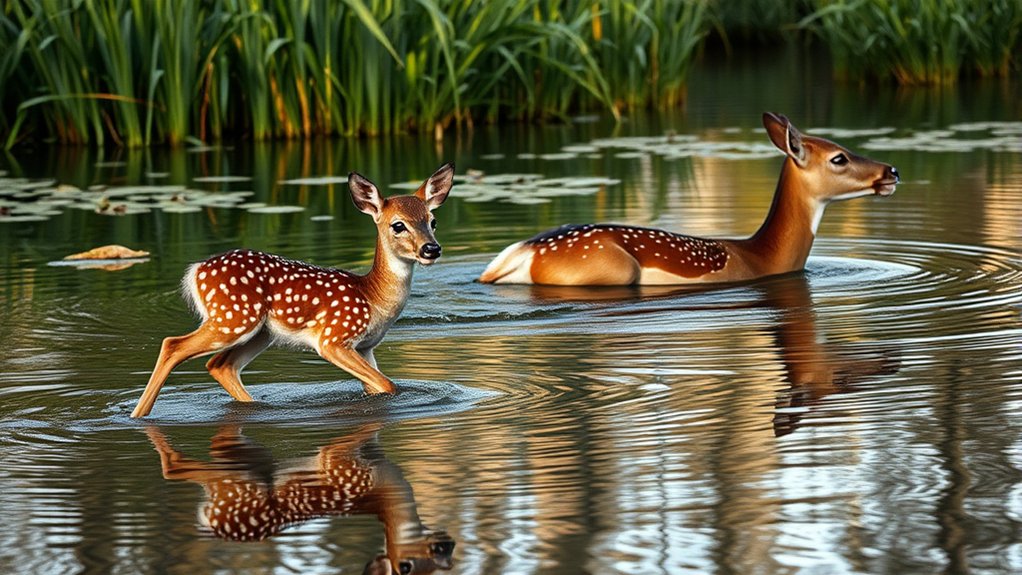
You’ll notice that fawns don’t swim as long or as strongly as adult deer—they tend to tire pretty quickly. Because of that, they usually don’t go very far in the water.
Their swimming style is mostly based on instinct, and they like to stay close to their moms for safety.
It’s interesting to see how these differences show that fawns adapt their swimming to survive, even though they’re not as physically capable yet.
Fawn Swimming Stamina
Because fawns lack the fully developed muscle strength and buoyancy adaptations seen in adult deer, their swimming stamina is considerably limited. You’ll notice that while fawns instinctively swim, their energy depletes rapidly, forcing them to cover only short distances.
This limited stamina makes them vulnerable in aquatic environments. Often, they need protection from adult deer.
| Aspect | Fawns |
|---|---|
| Muscle Strength | Underdeveloped hind legs |
| Swimming Duration | Short, tiring quickly |
| Energy Usage | High, inefficient |
| Dependency | Relies on adult deer for safety |
Understanding these differences helps you appreciate the survival challenges fawns face during water crossings.
Adult Versus Fawn Techniques
Although both adult deer and fawns have the instinct to swim, their techniques are quite different. This is mostly because of differences in muscle strength, stamina, and experience.
Adult deer use their powerful legs and built-up stamina to swim efficiently over long distances. This helps them escape predators quickly.
Fawns, on the other hand, swim with less strength and get tired faster. They rely more on instinct than on a refined technique. When you watch them move, you’ll notice some clear differences.
Adults show strong, rhythmic strokes that keep them moving steadily. Fawns, though, have shorter and less coordinated kicks.
Adults also maintain steady buoyancy and direction, but fawns often pause or struggle to stay afloat.
Knowing these differences helps you see how adult deer’s stronger muscles and stamina give them confident swimming skills. Meanwhile, fawns depend more on careful, tentative motions as they learn.
Protective Swimming Instincts
While fawns instinctively know how to swim, their limited stamina makes them more prone to exhaustion compared to adult deer. Deer can swim effectively, but fawns have protective swimming instincts that are quite different from adults. These instincts help fawns escape danger by prompting them to swim when threatened, but their endurance is much lower.
Fawns often rely on their mothers during swimming. Adult female deer guide them to safe spots like islands, which helps reduce the risks that come with getting tired in the water. This maternal presence makes up for the fawns’ vulnerability in aquatic environments and helps keep them safe.
Understanding these differences shows how protective swimming instincts work as an important survival tool. It’s a balance between the fawns’ natural ability and the need for their mother’s support.
Why Do Deer Swim? Key Survival Reasons
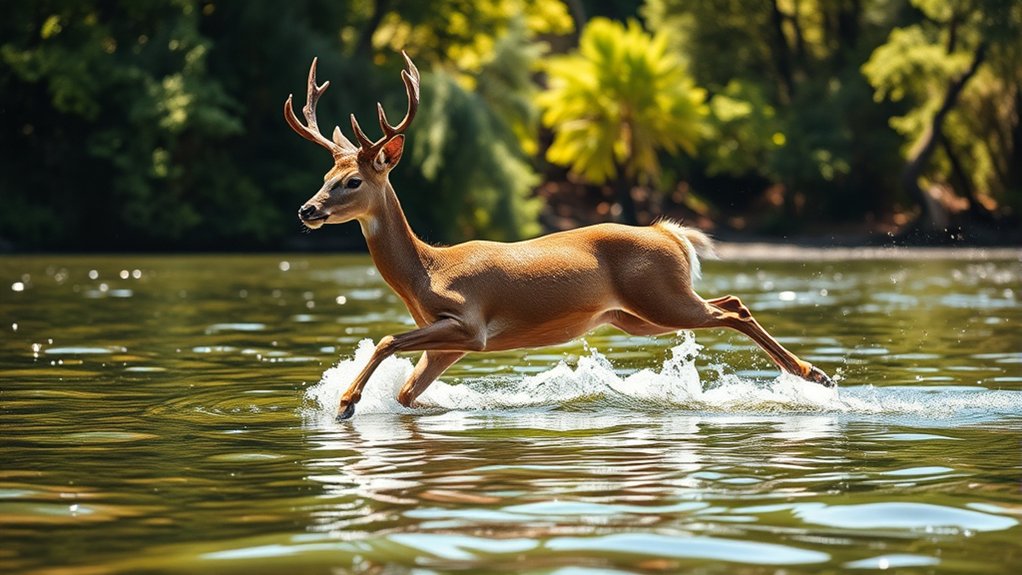
When deer face threats from predators like bears and mountain lions, they often swim to escape. Water becomes a natural refuge for them. They also swim to cross bodies of water to reach safer habitats or find better resources.
Pregnant females, in particular, swim to isolated areas to deliver their fawns. This helps reduce the risk of predators finding them.
Swimming isn’t just about safety, though. It also has health benefits. Deer use swimming to help get rid of external parasites like ticks and fleas. Plus, they swim to reach better food sources found in swampy or aquatic environments.
Common Places Where Deer Swim: Rivers, Lakes, and Open Water
Deer regularly swim across various bodies of water, including rivers, lakes, and even open coastal areas, to navigate their environments. They adapt well to different aquatic settings, with documented river crossings reaching up to 2.4 miles and lake swims extending several miles.
In places like Pennsylvania’s Susquehanna River, deer swim nearly 1,400 yards, while others traverse large water bodies such as the Mississippi and St. Clair Rivers. Their ability to swim in open water, including coastal zones up to five miles offshore, highlights their adaptability.
These aquatic journeys serve critical roles in seeking safety from predators and accessing resources. Understanding where deer swim—rivers, lakes, and open water—provides insight into their survival strategies and their remarkable capacity to adapt to diverse natural barriers.
Environmental Factors Influencing Deer Swimming
Although water bodies like rivers and lakes serve as natural barriers, they also shape how deer move and disperse across their habitats. Environmental features such as water width, flow rate, and dense vegetation along riverbanks uniquely influence deer crossing behavior.
Deer tend to avoid wide rivers, with few successful crossings exceeding 2 miles. Seasonal flooding changes these patterns, drawing deer toward agricultural fields and increasing crossing attempts. Changes in waterway structures also affect how they move.
Think about how these factors affect deer swimming. Swift river currents challenge a deer’s stamina and back strength during crossings. Dense vegetation provides both food and concealment but makes it harder to get to the water.
Narrow rivers are easier for deer to cross compared to wide water bodies. Plus, seasonal water fluctuations create changing conditions that influence how often deer swim.
Why Swimming Matters for Deer Survival and Management
Waterways not only influence how deer move but also play a big role in their survival and population management. Deer swim as a smart escape strategy, helping them get away from predators by crossing rivers and lakes to reach safer areas.
Pregnant females often swim to isolated spots, like islands, to keep their fawns safe during birth.
Swimming also lets deer reach better food sources across water barriers, which boosts their nutrition and overall fitness. This kind of mobility helps gene flow and keeps populations connected, which is super important for healthy ecosystems.
Plus, swimming helps deer stay healthy by washing off parasites like ticks and fleas.
Knowing about these behaviors makes it easier to manage deer populations well. When you understand how they use water, you can make sure their habitats support these natural survival tactics. That way, we promote balanced and thriving deer communities.
Frequently Asked Questions
Can Deer Swim in Saltwater Environments?
Yes, you’ll find deer swimming in saltwater environments thanks to their saltwater adaptations.
Their swimming techniques involve powerful hind legs and two-layered coats that enhance buoyancy factors, helping them stay afloat.
Deer swimming habits show they can navigate coastal environments despite marine predators.
These adaptations let them cross brackish and open waters while seeking food or escape routes.
It’s pretty impressive how they adjust to diverse aquatic habitats.
Do All Deer Species Swim Equally Well?
No, you won’t find all deer species swimming equally well. Deer swimming techniques vary because of species’ swimming abilities shaped by habitat and swimming adaptations.
For example, Chinese water deer show strong evolutionary swimming traits for river environments, while others struggle with environmental swimming challenges.
When you look at deer behavior, you’ll notice that streamlined bodies and stamina play a big role in how efficient they’re in the water.
How Do Deer Avoid Drowning During Floods?
You can understand how deer avoid drowning during floods through their instinctual behavior and emergency response mechanisms. Their body buoyancy is supported by a two-layered coat, which helps them navigate water and stay afloat.
They use their powerful hind legs to swim efficiently, making sure they survive floods.
On top of that, deer are pretty adaptable when it comes to their habitat. They tend to seek higher ground or islands when floods occur.
This mix of physical traits and smart behavior really helps them make it through tough flood conditions.
Are Deer Good Swimmers in Cold Water?
Yes, you’ll find deer are excellent swimmers in cold water thanks to their cold water adaptations and deer swimming techniques.
Their two-layered coat provides insulation and buoyancy, which helps them stay warm and float better. This also supports physiological responses that help conserve energy.
Their powerful hind legs drive effective swimming behaviors. Plus, their survival instincts guide them when they need to cross rivers or lakes.
These combined traits allow deer to swim efficiently.
Because of all this, they can endure cold water conditions with minimal fatigue. It’s pretty impressive how well they manage it!
Can Deer Swim Across Man-Made Water Bodies Like Pools?
Deer demonstrate deft deer swimming techniques, skillfully surmounting man-made obstacles like pools. Their water survival instincts guide them to paddle powerfully with all four legs, maintaining buoyancy and balance.
From a deer behavior analysis perspective, they sometimes enter pools for hygiene or when startled.
For humans, pool safety tips include avoiding disturbance to prevent stress-induced escapes. Understanding urban wildlife interactions helps you respect these swimmers’ natural navigation abilities across artificial aquatic environments.
It’s pretty amazing how well they adapt to these man-made challenges, isn’t it?
Conclusion
You might not realize it, but deer are natural swimmers, equipped with physical traits that make them adept in water. They can cover impressive distances, sometimes swimming miles across rivers or lakes to find food or escape danger.
Fawns, though less skilled, still manage to keep afloat. Understanding these abilities helps you appreciate how essential swimming is for deer survival and wildlife management. It’s their silent lifeline beneath the surface, quietly shaping their existence.