Can You Swim After Adding Clarifier?
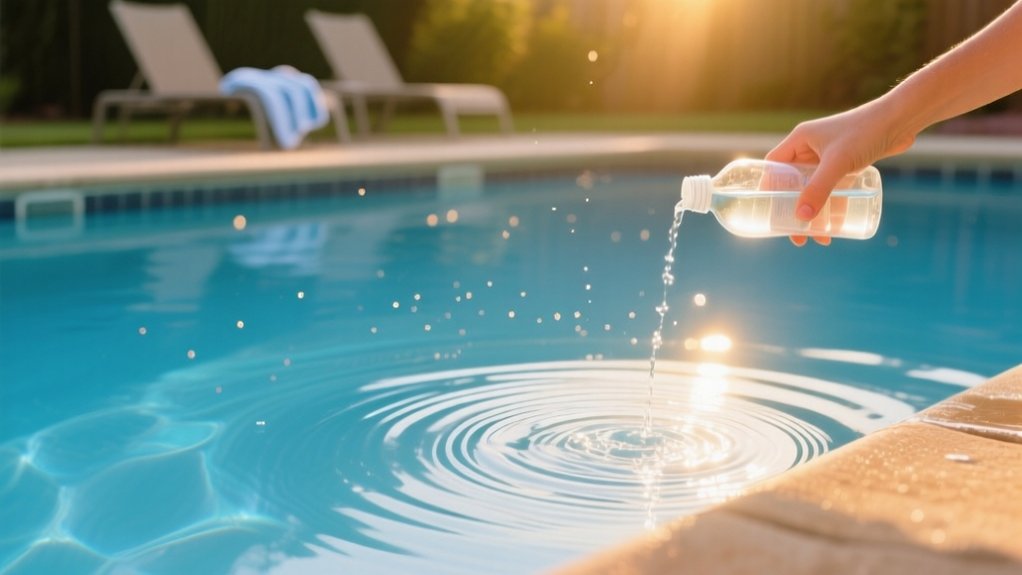
You should wait at least 20 minutes after adding pool clarifier before swimming to allow proper mixing and circulation. Though waiting up to 12 hours is safer to avoid skin or eye irritation.
Make sure your pool’s pH is balanced between 7.2 and 7.6, and the filter is running continuously for the best clarifier performance. Checking water chemistry after use confirms safe conditions.
If you want to enhance clarity and safety, understanding the detailed process helps you manage your pool confidently.
Understanding Pool Clarifier and Its Purpose
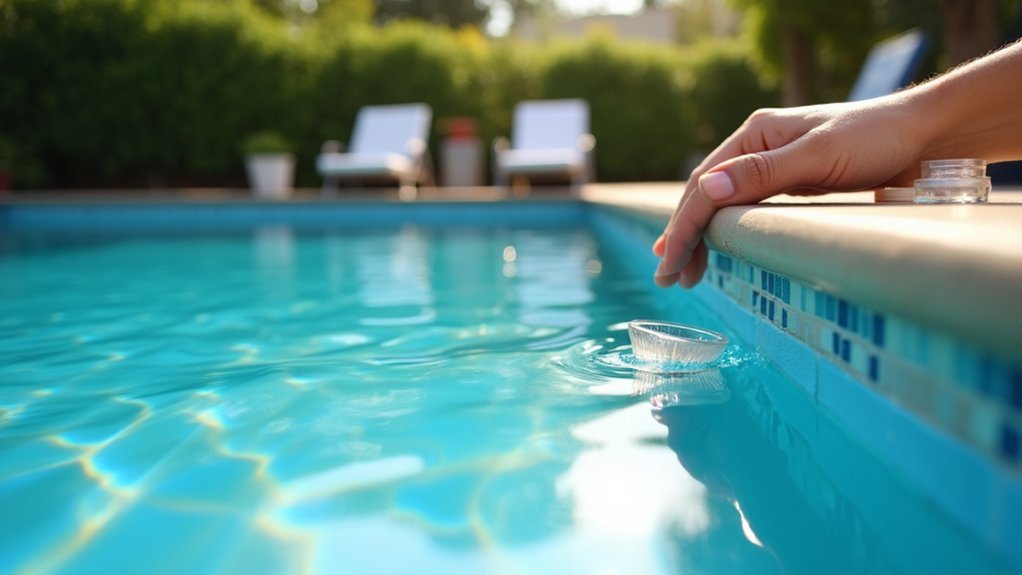
A pool clarifier acts as a coagulant, binding tiny particles like dirt and algae so your filter can capture them more effectively.
When your pool water looks cloudy, a clarifier helps by aggregating these microscopic particles into larger clumps that your filter can easily remove.
This process greatly improves your filtration system’s efficiency, especially after heavy rain or other events that introduce suspended debris.
To get the best results, you should check that your pool’s pH is between 7.2 and 7.6 before applying the clarifier.
After adding it, running the filter continuously for at least twelve hours is essential.
This approach restores water clarity while maintaining a safe swimming environment by reducing the presence of particles causing cloudy water.
How Pool Clarifier Works to Clear Cloudy Water
You’ll find that pool clarifiers work by binding tiny particles like dirt and algae into larger clumps. This makes them easier to filter out.
Because of this, your pool filter becomes more efficient, capturing particles that would otherwise float around in the water.
It’s a good idea to keep your filter running continuously after adding the clarifier. That way, those clumps get caught and removed effectively, and your cloudy water starts to clear up.
Clarifier’s Particle Binding
Although pool water may appear cloudy due to tiny particles like dirt, algae, and bacteria, pool clarifiers work by binding these microscopic contaminants into larger clumps.
This process makes it easier for your filtration system to capture and remove particles that would otherwise remain suspended.
When using a clarifier, consider these key factors:
- Clarifier acts as a coagulant, aggregating fine particles into filter-trappable sizes.
- Maintaining pH between 7.2 and 7.6 optimizes particle binding efficiency.
- Particle clumping results in clearer water, especially after rain or debris accumulation.
- Properly balanced pool chemicals and a clean filter are essential for effective removal of clumped particles.
Enhancing Filter Efficiency
When you add a pool clarifier, it improves your filter’s efficiency by coagulating tiny particles, such as dirt and algae, into larger clumps that your filtration system can easily trap and remove. This process notably boosts filter efficiency. It allows your pool’s filter to capture debris that would otherwise pass through.
Running your filter for at least twelve hours after adding clarifier guarantees these particles are effectively cleared, restoring water clarity.
| Particle Size | Before Clarifier |
|---|---|
| Tiny Particles | Pass through filter |
| Clumped Particles | Trapped by filter |
| Debris Removal | Inefficient without clarifier |
| Debris Removal | Improved with clarifier |
Using clarifier regularly maintains crystal clear water and optimizes your pool’s filtration system.
Recommended Waiting Time Before Swimming
A minimum waiting period of 20 minutes after adding pool clarifier allows for adequate mixing and circulation before swimming.
However, to swim after adding clarifier safely and effectively, you should wait at least 12 hours. This guarantees all particles are bound and filtered properly, reducing risks like skin irritation.
For safe swimming after adding clarifier, wait at least 12 hours to ensure proper filtration and reduce irritation.
Consider these guidelines:
- Wait at least 20 minutes for initial mixing and circulation.
- For best safety and clarity, wait at least 12 hours before swimming.
- Test water chemistry after waiting to confirm balanced parameters.
- Monitor water clarity daily, as clarifier effects can take 2–3 days to fully manifest.
Following these precise timelines helps maintain safe swimming conditions and maximizes clarifier effectiveness.
Factors Affecting Clarifier Effectiveness
To get the most out of your clarifier, it’s important to keep an eye on your pool’s water chemistry.
You’ll want to maintain the pH levels right between 7.2 and 7.6 for the best results.
Also, make sure your pool’s filtration system runs continuously for at least twelve hours.
This helps capture particles effectively and keeps the water circulating well.
Just a heads up—really tiny suspended particles might need a bit of extra treatment.
Clarifiers work by binding smaller debris into bigger clumps, making them easier to remove.
Water Chemistry Balance
Although adding a clarifier can greatly improve water clarity, you must verify your pool’s water chemistry is properly balanced for it to work effectively.
Before application, conduct a thorough water test to assess key parameters.
Pay close attention to chlorine levels, making sure they’re within the ideal range to avoid impeding the clarifier’s function.
Consider these critical factors:
- Maintain pH between 7.2 and 7.6 to optimize particle binding.
- Adjust alkalinity to prevent interference with clarifier efficacy.
- Monitor calcium hardness to avoid scaling and cloudiness.
- Run your filter for at least twelve hours post-clarifier to remove aggregated particles.
Balancing these elements verifies the clarifier performs at peak efficiency, resulting in clearer, healthier pool water.
Pool Filtration Efficiency
Ensuring your pool’s filtration system operates at peak performance directly affects how well a clarifier can remove suspended particles.
Pool filtration efficiency relies on factors like filter type, flow rate, and filtration duration.
After adding certain chemicals like clarifiers, running your filter continuously for at least 12 hours maximizes particle binding and removal.
A clean, well-maintained filter is essential; clogged filters reduce water flow, limiting clarifier effectiveness.
Moreover, balanced water chemistry supports filtration efficiency, but the focus here remains on mechanical filtration.
By maintaining proper filter function and timing your filtration correctly, you improve the clarifier’s ability to clear debris, ensuring clearer water faster.
Neglecting these aspects will diminish results, making it harder to achieve ideal pool clarity after treatment.
Particle Size Impact
Because clarifiers rely on binding suspended particles to increase their size, the particle size in your pool water directly impacts how effectively the clarifier works. Smaller particles are harder to aggregate and filter, delaying clarity.
To optimize clarifier performance, consider these factors:
- Fine debris and bacteria require more time for the clarifier to form larger aggregates.
- Larger particles clump quickly, allowing faster filtration and visible water clarity.
- Proper water circulation guarantees even distribution of the clarifier and particle contact.
- Combining clarifiers with compatible chemicals improves particle binding without interference.
Potential Skin and Eye Irritation Concerns
When you swim immediately after adding clarifier, you risk skin and eye irritation due to the concentrated chemicals that haven’t fully dispersed in the water.
To minimize these risks, it’s vital to wait at least 20 minutes before you swim with clarifier, allowing proper circulation and dilution.
Wait at least 20 minutes after adding clarifier before swimming to ensure safe circulation and dilution.
Maintaining the pool’s pH between 7.2 and 7.6 is critical, as improper pH can intensify irritation and reduce clarifier effectiveness.
Overdosing increases chemical concentration, further elevating irritation risk, so always follow dosage instructions precisely.
Monitoring water clarity and chemical levels after treatment guarantees a safe to swim environment, reducing potential discomfort.
Adhering to these practices ensures you enjoy your pool without compromising skin or eye health after clarifier application.
Comparing Clarifier With Flocculant for Cloudy Pools
When you add a clarifier, it works by binding small particles together so they can be filtered out more easily.
You can usually swim again after about 20 minutes.
On the other hand, flocculants cause particles to clump up and sink to the bottom.
This means you’ll need to vacuum up the settled debris before jumping back in.
Knowing how each one works can help you pick the right product depending on how cloudy your pool is and how soon you want to swim safely again.
Clarifier Vs Flocculant
Although both clarifiers and flocculants serve to clear cloudy pool water, they operate through different mechanisms and require distinct handling.
When choosing between them, consider these key differences:
- A clarifier binds tiny particles to improve filtration, while a flocculant causes debris to clump and settle for vacuuming.
- Clarifiers typically require about 20 minutes before swimming; flocculants need debris removal before use.
- Clarifiers are best for fine cloudiness; flocculants handle larger particles and severe cloudiness more effectively.
- Clarifier results develop over two to three days, whereas flocculants offer immediate clarity once debris settles.
Avoid using clarifier and flocculant simultaneously, as this can worsen cloudiness and reduce treatment effectiveness.
Mechanism of Action
Since pool clarity depends heavily on particle removal, understanding how clarifiers and flocculants operate is essential.
A clarifier works by aggregating tiny suspended particles, increasing their size so your pool’s filter can efficiently trap them. This process typically requires running the filter continuously for at least twelve hours and may take two to three days to fully clear the water.
Conversely, a flocculant induces coagulation that causes particles to settle quickly at the pool’s bottom. That allows you to remove debris manually via vacuuming or siphoning.
While clarifiers improve filter efficiency by enhancing particle capture, flocculants simplify debris removal by promoting sedimentation.
Knowing these mechanisms helps you optimize treatment and maintain crystal-clear pool water effectively.
Swimming Safety Considerations
Because maintaining safety is paramount, you should understand how swimming timing differs after adding a clarifier versus a flocculant. When treating a swimming pool, adding chemicals affects when it’s safe to swim.
- Clarifiers require about 20 minutes before swimming is safe, assuming chemical levels are balanced.
- Flocculants demand no swimming during treatment since they settle debris, which must be vacuumed out first.
- Clarifiers improve filtration by binding particles; flocculants cause debris to sink, impacting water clarity differently.
- Always monitor water clarity post-treatment. If cloudiness remains, avoid swimming until clarity is restored.
Understanding these distinctions guarantees safety and ideal pool conditions after chemical treatment.
Best Practices for Adding Pool Clarifier
When adding a pool clarifier, start by confirming your pool filter is clean and operating properly to maximize the clarifier’s effectiveness. Maintain the pH between 7.2 and 7.6 to optimize chemical reactions.
Add the clarifier evenly across the pool surface while the filtration system runs continuously. Wait at least 20 minutes before swimming to allow proper dispersion and safety.
| Step | Recommendation |
|---|---|
| Filter Condition | Clean and running |
| pH Range | 7.2 to 7.6 |
| Swimming Wait Time | Minimum 20 minutes |
Following these best practices confirms effective chemical use and accelerates water clarification without compromising swimmer safety.
Monitoring Water Chemistry After Clarifier Use
Although you’ve added clarifier to your pool, you still need to monitor water chemistry closely to maintain pH levels between 7.2 and 7.6 for ideal clarifier performance.
Maintain pH between 7.2 and 7.6 to ensure your pool clarifier works effectively.
Continuous monitoring guarantees the clarifier works efficiently and the pool remains safe.
Here’s what to do after adding clarifier:
- Retest water chemistry 24 hours post-application to verify balanced chemical levels.
- Check free chlorine levels; they should stabilize between 1-3 ppm before swimming.
- Keep the pump and filter running continuously to promote circulation and improve clarifier effectiveness.
- If cloudiness persists beyond a few days, test for additional imbalances or contaminants and add chemicals accordingly.
Signs Your Pool Is Ready for Swimming
After verifying your pool’s water chemistry is balanced and circulation is maintained post-clarifier addition, you need to confirm the pool is safe for swimming.
First, verify the pool water is visibly clear and free from debris, indicating effective particle binding and filtration.
Test the pH and chlorine levels to ascertain they remain within safe ranges, typically pH between 7.2 and 7.8 and chlorine at 1 to 3 ppm.
Wait at least 20 minutes after adding the clarifier before testing or swimming to allow proper circulation.
Observe water clarity over several hours; gradual improvement signals clarifier efficacy.
Finally, when you swim, monitor for any skin irritation or discomfort, which suggests chemical imbalance.
Only proceed with swimming once these signs validate the pool water’s safety and clarity.
Tips for Maintaining Crystal Clear Pool Water
To maintain crystal clear pool water, you must regularly test and adjust the pH levels, keeping them between 7.2 and 7.6 to optimize clarifier performance.
Proper chemical balance improves the clarifier’s ability to bind particles and clear the water efficiently.
Follow these essential tips:
- Run your pool filter for at least 12 hours after adding the clarifier to guarantee thorough circulation and removal of debris.
- Wait a minimum of 20 minutes post-clarifier application before swimming to assure safety and efficacy.
- Monitor water clarity daily, especially after heavy use or rainfall, to assess if additional clarifier or treatment is necessary.
- Use a flocculant if cloudiness persists; it aggregates particles, causing them to settle for easier cleaning.
Consistent maintenance keeps your pool water crystal clear and safe.
Frequently Asked Question
Can Clarifier Be Used With Saltwater Pools?
Yes, you can use clarifier in saltwater pools effectively.
Since saltwater pools generate chlorine through electrolysis, clarifiers function in a comparable way by aggregating fine particles for easier filtration.
Just make certain your pool’s pH is between 7.2 and 7.6 before adding clarifier.
Run your pump and filter continuously for at least 12 hours after application.
Always retest water chemistry afterward to maintain proper balance and guarantee safe swimming conditions.
Does Clarifier Affect Pool Heater Performance?
Don’t throw the baby out with the bathwater. Clarifier typically doesn’t affect your pool heater’s performance directly. It works by coagulating tiny particles, improving water clarity without altering heater efficiency.
However, if clarifier causes excess debris or cloudiness, it can temporarily reduce heating efficiency by clogging filters or obstructing water flow.
To keep your heater running smoothly, maintain balanced water chemistry and clean your filters regularly, following your heater’s manufacturer guidelines.
Can Pets Swim in the Pool After Clarifier Use?
Yes, your pets can swim after you add clarifier, but wait at least 20 minutes to guarantee safety.
Always test your pool water to confirm chemical levels are balanced and non-toxic.
Watch your pets closely for any skin irritation or distress, since some may be more sensitive.
Avoid letting them ingest pool water, and maintain regular water quality checks to keep clarifier concentrations within safe limits for your pets.
How Does Clarifier Interact With Algaecides?
You might think clarifiers and algaecides throw a wild chemical party when mixed but they actually clash big time!
When you add clarifier, it binds tiny particles for filtration, while algaecides target algae.
Mixing them simultaneously causes cloudiness and reduces effectiveness.
To keep your pool crystal clear, shock first, then add clarifier.
Wait for clarity and test chemicals before using algaecide, ensuring they work in harmony without interference.
Is Pool Clarifier Safe for Children With Sensitive Skin?
Yes, pool clarifier is generally safe for children with sensitive skin when you follow the manufacturer’s instructions and wait at least 20 minutes after application before swimming.
You should also test the water’s pH and chlorine levels to verify they’re within safe ranges (pH 7.2–7.6).
If your child has a history of skin sensitivities, consult a pool professional to confirm the water chemistry is balanced and safe before allowing them to swim.
Conclusion
You might worry about swimming immediately after adding clarifier, but it’s generally safe once the product fully disperses, usually within 30 minutes to an hour. Waiting guarantees the clarifier effectively binds particles without causing skin or eye irritation.
To maximize results and comfort, always follow the manufacturer’s instructions and monitor your pool’s chemistry. This careful approach helps you enjoy clearer, safer water without unnecessary delays.