How Long Does It Take to Swim the English Channel?
You can expect to swim the English Channel anywhere from about 7 to 27 hours, depending heavily on your conditioning, tides, and navigation skill. Strong currents often push swimmers off course, extending your distance beyond the standard 21 miles.
Cold water around 57–64°F demands acclimation and energy management. With precise planning and real-time adjustments, you can optimize your pace and safety. Understanding these factors is key. Explore further to uncover strategies that sharpen your strategy and endurance.
Factors Influencing Swim Duration
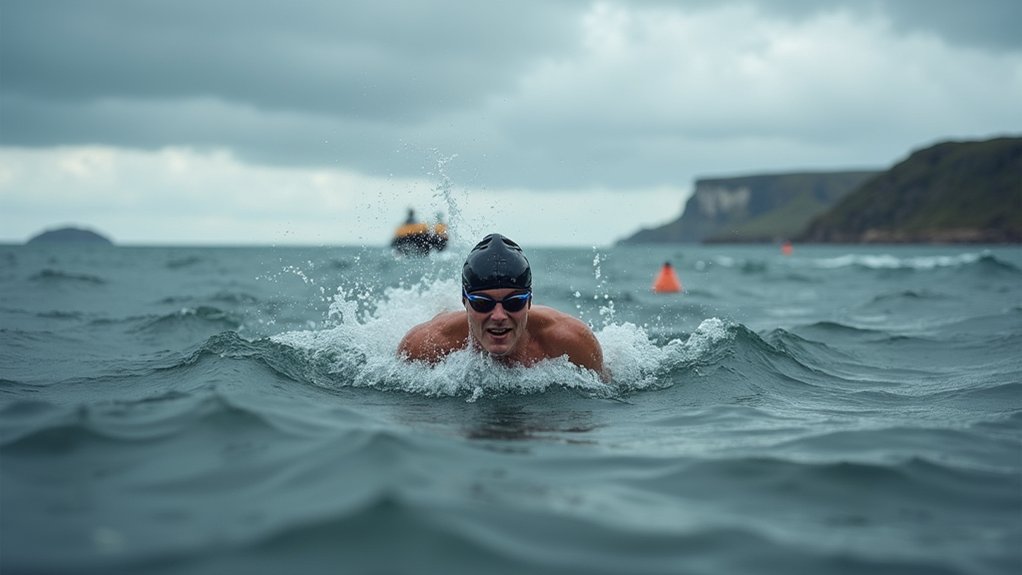
Although you might plan for a 21-mile swim, tidal currents and shifting weather conditions often push you beyond that distance, directly impacting your total time in the water.
Key factors influencing your swim across the Channel include the prevailing channel conditions, which can vary dramatically with tides and winds, forcing you to swim extra miles and adjust your course.
Tides and winds significantly impact your Channel swim, often requiring extra miles and course adjustments.
Water temperatures between 57°F and 64°F challenge your endurance, requiring ideal acclimatization.
Your individual training plays a crucial role; extensive open water experience and mental resilience enable you to maintain pace under unpredictable conditions.
Understanding these elements allows you to prepare strategically, adapting to environmental demands and maximizing efficiency, ultimately improving your chances of completing the swim within your target timeframe.
Typical Distance and Route Details
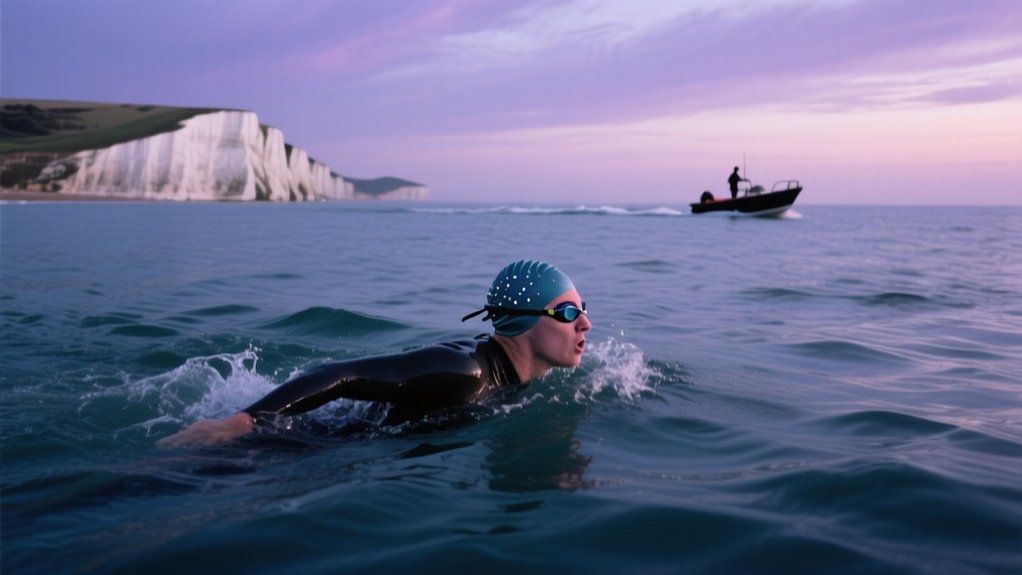
You’ll usually kick off your swim from Shakespeare’s Cliff or Samphire Hoe over on the English coast. Your goal is to make it across to Cap Gris-Nez in France.
Now, the shortest distance is roughly 21 miles, but don’t be surprised if you end up covering more ground because of the shifting tides and currents.
It’s really important to plan your route carefully. The actual swim can vary by several kilometers, and those strong tidal forces will definitely impact your path, especially as you get closer to the finish.
Standard Channel Distance
Covering roughly 21 miles (32 km) in a straight line, the English Channel swim demands you traverse a route from Shakespeare’s Cliff or Samphire Hoe in England to Cap Gris-Nez in France.
While this represents the standard channel distance, the total distance you’ll actually cover often exceeds this due to strong tidal influences that push you off course.
Experienced pilots keep you on a consistent compass heading, but expect course adjustments, especially in the last mile, as tides shift.
Steering through busy shipping lanes adds a layer of complexity, requiring precise timing and coordination for your safety.
When you swim the Channel, understanding these factors helps you prepare mentally and physically for a swim that can extend beyond the nominal 21 miles.
It truly becomes a test of endurance and strategy.
Common Starting Points
When you choose your starting point for the English Channel swim, Shakespeare’s Cliff and Samphire Hoe stand out as the most common launches on the English side.
These common starting points set you up for an approximate distance of 21 miles (32 km) to Cap Gris-Nez, France. However, you’ll often swim farther due to the need to navigate currents and shifting winds.
Keep these critical factors in mind:
- You must plan to navigate busy shipping lanes, with hundreds of tankers and ferries crossing daily.
- The route crosses the Strait of Dover, requiring precise timing and positioning to manage tidal flows.
- Currents can push you off course, extending your swim beyond the target distance.
Understanding these details will help you prepare mentally and physically to swim across the English Channel successfully.
Typical Landing Locations
Although swimmers typically aim for Cap Gris-Nez on the French coast, landing locations can vary markedly due to shifting tides and currents. When you swim the English Channel, expect the typical distance to exceed 21 miles as tides push you off course.
Landing points depend on real-time tidal shifts and pilot navigation, especially in the final stretch. Your swim duration can range widely, so understanding these variables is essential for a successful crossing.
| Landing Point | Typical Distance (miles) | Swim Duration (hours) |
|---|---|---|
| Cap Gris-Nez | 21 | 7 – 27+ |
| Wissant | 22+ | 8 – 28 |
| Sangatte | 21 – 23 | 7.5 – 27 |
| Calais | 22 – 24 | 8 – 27+ |
| Audresselles | 23+ | 9 – 29 |
Adjust your route wisely for tides to optimize your swim duration and landing success.
Water Temperature and Its Impact
Because water temperature ranges from 57°F to 64°F during the swim season, you need to prepare rigorously for cold conditions that can sap your energy and slow your pace.
Cold water below 62°F demands acclimation. Consider cold showers to build tolerance and reduce shock.
Hypothermia is a real risk. Your body loses heat faster than it can produce it, impacting swim duration and endurance.
To optimize your performance:
- Gradually increase exposure to cold water weeks before your swim.
- Monitor your body’s response closely to prevent hypothermia onset.
- Adjust your stroke rate and breathing to conserve energy in colder water.
Mastering these elements lets you confront the Channel’s chill confidently, transforming cold water from an obstacle into a manageable challenge.
Historical Swim Times and Records
If you want to understand the challenge ahead, studying historical swim times and records offers invaluable insight into what’s possible.
Captain Matthew Webb’s pioneering 21-hour, 45-minute crossing in 1875 set the standard for open-water endurance.
Since then, historical swim times have improved dramatically. The fastest swim was recorded by Trent Grimsey in 2012, finishing in just 6 hours and 55 minutes, narrowly beating Peter Stoychev’s 2007 record of 6 hours and 57 minutes.
Gertrude Ederle, the first woman to swim the Channel in 1926, completed it in 14 hours and 39 minutes, demonstrating exceptional stamina and skill.
On the other end, the slowest recorded swim took 27 hours and 31 minutes by Jackie Cobell in 2010, highlighting the unpredictable nature of the Channel.
These benchmarks guide you in setting realistic goals.
Training and Preparation for Endurance
When you commit to swimming the English Channel, rigorous training becomes your foundation for success. Focus on building endurance and cold water acclimation through consistent, long-distance swims in salty, chilly water. Your preparation must include:
- Completing a 6-hour qualifying swim below 60°F to prove your readiness.
- Training beyond the 21-mile distance to account for tides and currents.
- Experimenting with nutrition and feeding strategies to maintain energy during the swim.
Alongside physical training, develop mental resilience to overcome negativity and maintain focus throughout your journey.
This combination of physical stamina, cold water adaptation, strategic nutrition, and mental toughness equips you to tackle the Channel’s grueling conditions confidently.
Your disciplined training and mental preparation are what ultimately transform endurance into achievement.
Role of Weather and Sea Conditions
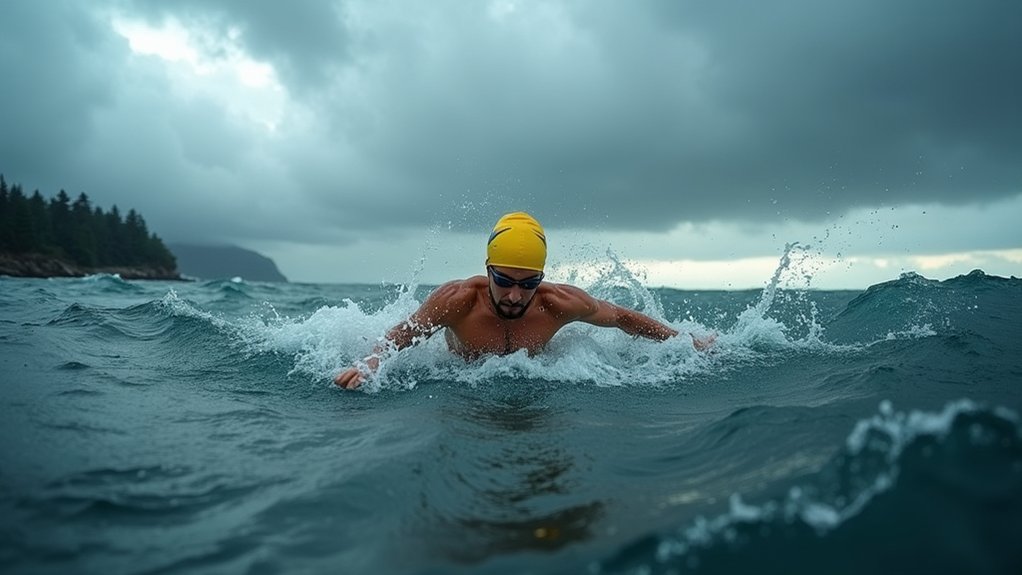
Although your training prepares you physically and mentally, the English Channel’s weather and sea conditions ultimately dictate your swim’s duration and safety.
You’ll face water temperatures between 57°F and 64°F, challenging your endurance and requiring precise pacing.
Weather can shift rapidly, pushing pilots to delay or halt swims to protect you. Sea conditions vary from gentle Force 1/2 to rough Force 4/5 waves, directly influencing your swim timing and energy expenditure.
Rapid weather changes and varying sea conditions can delay swims and impact your timing and energy levels.
Tides also play an essential role, often extending your swim beyond the standard 21 miles by pushing you off course.
Understanding how these factors interact will help you anticipate changes and adapt your strategy, ensuring you optimize your swim duration while prioritizing safety throughout this demanding challenge.
Navigation Challenges and Currents
You’ll face strong tidal currents that can push you off course, adding several kilometers to your swim.
So, staying on a precise compass heading is essential.
But don’t be surprised if you need to make real-time adjustments, especially as you get closer to the French coast.
Mastering these navigational challenges can really be the difference between success and having to turn back.
Impact of Tidal Currents
Since tidal currents constantly shift across the English Channel, you’ll often swim well beyond the shortest 21-mile route.
These tidal currents profoundly affect your swim duration and expected distance. You must anticipate and adapt to changing tidal conditions to maintain efficiency.
Key factors to evaluate include:
- Tidal currents can increase your actual swim distance up to or beyond 32 km, demanding greater endurance.
- Shifting currents disrupt consistent heading, complicating navigational adjustments, especially near the finish.
- Understanding tidal patterns enables better timing and route planning, directly influencing your overall swim time.
Mastering these dynamics is essential.
Navigational Course Adjustments
While steering through the English Channel, strong tidal currents demand constant course adjustments to keep you on track and guarantee a safe landing.
Navigational adjustments are critical as pilots expertly interpret shifting tides to compensate for drift, especially near the busy shipping lanes.
These pilots, deeply familiar with local tidal currents, continuously refine your heading to avoid maritime traffic and prevent unnecessary detours.
Because of these factors, your swim duration can vary widely—from just over 7 hours to nearly 27—depending on how effectively navigational challenges are managed.
Trusting your pilot’s expertise allows you to maintain a consistent course despite unpredictable currents, ensuring you conserve energy and stay safe.
Mastering these navigational nuances is essential to conquering the Channel and achieving your goal.
Support and Safety Measures During the Swim
Although swimming the English Channel is a monumental personal challenge, having a dedicated support team on a pilot boat is crucial for your safety and success. Your support team guarantees compliance with strict safety regulations set by the Channel Swimming Association, including the presence of an official observer.
They monitor your condition closely for signs of swimming-induced pulmonary edema and provide immediate medical assistance if needed.
Key support and safety measures include:
- Support swimmers join after two hours, swimming for one hour shifts to maintain your pace and morale.
- Wearing light sticks during low visibility improves your safety from maritime traffic.
- The pilot boat serves as your mobile base for navigation, medical support, and emergency response.
Trust your team. They’re your lifeline in this grueling endeavor.
Frequently Asked Question
What Nutrition Is Recommended During the Swim?
You’ll want to consume easy-to-digest, high-energy nutrition like carbohydrate-rich drinks, gels, and snacks such as energy bars or bananas.
Feed yourself every 30 to 60 minutes with diluted sports drinks to stay hydrated and replace electrolytes lost in saltwater.
Practice these feeding methods during training in similar conditions to find what your body tolerates best.
Staying fueled and hydrated is critical to maintaining stamina and conquering the challenge ahead.
Can Swimmers Use Wetsuits to Cross the Channel?
You can’t dress a knight in armor for this quest. Wetsuits aren’t allowed for the Channel swim.
You’ll rely on your own shield: body fat and cold-water training.
The Channel’s guardians, the CSA and CS&PF, enforce this strict code to honor tradition.
So, you’ll prepare meticulously, embracing the raw challenge.
Know that true victory comes from mastering your own strength and resilience without artificial aids.
Are There Specific Age Limits for Channel Swimmers?
Yes, you must be at least 16 years old to attempt a solo English Channel swim, ensuring you have the physical and mental maturity needed for this grueling challenge.
If you’re doing a relay, younger swimmers can participate, but age minimums vary by organization.
These limits exist because the Channel demands peak stamina, resilience, and experience.
These are qualities that develop with age and training.
Prepare thoroughly and respect these guidelines to maximize your chances of success.
How Do Swimmers Manage Sleep Deprivation During the Swim?
You manage sleep deprivation by training your body to endure long hours with minimal rest through extensive distance swims.
Your support crew keeps you fueled and motivated, ensuring you stick to a strict feeding schedule.
Use mental resilience techniques like visualization and positive self-talk to push through fatigue.
If conditions permit, brief rest periods on the boat can help, but staying mentally focused on your goal remains essential to overcome exhaustion.
What Mental Strategies Help Swimmers Overcome Fatigue?
You might think zoning out is the best way to beat fatigue, but ironically, staying mentally sharp is key.
You use visualization to picture success, turning exhaustion into motivation.
You set small goals, celebrate progress, and rely on your support crew’s encouragement to push through doubt.
Mindfulness and breathing techniques keep you calm in cold, choppy waters.
Managing seasickness with a clear plan guarantees your focus never drifts away.
Conclusion
Swimming the English Channel is like crossing an ever-shifting bridge between two worlds, where time bends to the forces of nature and your endurance. You’ll face currents, cold, and navigation puzzles that test your limits.
With the right training, preparation, and support, you’ll turn this monumental challenge into a powerful achievement. Remember, each stroke isn’t just forward motion. It’s you mastering the unpredictable tides, proving resilience in the face of nature’s greatest trials.