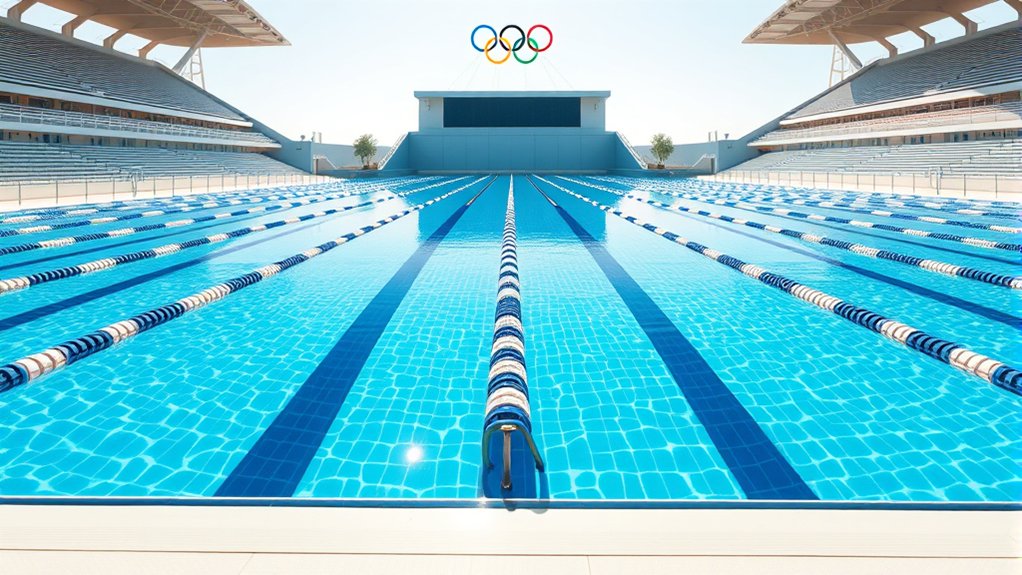
How Big Is An Olympic Size Swimming Pool – Dimensions Guide
An Olympic-size swimming pool measures exactly 50 meters long, 25 meters wide, and is at least 2 meters deep to meet competition standards. It has ten lanes, each 2.5 meters wide, with starting blocks 0.5 to 0.75 meters above the water.
The pool’s depth and lane setup guarantee safety and enhance performance. Durable materials like reinforced concrete keep it stable, while movable bulkheads add versatility.
Keep exploring to discover how these features impact competition and design. You’ll find that every detail plays a role in making the pool both functional and efficient.
What Are the Official Dimensions of an Olympic Swimming Pool?
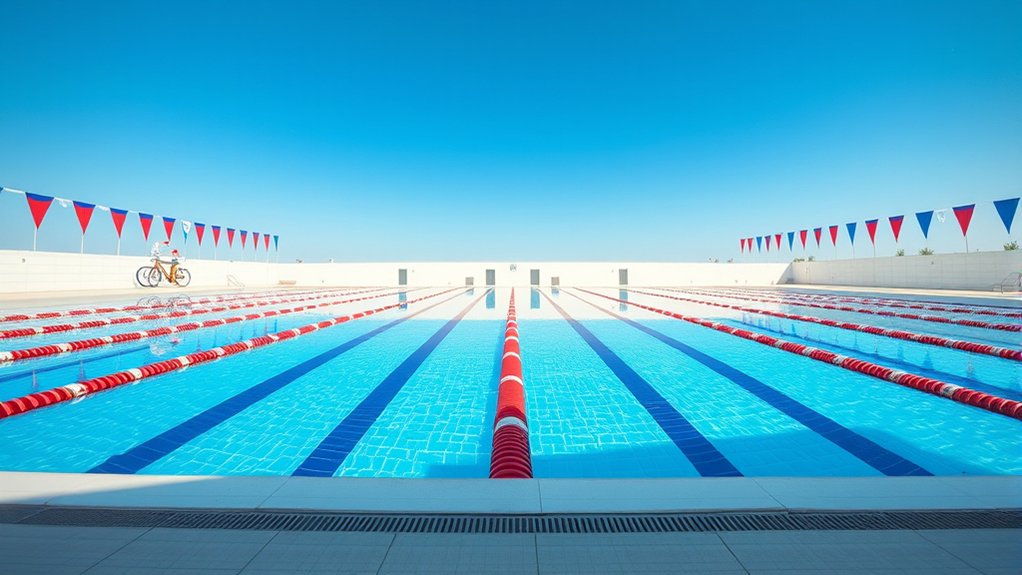
An Olympic-size swimming pool measures exactly 50 meters long and 25 meters wide, meeting strict standards set by World Aquatics. These precise dimensions promote fairness and consistency in swimming competitions worldwide.
The pool features at least eight lanes, each a minimum of 2.5 meters wide, giving swimmers ample space to compete without interference.
World Aquatics also mandates a minimum depth of 2 meters to guarantee safety and peak performance, with a recommended depth of 3 meters for multi-discipline events.
These specifications aren’t arbitrary. They’re essential for official competitions, providing a standardized environment recognized globally.
When you think about an Olympic-sized swimming pool, remember it’s not just about size. It’s about meeting exact dimensions and depths to support world-class swimming competitions under strict regulatory oversight.
What Is the Standard Width and Depth of an Olympic Pool?
You’ll find that an Olympic pool is typically 25 meters wide, fitting at least eight lanes, each 2.5 meters across.
The depth can vary, but it has to be at least 2 meters. For major competitions, though, the depth needs to be 2.5 meters to ensure safety and top performance.
These dimensions are really important because they help create fair and competitive conditions for swimmers.
Standard Width Dimensions
One key dimension you should know about an Olympic swimming pool is its width, which measures 25 meters (82 feet) to fit multiple competitive lanes. This width dimension allows for eight lanes, each designed to meet minimum lane width standards essential for swimming events.
The middle lanes must be at least 2.5 meters (8.2 feet) wide, while the outer lanes are slightly narrower at 2.4 meters (7.9 feet). These precise measurements guarantee fair competition and adequate space for swimmers.
Alongside width, depth requirements also play a role in the pool’s design, but the width dimensions primarily focus on accommodating swimmers comfortably and safely.
When you step into an Olympic-sized pool, you experience these exact standards that make competitive swimming possible worldwide. It’s pretty cool to realize how much thought goes into these dimensions!
Depth Requirements Explained
Olympic pools must meet strict depth requirements to guarantee safety and fairness during competitions. According to the World Aquatics federation, an Olympic size swimming pool must have a minimum depth of 2 meters (6 feet 7 inches). This assures swimmers can perform safely and effectively, especially during turns and underwater phases.
For events involving starting blocks, the depth in those areas can’t be less than 1.35 meters (4.4 feet), protecting athletes as they plunge in.
While 2 meters is the minimum, a depth of 3 meters (9 feet 10 inches) is often recommended for multi-discipline use, providing ideal competition conditions.
These depth requirements play a vital role in maintaining high standards for Olympic and World Championship events.
Impact on Competition
Although the length of an Olympic pool is fixed at 50 meters, its width and depth greatly influence competition quality. An Olympic sized pool spans 25 meters wide, featuring ten lanes with standardized lane widths of 2.5 meters in the middle lanes. This spacing guarantees fair competition by minimizing turbulence and wave interference.
The pool’s depth is a minimum of 2 meters but ideally 3 meters, which further reduces water resistance. This allows swimmers to perform at their best.
These precise dimensions and regulations, set by World Aquatics, are essential for official events and help create the perfect environment where world records can be broken.
When you understand these standards, you see how the pool’s design directly impacts competitive fairness and overall performance. It’s pretty clear that every detail matters in making the competition as fair and fast as possible.
Why Do Olympic Pools Have Ten Lanes Instead of Eight?
You might be wondering why Olympic pools have ten lanes instead of just eight.
Well, the extra lanes actually serve as buffer zones. They help absorb waves and reduce turbulence for the swimmers in the middle lanes.
This setup makes a big difference by minimizing drag and creating smoother race conditions, which ultimately helps improve performance.
Buffer Lanes Purpose
Because swimmers create waves that can slow down their competitors, pools now include buffer lanes to absorb this turbulence.
In Olympic pools, lanes must be designed not just for space but to enhance fair competition. The addition of a buffer lane, which are empty lanes on the outer sides, helps minimize the disruptive waves swimmers generate.
This design was first used in the 2008 Beijing Olympics and it contributed to a surge in world records by reducing drag. The swimming world quickly embraced the ten-lane format, which was approved by FINA in 2009 because it improved race conditions.
These buffer lanes allow swimmers to perform at their best without interference from side turbulence.
Wave Reduction Benefits
Buffer lanes play a key role in reducing waves, but the full impact comes from the Olympic pool’s ten-lane design. By adding two extra lanes beyond the standard eight, the pool minimizes water churn, markedly cutting down on turbulence.
This wave reduction creates calmer water, allowing you to maintain better swimming performance during competitive swimming events.
Officially adopted after the 2008 Beijing Olympics, the ten lanes helped set 25 world records, proving their effectiveness.
Furthermore, the pool’s increased depth of at least 2 meters works alongside the lanes to dissipate waves further.
How Does Olympic Pool Depth Affect Performance and Safety?
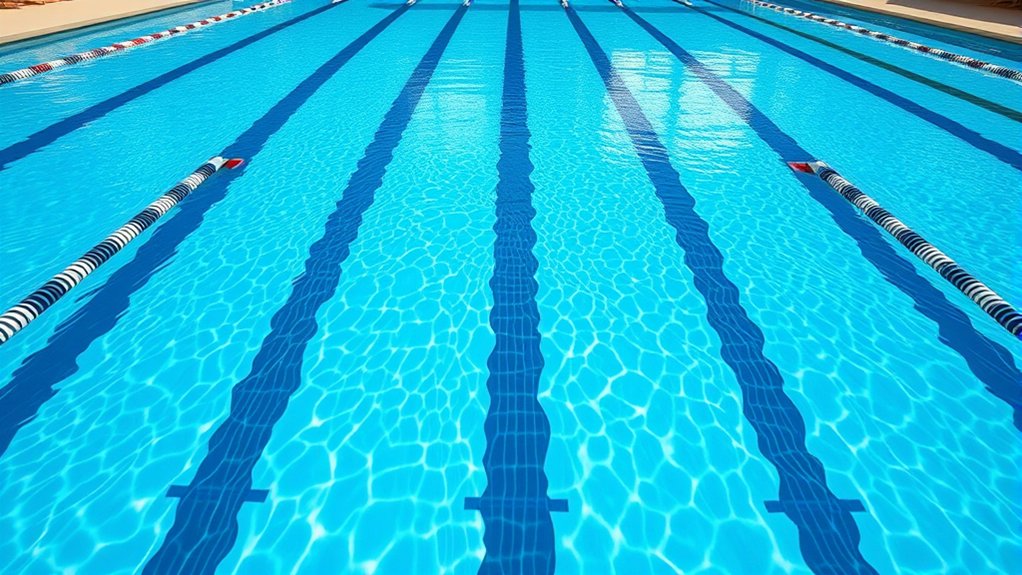
Although pool length and width grab most of the attention, the depth of an Olympic swimming pool plays an essential role in both performance and safety. The minimum depth of 2 meters, as required by FINA regulations, reduces water disturbance by effectively dissipating waves, which enhances swimmer performance.
A deeper pool, around 3 meters, is recommended for multi-discipline use. It provides safer conditions for starts, turns, and activities like diving. When depth is adequate, it absorbs waves generated during races, creating stable water that helps you swim faster.
Insufficient depth can lead to increased turbulence and safety risks, especially during high-impact moments.
What Materials Are Used to Build Olympic Pool Walls and Floors?
Durability and safety are the top priorities when choosing materials for Olympic pool walls and floors. You’ll find that pool walls are typically made from reinforced concrete, providing the strength needed to withstand water pressure and swimmer impact. This construction guarantees stability and longevity, which are essential for high-performance swimming pools.
For floors, there’s usually a solid base with a non-slip finish extending about 0.8 meters below the surface. This helps reduce slip hazards during competitions, keeping swimmers safe. Some pools also use fiberglass or stainless steel to boost durability and cut down on maintenance.
Importantly, all materials must comply with FINA regulations to make sure they don’t affect water quality or swimmer safety.
The pool walls are built vertical and parallel with precise 90-degree angles. This preserves lane integrity and guarantees fair competition.
How Are Lanes, Lane Ropes, and Starting Blocks Standardized?
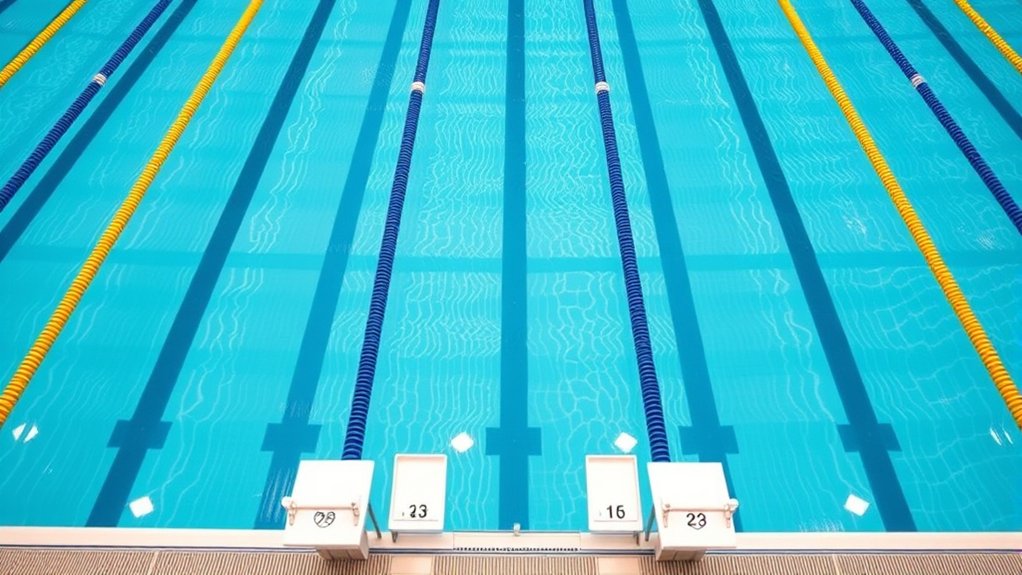
When you step up to an Olympic pool, you’ll notice that every lane, lane rope, and starting block is designed with strict standards to guarantee fair competition and swimmer safety.
The lanes must be at least 2.5 meters wide, typically with 10 lanes in total. Lane ropes, thicker for Olympic events at 0.15 meters diameter, reduce wave interference effectively.
Starting blocks stand between 0.5 to 0.75 meters above the water, with clear numbering and a surface area of 0.5 x 0.5 meters. The pool’s minimum depth is essential, at least 2.0 meters for Olympic and international competition areas with starting blocks.
- Lanes provide equal space for every swimmer.
- Lane ropes minimize disruptive waves.
- Starting blocks provide consistent takeoff points.
- Minimum depth keeps races safe and fair.
What Lighting and Water Conditions Must Olympic Pools Meet?
Maintaining precise lighting and water conditions is essential to the performance and safety of swimmers in Olympic pools. You need to confirm the water temperature stays between 25–28°C (77–82°F) for ideal competition conditions.
The pool’s water depth must be at least 2 meters to reduce drag and help wave dissipation during races. Areas with starting blocks require a minimum depth of 1.35 meters to protect swimmers during starts.
Lighting intensity plays a vital role too. For the Olympic Games and World Championships, pools must provide at least 1500 lux (140 footcandles) to guarantee clear visibility for athletes and officials.
Moreover, ongoing water treatment and maintenance keep the pool sanitized and safe. This supports peak performance in these world-class events.
It’s all about creating the perfect environment for top-level competition.
How Do Movable Bulkheads and Floors Improve Olympic Pool Versatility?
Although Olympic pools are traditionally designed for swimming races, movable bulkheads and floors greatly boost their versatility. A movable bulkhead lets you divide a 50-meter pool into smaller sections, perfect for hosting multiple competitive events or diverse training setups simultaneously.
Movable floors adjust pool depth, accommodating activities like water polo and synchronized swimming with ease.
Here’s how these features enhance Olympic pools’ versatility:
- Maximize space by creating multiple zones for different training setups.
- Adjust pool depth quickly for various aquatic sports.
- Guarantee safety with seamless bulkhead designs that prevent injuries.
- Expand the range of competitive events your facility can host.
With these innovations, you get a flexible, multi-use Olympic pool that meets all your aquatic needs.
Frequently Asked Questions
How Much Does It Cost to Build an Olympic-Size Swimming Pool?
You’re looking at pool construction costs ranging from $2 million to $5 million for an Olympic-size swimming pool.
Funding options depend on your location’s impact and available grants.
Design considerations include specialized materials used and regulatory requirements like safety standards.
Keep in mind, advanced water treatment and infrastructure add expenses.
Planning thoroughly helps you manage costs while meeting all regulations and ensuring your pool serves competitions and training efficiently.
How Long Does It Take to Fill an Olympic Pool With Water?
It usually takes you anywhere from several hours to a few days to fill an Olympic pool, depending on pool filling speed and your water source options.
Using fire hydrants speeds things up, while garden hoses slow it down.
Employing efficient filling techniques helps reduce environmental impact.
You’ll also want to evaluate water quality, temperature, and seasonal factors to guarantee balanced chemistry and avoid delays.
What Maintenance Is Required to Keep an Olympic Pool Clean?
You’ll feel like you’re taming a giant blue beast when you tackle Olympic pool cleaning.
To keep that massive water crystal clear, you must stick to a strict maintenance schedule. Monitor water chemistry daily to balance pH and chlorine for algae prevention.
Rely on advanced filtration systems and regular debris skimming.
Don’t hesitate to call professional services for equipment checks and deep cleanings. Consistency is key to keeping your pool sparkling and safe!
Can Olympic Pools Be Used for Other Sports Besides Swimming?
Yes, you can use Olympic pools for more than just swimming. They’re perfect for water polo and synchronized swimming, thanks to their size and depth.
Diving events fit well, too, with safe depths for springboards and platforms.
You can also train for triathlons, engage in aquatic fitness routines, or even play underwater rugby.
The pool’s versatility makes it ideal for various aquatic sports and training activities beyond traditional swimming.
It’s pretty cool how one pool can serve so many purposes, right?
How Is the Water Temperature Regulated in an Olympic Pool?
Imagine stepping into crystal-clear water that feels just right, neither too cold nor too warm. You regulate this by using advanced heating systems paired with precise temperature sensors. These sensors constantly monitor water quality to keep things perfect.
Pool covers help retain heat, which is a simple but effective way to maintain temperature. Plus, energy efficiency is boosted through solar or heat pump technology. This makes sure the pool doesn’t waste energy while staying comfortable.
Seasonal adjustments guarantee the temperature stays steady year-round. So, every swim feels perfect and meets competition standards. It’s all about creating the ideal environment for swimmers anytime.
Conclusion
Now that you know the exact size, depth, and design behind an Olympic pool, imagine standing at the edge, ready to plunge into crystal-clear water framed by ten perfect lanes. Every detail, from lane ropes to lighting, is meticulously crafted to boost performance and safety.
But here’s the twist. Those movable bulkheads and floors mean this giant pool can transform in seconds. Ready to see how versatility turns a giant pool into a world-class arena?